JAMB Mathematics 2011 Past Questions & Answers
47 JAMB Mathematics 2011 questions with verified answers and worked explanations. Here are the first 25 — sign up free to practise the full paper.
If = , find q
- A.2
- B.1
- C.4
- D.0
To find the value of q, first convert both numbers to base 10. The number 2q3 in base 5 is (2 x 5²) + (q x 5¹) + (3 x 5⁰), which equals 50 + 5q + 3 = 53 + 5q. The number 77 in base 8 is (7 x 8¹) + (7 x 8⁰), which equals 56 + 7 = 63. Now, set the two base 10 results equal to each other: 53 + 5q = 63. Solving for q gives 5q = 63 - 53, so 5q = 10, and therefore q = 2.
Common mistake: A common mistake is to expand the numbers incorrectly, for example, forgetting that the powers of the base start from 0 for the rightmost digit.
3 2 3 ×<!-- × --> 5 6 ×<!-- × --> 2 3 11 15 ×<!-- × --> 3 4 ×<!-- × --> 2 27
simolify
- A.
- B.30
- C.
- D.50
First, convert the mixed fraction 3 to an improper fraction, which is , and simplify the numerator to . Next, simplify the denominator by multiplying the fractions to get . To divide the numerator by the denominator, you multiply the numerator by the reciprocal of the denominator. This gives × , which simplifies to 5 × 10, resulting in 50.
Common mistake: The most common mistake is incorrectly dividing the two parts; students might forget to invert the denominator fraction and multiply, leading to a wrong answer.
A man invested N5,000 for 9 months at 4%. What is the simple interest?
- A.N150
- B.N220
- C.N130
- D.N250
To find the simple interest, use the formula I = PRT/100, where P is Principal, R is Rate, and T is Time in years. The Principal (P) is N5,000 and the Rate (R) is 4%. Since the time is given as 9 months, you must convert it to years by dividing by 12, which gives T = years. Putting these values into the formula gives Interest = / 100, which simplifies to N150.
Common mistake: A common mistake is forgetting to convert the time from months to years before applying the simple interest formula, leading to an incorrect calculation.
If the numbers M, N, Q are in the ratio 5:4:3, find the value of 2N−Q/M
- A.2
- B.3
- C.1
- D.4
Since the numbers M, N, and Q are in the ratio 5:4:3, we can represent them as M=5k, N=4k, and Q=3k. The expression to find is (2N - Q) / M. Substituting the values, we get (2(4k) - 3k) / 5k. This simplifies to (8k - 3k) / 5k, which is equal to 5k / 5k. The 'k's cancel out, and 5 divided by 5 is 1.
Common mistake: A common mistake is to misread the expression, for example, by calculating (M+Q)/N which would give = 2, leading to the incorrect option A.
( 16 81 ) 1 4 ÷<!-- ÷ --> ( 9 16 ) −<!-- − --> 1 2
Simplify
- A.
- B.
- C.
- D.
First, simplify each part using the laws of indices. For to the power of , find the 4th root of 16 and 81 to get . For to the power of , the negative power inverts the fraction to , and the power of means you find the square root, which gives . Finally, divide the two results: ÷ is the same as × , which simplifies to or .
Common mistake: A common mistake is forgetting to invert the fraction when dealing with the negative power, which leads to incorrectly calculating (Option C).
If + - = 3, Find x.
- A.1
- B.2
- C.0
- D.3
To solve this, we use the laws of logarithms. First, combine the terms on the left side: log₃18 + log₃3 - log₃x becomes , which simplifies to log₃(54/x). The equation is now log₃(54/x) = 3. To remove the logarithm, we convert it to index form, which gives 3³ = 54/x. Since 3³ is 27, we have 27 = 54/x, and solving for x gives x = , which is 2.
Common mistake: A common mistake is to incorrectly calculate the final division, perhaps thinking 54 divided by 27 is 3 instead of 2, which leads to the wrong answer D.
Rationalize
- A.
- B.
- C.
- D.
To rationalize the expression, you must remove the square root from the denominator by multiplying both the numerator and the denominator by the conjugate of the denominator, which is . Multiplying the numerator by gives 6 + - - 5, which simplifies to . Multiplying the denominator by is a difference of two squares, resulting in 3² − , which is 9 − 5 = 4. Therefore, the final simplified expression is .
Common mistake: Students often make sign errors when expanding the numerator, for example calculating + as instead of , which would lead them to incorrectly choose option D.
2 + 1 3 ) ( 2 −<!-- − --> 1 3
Simplify
- A.
- B.
- C.
- D.
This question is a classic example of the difference of two squares, which follows the formula (a + b)(a - b) = a² - b². In this case, 'a' is and 'b' is , so the expression simplifies to - . Squaring gives 2, and squaring gives . The final step is to subtract the results: 2 - = - , which equals .
Common mistake: A common mistake is to incorrectly apply the formula and add the terms instead of subtracting, which would result in 2 + = (Option A).
Raial has 7 different posters to be hanged in her bedroom, living room and kitchen. Assuming she has plans to place at least a poster in each of the 3 rooms, how many choices does she have?
- A.49
- B.170
- C.21
- D.210
This is a permutation problem because the posters are different and the rooms are distinct, meaning the order of arrangement matters. To satisfy the condition of placing at least one poster in each of the 3 rooms, we can find the number of ways to select 3 posters from the 7 and assign them to the 3 rooms. This is calculated as a permutation of 7 items taken 3 at a time (⁷P₃), which is 7! / ! = 7 × 6 × 5 = 210.
Common mistake: A common mistake is to calculate the combination ⁷C₃ = 35, which only counts the ways to select 3 posters but does not account for arranging them in the 3 different rooms.
Make R the subject of the formula if T =
- A.
- B.
- C.
- D.
To make R the subject, we first interpret the formula as T = (KR² + M) / 3. Multiply both sides by 3 to clear the fraction, which gives 3T = KR² + M. Next, subtract M from both sides to isolate the term with R², resulting in 3T - M = KR². Finally, divide both sides by K and then take the square root to get R = .
Common mistake: Students often make a mistake by incorrectly subtracting K instead of M from 3T, or by dividing by M instead of K in the final steps.
Find the remainder when X3 - 2X2 + 3X - 3 is divided by X2 + 1
- A.2X - 1
- B.X + 3
- C.2X + 1
- D.X - 3
To find the remainder, use polynomial long division. First, divide X³ by X² to get X; multiplying X by the divisor (X² + 1) and subtracting gives -2X² + 2X - 3. Next, divide -2X² by X² to get -2; multiplying -2 by (X² + 1) and subtracting from the previous result gives (-2X² + 2X - 3) - (-2X² - 2). This simplifies to 2X - 1, which is the final remainder as its degree is less than the divisor's.
Common mistake: The most common mistake is an error in subtraction, particularly with negative signs, such as calculating (-3) - (-2) as 1 instead of -1, which would incorrectly lead to option C (2X + 1).
Factorize completely -
- A.(3y - 2x)(3y + 4x)
- B.(3y + 4x)(3y + 4x)
- C.(3y + 2x)(3y - 4x)
- D.(3y - 4x)(3y + 4x)
The expression 9y² - 16x² is an example of the difference of two squares, which follows the formula a² - b² = (a - b)(a + b). Here, a² is 9y² (so a = 3y) and b² is 16x² (so b = 4x). Substituting these values into the formula gives (3y - 4x)(3y + 4x), which matches the correct option.
Common mistake: A common mistake is to incorrectly find the square root of 16x² as 2x instead of 4x, leading to wrong options like A or C.
Solve for x and y respectively in the simultaneous equations -2x - 5y = 3. x + 3y = 0
- A.-3, -9
- B.9, -3
- C.-9,3
- D.3, -9
We have two equations: -2x - 5y = 3 (equation 1) and x + 3y = 0 (equation 2). From equation 2, we can make x the subject of the formula, which gives x = -3y. Substitute this value of x into equation 1 to get -2(-3y) - 5y = 3. This simplifies to 6y - 5y = 3, which means y = 3. Finally, substitute y = 3 back into x = -3y to find x, giving x = -3(3) = -9. Therefore, x = -9 and y = 3.
Common mistake: Students often choose option B due to a sign error, for instance, incorrectly calculating -2x + 2x during elimination or making a mistake when moving terms across the equals sign.
If x varies directly as square root of y and x = 81 when y = 9, Find x when y =
- A.
- B.27
- C.
- D.36
The statement 'x varies directly as square root of y' is written as x = , where k is a constant. First, we find the value of k using the given values, x = 81 and y = 9, which gives us 81 = , so k = = 27. Now we have the relationship x = . To find x when y = , we convert the mixed number to an improper fraction and substitute it into the formula: x = 27 * = 27 * = 36.
Common mistake: The most common mistake is stopping after finding the constant of variation, k = 27, and incorrectly choosing it as the final answer.
T varies inversely as the cube of R. When R = 3, T = , find T when R = 2
- A.
- B.
- C.
- D.
The statement 'T varies inversely as the cube of R' is written as the equation T = k/R³, where k is a constant. First, we find k using the given values: = k/3³, which simplifies to = k/27. Solving for k gives k = * 27 = . The full relationship is now T = 2/(3R³). To find T when R = 2, we substitute R=2 into the equation: T = 2 / = 2 / = , which simplifies to .
Common mistake: A common mistake is to correctly calculate the value as but then fail to simplify the fraction to its lowest term, leading to the incorrect choice of .
Solve the inequality -6(x + 3) ≤ 4(x - 2)
- A.x ≤ 2
- B.x ≥ -1
- C.x ≥ -2
- D.x ≤ -1
To solve the inequality, first expand the brackets on both sides to get -6x - 18 ≤ 4x - 8. Next, collect the like terms by moving the 'x' terms to one side and the constant numbers to the other, which gives -18 + 8 ≤ 4x + 6x. This simplifies to -10 ≤ 10x. Finally, divide both sides by 10 to get -1 ≤ x, which is the same as x ≥ -1.
Common mistake: A common mistake is forgetting to reverse the inequality sign when dividing by a negative number; if a student moved terms to get -10x ≤ 10, they might incorrectly conclude x ≤ -1 (Option D) by not flipping the sign.
Solve the inequality + 2x > 15.
- A.x < -3 or x > 5
- B.-5 < x < 3
- C.x < 3 or x > 5
- D.x > 3 or x < -5
To solve the inequality x² + 2x > 15, first rearrange it to the standard form x² + 2x - 15 > 0. Next, find the critical values by solving the equation x² + 2x - 15 = 0, which factorizes to (x + 5)(x - 3) = 0, giving roots x = -5 and x = 3. Since the quadratic expression is positive (greater than 0), the solution lies outside the roots. Therefore, the correct answer is x < -5 or x > 3.
Common mistake: Students often mistakenly choose the range between the roots (option B), which is the correct solution for the inequality x² + 2x - 15 < 0, not > 0.
Find the sum of the first 18 terms of the series 3, 6, 9,..., 36.
- A.505
- B.513
- C.433
- D.635
This series is an Arithmetic Progression (AP) because there is a common difference of 3 between each term. To find the sum of the first 18 terms, we use the formula = n/2 * [2a + (n-1)d], where n=18, the first term a=3, and the common difference d=3. Substituting these values gives = * , which simplifies to 9 * . This equals 9 * 57, giving a final answer of 513.
Common mistake: A common mistake is a simple calculation error when multiplying 9 by 57, or getting confused by the '..., 36' in the question and using an incorrect number of terms for the sum.
The seconds term of a geometric series is 4 while the fourth term is 16. Find the sum of the first five terms
- A.60
- B.62
- C.54
- D.64
First, use the formula for the nth term of a geometric progression, Tₙ = arⁿ⁻¹. We are given T₂ = ar = 4 and T₄ = ar³ = 16. Dividing the fourth term by the second term gives r² = 4, so the common ratio r = 2. Substituting r=2 into the first equation gives the first term a = 2. Finally, use the sum formula Sₙ = a(rⁿ - 1)/(r - 1) to find the sum of the first five terms: S₅ = = 2(31) = 62.
Common mistake: A common mistake is to forget to subtract 1 in the sum formula's numerator (rⁿ - 1), leading to a calculation of a(rⁿ)/(r-1) which would give 2(32)/1 = 64.
A binary operation ⊕ on real numbers is defined by x ⊕ y = xy + x + y for two real numbers x and y. Find the value of 3 ⊕ .
- A.-
- B.
- C.-1
- D.2
The binary operation is defined by the rule x ⊕ y = xy + x + y. To solve for 3 ⊕ , we substitute x = 3 and y = into the formula. This gives + 3 + . The product is -2, so the expression becomes -2 + 3 - . Adding the whole numbers gives 1, and then subtracting the fraction results in .
Common mistake: A common mistake is to miscalculate with the negative numbers, for example, after simplifying to -2 + 3 - , a student might incorrectly compute 1 - 2 to get -1, leading to option C.
| 2 3 5 3 x |
If ∣∣∣2533x∣∣∣ = ∣∣∣4312x∣∣∣ , find the value of x.
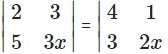
- A.-6
- B.6
- C.-12
- D.12
The question requires you to find the value of x by equating the determinants of two 2x2 matrices. The determinant of a 2x2 matrix is found by subtracting the product of the minor diagonal from the product of the major diagonal. For the left side, the determinant is - = 6x - 15. For the right side, it is - = 8x - 3. Setting them equal gives the equation 6x - 15 = 8x - 3. Solving for x by collecting like terms, we get -15 + 3 = 8x - 6x, which simplifies to -12 = 2x, so x = -6.
Common mistake: A common mistake is to incorrectly handle the signs when collecting like terms, or to add the products of the diagonals instead of subtracting, which would lead to the incorrect answer of x = 6.
| 4 2 −<!-- − --> 1 2 3 −<!-- − --> 1 −<!-- − --> 1 1 3 |
Evaluate ∣∣∣∣42−1231−1−13∣∣∣∣
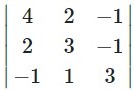
- A.25
- B.45
- C.15
- D.55
To evaluate the determinant of the 3x3 matrix shown in the image, we expand along the first row. This gives 4 multiplied by the determinant of the 2x2 matrix left after removing its row and column, minus 2 multiplied by its corresponding 2x2 determinant, plus (-1) multiplied by its determinant. The calculation is - + . This simplifies to - - , which is 4(10) - 2(5) - 1(5) = 40 - 10 - 5 = 25.
Common mistake: A common mistake is forgetting the alternating signs (+, -, +) when expanding the determinant, particularly forgetting the minus sign on the second term, which would lead to an incorrect answer like 45.
What is the size of each interior angle of a 12-sided regular polygon?
- A.120°
- B.150°
- C.30°
- D.180°
To find the size of each interior angle of a regular polygon, you can first find the exterior angle. The formula for the exterior angle is 360° divided by the number of sides (n). For a 12-sided polygon, the exterior angle is 360° / 12 = 30°. Since the interior angle and exterior angle on a straight line add up to 180°, the interior angle is 180° - 30° = 150°.
Common mistake: A common mistake is to calculate the exterior angle and select that as the answer, forgetting that the question asks for the interior angle.
A chord of circle of radius 7cm is 5cm from the centre of the circle.What is the length of the chord?
- A. cm
- B. cm
- C.. cm
- D. cm
A right-angled triangle is formed by the radius, the perpendicular distance from the centre to the chord, and half the length of the chord. The radius (7cm) acts as the hypotenuse. Using Pythagoras' theorem, the square of half the chord's length is 7² - 5² = 49 - 25 = 24. Therefore, half the chord is , which simplifies to cm, and the full length of the chord is 2 times this, which is cm.
Common mistake: Students often find the length of half the chord and mistakenly choose it as the final answer, forgetting to multiply by two to get the full chord length.
A solid metal cube of side 3 cm is placed in a rectangular tank of dimension 3, 4 and 5 cm. What volume of water can the tank now hold
- A.48
- B.33
- C.60
- D.27
First, calculate the total volume of the rectangular tank by multiplying its dimensions: 3 cm x 4 cm x 5 cm = 60 cm³. Next, find the volume of the solid metal cube, which is side cubed, so 3 cm x 3 cm x 3 cm = 27 cm³. The volume of water the tank can now hold is the total volume of the tank minus the volume taken up by the cube, which is 60 cm³ - 27 cm³ = 33 cm³.
Common mistake: Students might mistakenly choose 60 cm³ because they only calculate the total volume of the tank and forget to subtract the volume of the cube inside it.
See all 47 JAMB Mathematics 2011 questions
Sign up free to unlock every question in this paper — with the verified answer and Beta's worked explanation on each one. No card needed to begin.
Start free