JAMB Mathematics 2016 Past Questions & Answers
50 JAMB Mathematics 2016 questions with verified answers and worked explanations. Here are the first 10 — sign up free to practise the full paper.
∫<!-- ∫ -->
Integrate with respect to x
- A. - 2x + k
- B. + 2x + k
- C. + 2x + k
- D. - 2x + k
First, you must simplify the expression (2x³+2x)/x by dividing each term in the numerator by x. This gives you (2x³/x) + (2x/x), which simplifies to 2x² + 2. Next, integrate the simplified expression (2x² + 2) with respect to x. Using the power rule of integration, the integral of 2x² is 2x³/3, and the integral of 2 is 2x. Finally, you must add the constant of integration, k, to get the final answer 2x³/3 + 2x + k.
Common mistake: A common mistake is to forget the coefficient '2' on the first term after simplifying, causing students to integrate x² + 2 instead of 2x² + 2, which leads to the incorrect option B.
If the mean of 4, y, 8 and 10 is 7. Find Y?
- A.6
- B.10
- C.7
- D.9
The mean is the sum of all the numbers divided by the count of the numbers. In this question, the mean is 7 and there are 4 numbers. So, we set up the equation: / 4 = 7. This simplifies to (22 + y) / 4 = 7. To find y, multiply both sides by 4 to get 22 + y = 28, then subtract 22 from 28, which gives y = 6.
Common mistake: Students might incorrectly choose 7 (Option C) because it is the given mean, mistakenly thinking the missing value must be the same as the average.
Find the derivative of y =
- A.
- B.
- C.
- D.
To find the derivative of y = , we use the chain rule for differentiation. First, bring the power down and reduce the power by one, which gives . Then, differentiate the expression inside the bracket, , which gives . Finally, multiply these two results together to get * , which simplifies to .
Common mistake: A common mistake is to only apply the power rule to the bracket, resulting in , while forgetting to multiply by the derivative of the inner function .
In a school of 150 students, 80 offer French while 60 offer Arabic and 20 offer neither. How many students offer both subjects?
- A.45
- B.10
- C.35
- D.30
First, find the number of students who offer at least one subject by subtracting those who offer neither from the total: 150 - 20 = 130. The formula for the union of two sets is n(A U B) = n(A) + n(B) - n(A ∩ B), where n(A ∩ B) represents those who offer both. So, we have 130 = 80 (French) + 60 (Arabic) - n(Both). This gives 130 = 140 - n(Both), which means the number of students offering both subjects is 140 - 130 = 10.
Common mistake: A common mistake is to add all the given numbers and subtract the total number of students ; although this gives the correct answer here, the method is wrong and will fail on other questions.
If the 2nd term of a G.P is and the 6th term is . Find the common ratio.
- A.2
- B.
- C.
- D.3
In a Geometric Progression (G.P.), the nth term is given by the formula = . The 2nd term is ar = , and the 6th term is = = . To find the common ratio (r), we divide the 6th term by the 2nd term: / (ar) = / . This simplifies to = , and taking the fourth root of both sides gives r = .
Common mistake: Students might mistakenly divide the 2nd term by the 6th term, which leads to = , and incorrectly results in the reciprocal answer of .
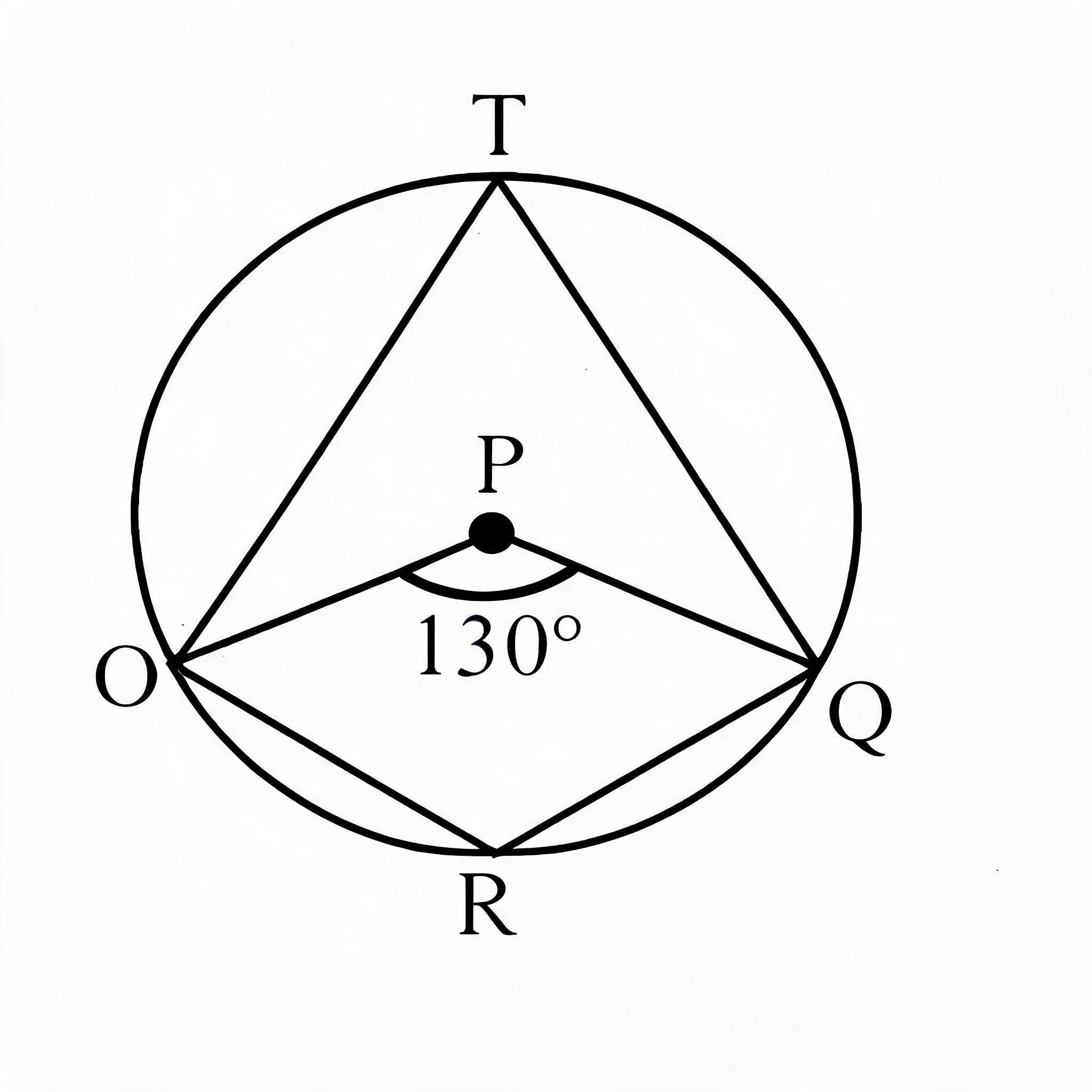
From the diagram above, find the value of < OTQ
- A.230°
- B.55°
- C.115°
- D.65°
According to a key circle theorem, the angle an arc subtends at the center is double the angle it subtends at the circumference. The diagram shows the angle at the center P is 130°, subtended by the minor arc OQ. The angle at the circumference subtended by this same arc is ∠OTQ, so we find it by dividing the center angle by two. Therefore, ∠OTQ = 130° ÷ 2 = 65°.
Common mistake: Students may mistakenly use the reflex angle at the center (360° - 130° = 230°) and divide by two, leading to the incorrect answer of 115°.
The sum of the interior angles of a polygon is a given as 1080o. Find the number of the sides of the polygon.
- A.5
- B.7
- C.6
- D.8
The formula for the sum of the interior angles of a polygon with 'n' sides is (n - 2) × 180°. We are given that this sum is 1080°, so we set up the equation (n - 2) × 180° = 1080°. To find 'n', we first divide both sides by 180°, which gives n - 2 = 6. Finally, we add 2 to both sides to get n = 8, which means the polygon has 8 sides.
Common mistake: A common mistake is to stop after dividing 1080 by 180 to get 6, and then incorrectly choose 6 as the answer instead of adding 2 to find the final value of 'n'.
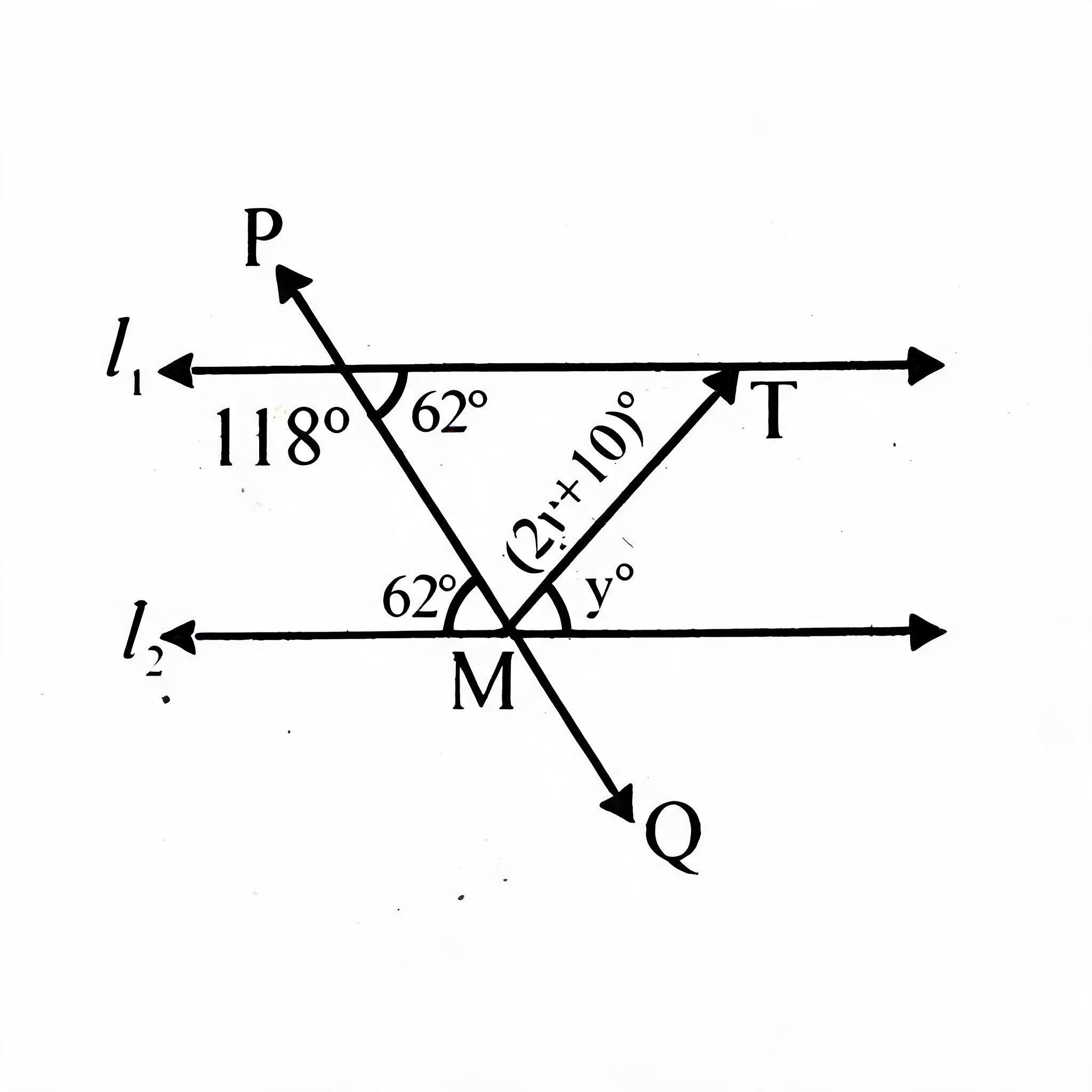
In the diagram above, is parallel to , Find the value of < PMT
- A.82°
- B.36°
- C.72°
- D.118°
The angles 62°, (2y+10)°, and y° are all on the straight line l₂, so their sum must be 180°. This gives the equation 62 + (2y + 10) + y = 180. Solving this, we get 3y + 72 = 180, which means 3y = 108, and therefore y = 36. The question asks for the value of angle PMT, which is given as (2y + 10)°, so we substitute y = 36 to get 2(36) + 10 = 72 + 10 = 82°.
Common mistake: Students might solve for 'y' and incorrectly choose 36° as the final answer, forgetting to substitute it back into the expression for angle PMT.
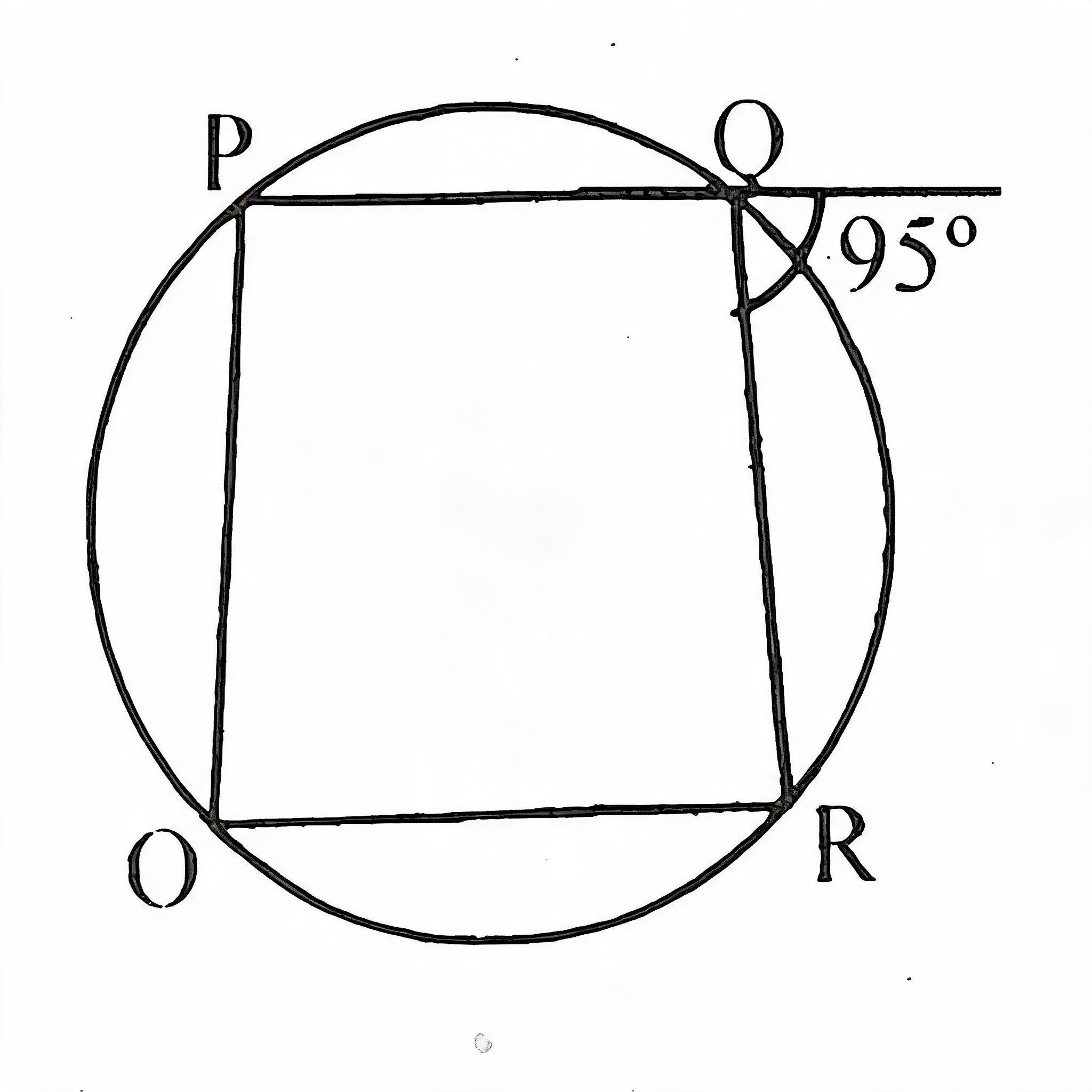
From the diagram above, Find the value of < ROP
- A.110°
- B.70°
- C.95°
- D.85°
The shape PQRO in the diagram is a cyclic quadrilateral because all its four vertices lie on the circumference of the circle. The angle marked 95° is the exterior angle at vertex Q. A fundamental property of cyclic quadrilaterals is that the exterior angle is equal to the interior opposite angle. The interior angle opposite to the angle at vertex Q is ∠ROP, which means the value of ∠ROP is 95°.
Common mistake: A common mistake is to calculate the adjacent interior angle ∠PQR as 180° - 95° = 85° and then incorrectly choose 85° as the answer, forgetting that the question asks for the opposite angle, ∠ROP.
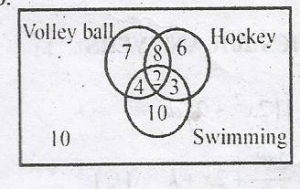
The venn diagram shows a class of 50 students with the games they play. How many students play only two games?
- A.15
- B.16
- C.20
- D.18
To find the number of students who play only two games, we must add the numbers in the regions of the Venn diagram where exactly two circles overlap. From the diagram, the number of students who play only Volleyball and Hockey is 8, only Hockey and Swimming is 3, and only Volleyball and Swimming is 4. Adding these numbers together gives the total number of students who play exactly two games: 8 + 3 + 4 = 15.
Common mistake: A common mistake is to include the number of students who play all three games (2) in the calculation, or to accidentally add a number from an 'only one game' region instead of an 'only two games' region.
See all 50 JAMB Mathematics 2016 questions
Sign up free to unlock every question in this paper — with the verified answer and Beta's worked explanation on each one. No card needed to begin.
Start free