JAMB Mathematics 2022 Past Questions & Answers
39 JAMB Mathematics 2022 questions with verified answers and worked explanations. Here are the first 25 — sign up free to practise the full paper.
Solve for k in the equation = 1
- A.2
- B.-4
- C.-2
- D.4
To solve this equation, we must first understand that for the fraction 1/x to be equal to 1, the denominator x must be equal to 1. Therefore, must be equal to 1. According to the laws of indices, any number raised to the power of 0 is 1, so we can write 1 as . The equation becomes = , and since the bases are the same, we can equate the powers: k + 2 = 0. Solving for k, we get k = -2.
Common mistake: A common mistake is to make a sign error when solving the final step, for example, solving k + 2 = 0 to get k = 2, which leads to the incorrect option A.
Evaluate
- A.
- B.
- C.
- D.
First, convert the number 101 from base two to our normal base ten. This gives + + which equals 4 + 0 + 1 = 5 in base ten. Next, you need to find the cube of this number, so you calculate 5³ = 5 × 5 × 5 = 125 in base ten. Finally, convert 125 from base ten back to base two by repeatedly dividing by 2 and recording the remainders from bottom to top, which gives 1111101₂.
Common mistake: A common mistake is to calculate the square (5²) instead of the cube (5³), which results in 25 in base ten or 11001 in base two, leading to the incorrect option D.
The shaded portion in the venn diagram above represents?
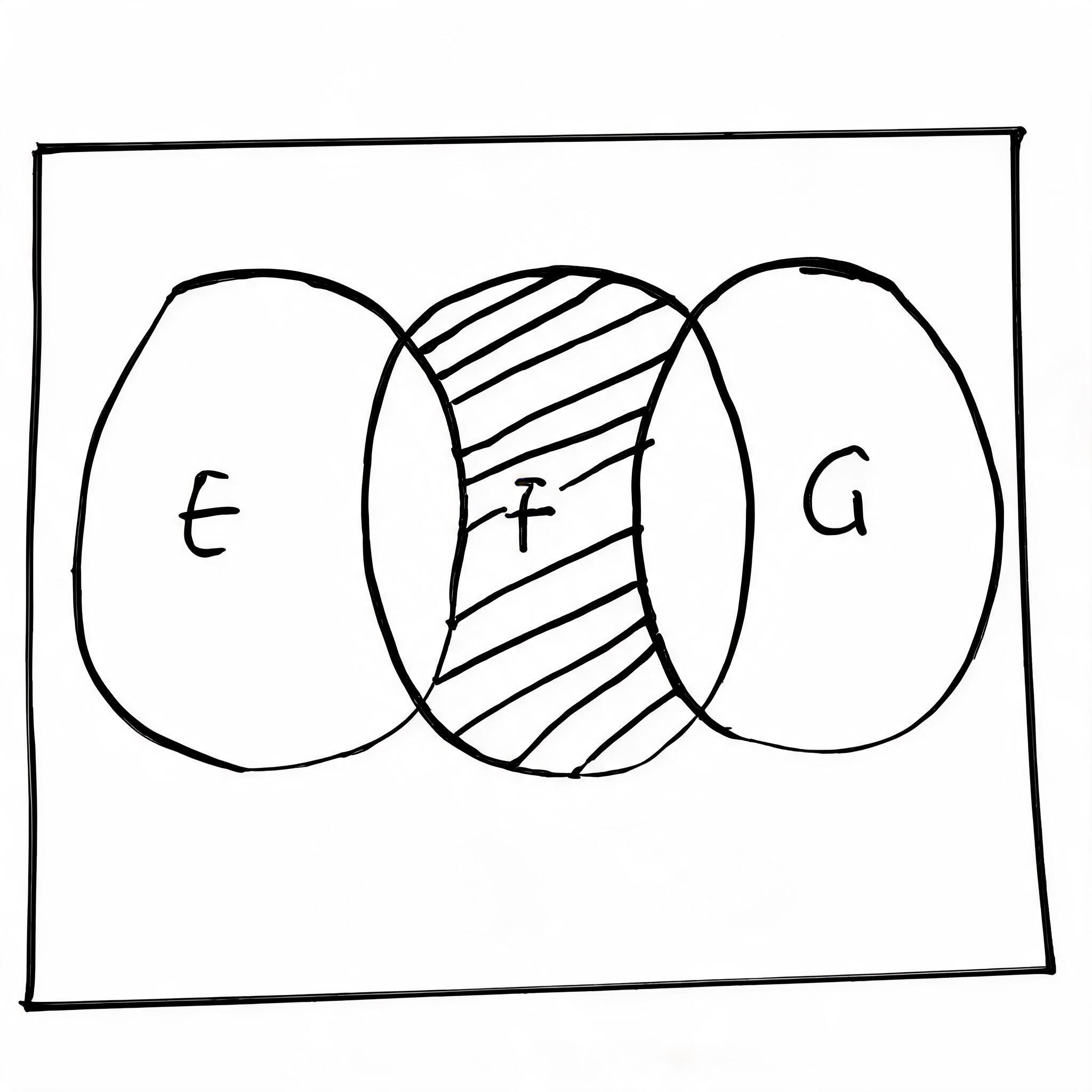
- A.F - (E n F) - (G n F)
- B.E' n F n G'
- C.E u F u G
- D.F
The Venn diagram shows the shaded portion is the area that belongs to set F only, and not to set E or set G. In set notation, 'not in E' is written as E' and 'not in G' is written as G'. The intersection symbol 'n' means 'and', so the shaded region represents the elements that are in F AND not in E AND not in G, which is correctly written as E' n F n G'.
Common mistake: A common mistake is choosing option D (F), as the shaded area is within set F, but this choice incorrectly includes the unshaded intersection areas with E and G.
If a fair coin is tossed twice, what is the probability of obtaining at least one head?
- A.0.25
- B.0.75
- C.0.5
- D.0.33
When a fair coin is tossed twice, the set of all possible outcomes is HH, HT, TH, TT, giving a total of 4 outcomes. The event 'at least one head' includes the outcomes HH, HT, TH, which are 3 favourable outcomes. Therefore, the probability is the number of favourable outcomes divided by the total number of outcomes, which is or 0.75.
Common mistake: A common mistake is to calculate the probability of getting exactly two heads (HH), which is or 0.25, forgetting to include the other outcomes (HT, TH) that also satisfy the 'at least one head' condition.
If the mean of 2, 5, (x+1), (x+2), 7 and 9 is 6. Find the median
- A.5.5
- B.5
- C.6.5
- D.6
First, use the given mean to find the value of x. The mean is the sum of the numbers divided by how many numbers there are, so 6 = / 6, which simplifies to 36 = 2x + 26, giving x = 5. Now, substitute x=5 back into the list to get the numbers: 2, 5, 6, 7, 7, 9. To find the median, arrange the numbers in order and find the middle value; since there are six numbers (an even amount), the median is the average of the two middle numbers (6 and 7). Therefore, the median is / 2 = 6.5.
Common mistake: A common mistake is to select the mean (6) as the answer, forgetting that the question asks for the median after finding the value of x.
If sin θ = - and θ lies in the third quadrant, find cos θ
- A.
- B.-1
- C.
- D.-
To solve this, we use the trigonometric identity sin²θ + cos²θ = 1. Substituting sin θ = , we get + cos²θ = 1, which simplifies to + cos²θ = 1. Solving for cos²θ gives , so cos θ is either or . Since the question states that θ is in the third quadrant where only tangent is positive (CAST rule), cosine must be negative. Therefore, cos θ = .
Common mistake: Students often correctly calculate the value as but forget that in the third quadrant, cosine is negative, leading them to incorrectly choose the positive option.
Simplify in the form of p +
- A.
- B.
- C.
- D.
To simplify the expression, you need to rationalize the denominator by removing the square root. You do this by multiplying both the numerator and the denominator by the conjugate of the denominator, which is . This gives in the numerator and in the denominator. The expression becomes / , which simplifies to / , resulting in / 7 or + .
Common mistake: A common mistake is to incorrectly expand the denominator, for example by calculating 3² + = 11 instead of using the difference of two squares to get 9 - 2 = 7.
Find the length of a chord 3cm from the centre of a circle of radius 5cm
- A.8cm
- B.5.6cm
- C.7cm
- D.6.5cm
This problem forms a right-angled triangle inside the circle, with the radius as the hypotenuse (5cm) and the distance from the centre as one of the other sides (3cm). The third side of the triangle is half the length of the chord. Using Pythagoras' theorem, the length of half the chord is = = , which is 4cm. Therefore, the full length of the chord is twice this value, which is 2 x 4cm = 8cm.
Common mistake: A common mistake is to calculate the length of half the chord (4cm) and forget to multiply by two to find the full length of the entire chord.
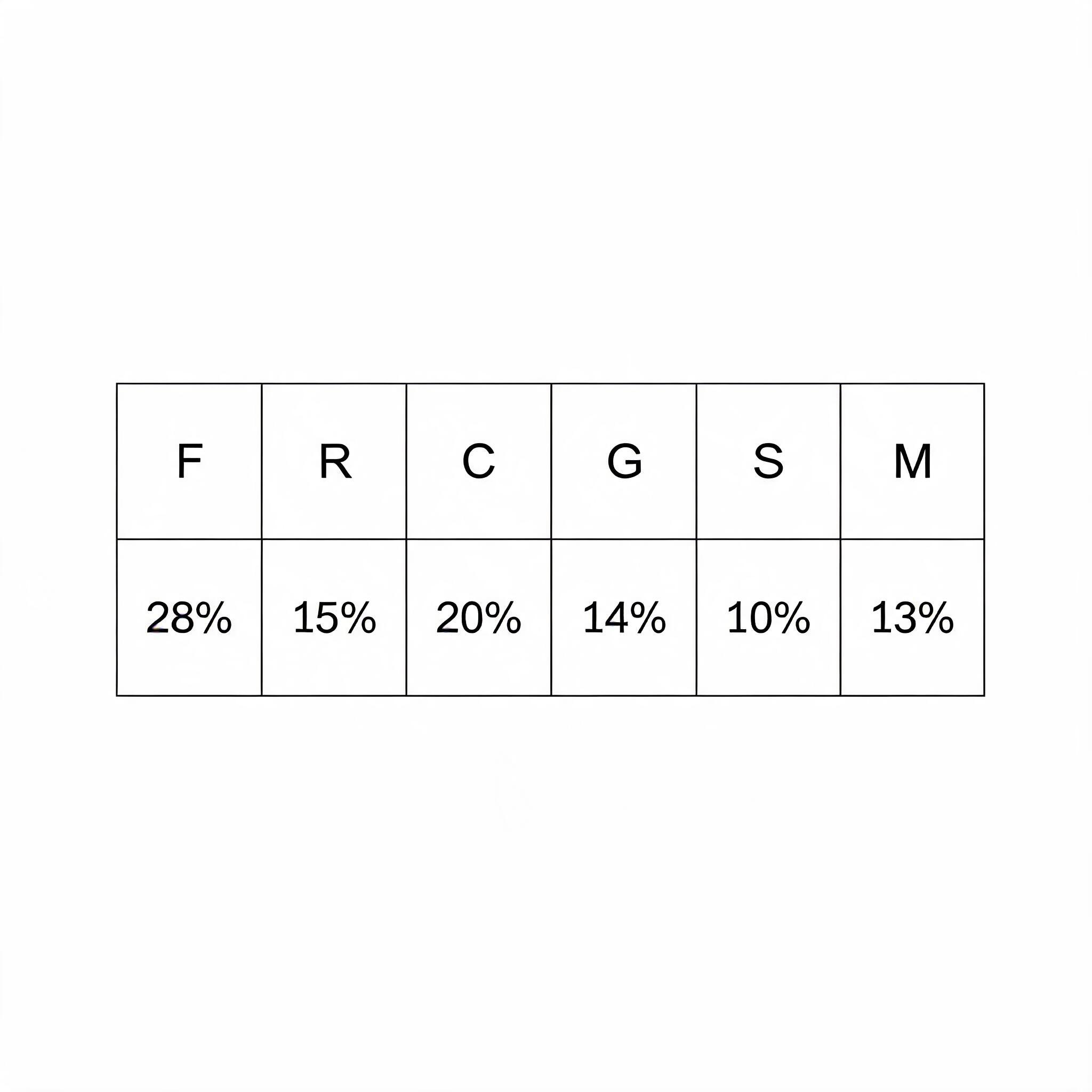
Mr Adu spends his annual salary on food(f), rent(r), car maintenance, gift+B10s(g), savings(s) and some B28miscellaneous (m) as indicate in the table below: If the above information is represented on a pie chart. What angle represents his spending on food?
- A.108.5
- B.100.8
- C.98.8
- D.120.5
To find the angle for an item on a pie chart, you use the formula: (Percentage of the item / 100) * 360°. From the table, the percentage spent on food (F) is 28%. Therefore, the angle representing food is multiplied by 360°, which equals 100.8°.
Common mistake: A common mistake is to simply multiply the percentage by 10 or make a calculation error, for instance, calculating 28 * 3 instead of 28 * 3.6.
A rectangular pyramid has an area and height 7.5cm. Find its volume?
- A.
- B.
- C.
- D.
The volume of a pyramid is calculated using the formula V = × Base Area × Height. Given the base area is 24cm² and the height is 7.5cm, we substitute these values into the formula. This gives us Volume = × 24 × 7.5, which simplifies to 8 × 7.5, resulting in 60.0cm³.
Common mistake: A common mistake is forgetting to divide by 3, which is part of the pyramid volume formula, and instead calculating the volume as if it were a prism (Base Area × Height).
The 10th term of an AP is 32. If the first term is , what is the 4th term?
- A.
- B.64
- C.16
- D.
First, find the common difference (d) using the formula for the nth term of an AP, = a + (n-1)d. Given = 32 and a = , we have 32 = + 9d, which solves to d = . Then, use this common difference to find the 4th term, = a + . Substituting the values gives = + , which simplifies to + . This calculates to , which reduces to .
Common mistake: A common mistake is choosing option C (16) by incorrectly assuming the 4th term is simply half of the 10th term, instead of correctly calculating the common difference first.
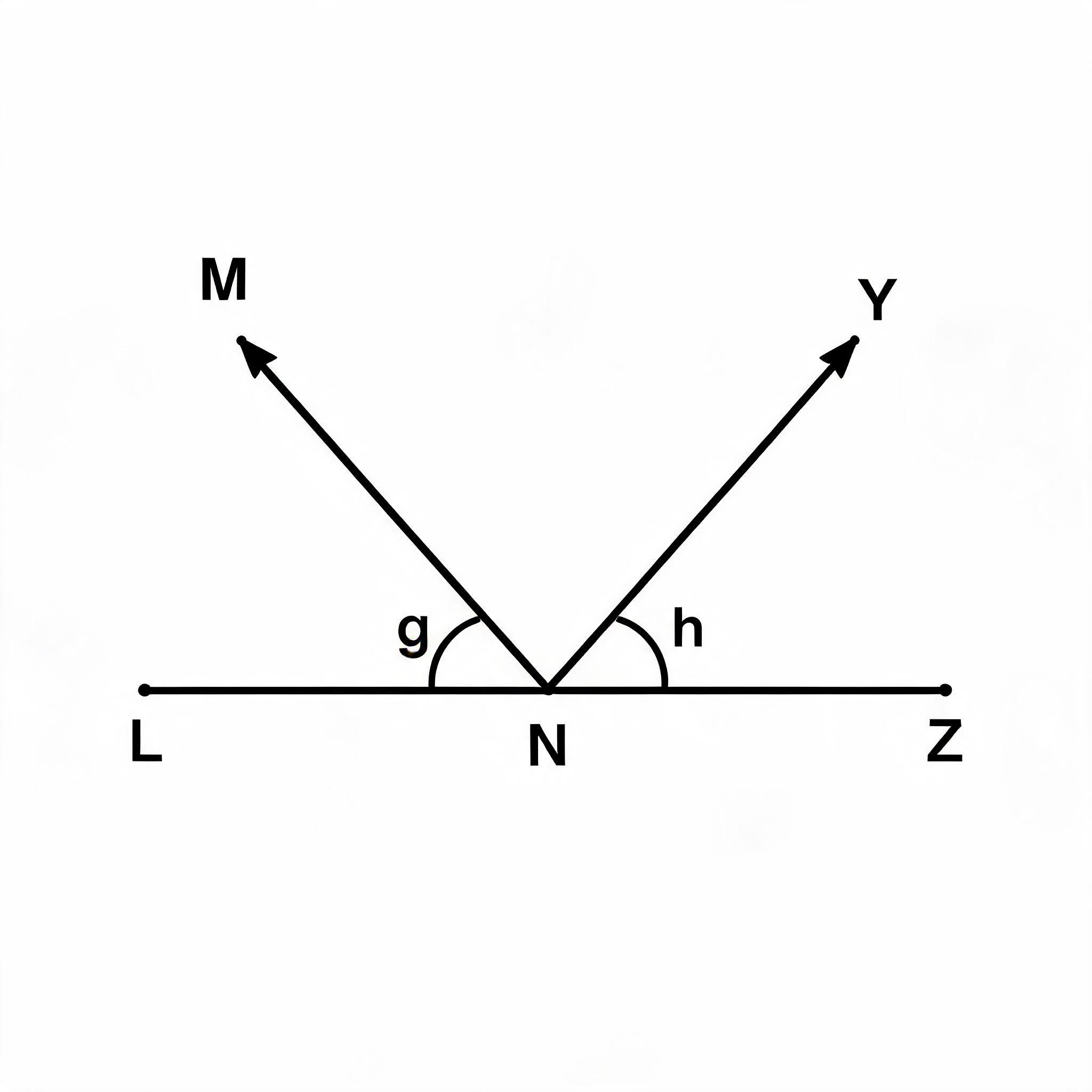
In the diagram above angle LNM and angle YNZ are represented by g and h respectively. Find ∠MNY
- A.180° - g° - h°
- B.360° - (g-h)°
- C.180° - (g-h)°
- D.360° - g° - h°
The diagram shows that the points L, N, and Z form a straight line. The sum of adjacent angles on a straight line is always 180°. In this case, the angles on the line are ∠LNM, ∠MNY, and ∠YNZ. So, we can write the equation ∠LNM + ∠MNY + ∠YNZ = 180°. Substituting the given values g for ∠LNM and h for ∠YNZ, we get g + ∠MNY + h = 180°. To find ∠MNY, we rearrange the equation to get ∠MNY = 180° - g - h.
Common mistake: A common mistake is to confuse the sum of angles on a straight line (180°) with the sum of angles around a point (360°), which could lead a student to incorrectly choose option D.
In how many ways can the letter of ZOOLOGY be arranged?
- A.720
- B.360
- C.840
- D.120
The word ZOOLOGY has 7 letters in total, but the letter 'O' is repeated 3 times. To find the number of unique arrangements, we use the formula for permutations with repetition, which is n! divided by the factorial of the number of repetitions. The calculation is therefore 7! / 3!, which equals / . This simplifies to 5040 divided by 6, which gives the correct answer of 840.
Common mistake: Students often mistakenly calculate 6! (which is 720) instead of correctly dividing 7! by the factorial of the repeated letters (3!).
Integrate
- A. + C
- B. + C
- C. + C
- D. + C
To integrate (2x+1)³, we use the rule for integrating a linear function raised to a power. First, increase the power by 1, which gives (2x+1)⁴. Then, divide by the new power (4) and also by the derivative of the expression inside the bracket (which is 2). So, we have (2x+1)⁴ divided by , which simplifies to (2x+1)⁴/8. Finally, we add the constant of integration, C, to get the final answer.
Common mistake: Students often choose option C because they correctly raise the power to 4 and divide by 4, but forget to also divide by the derivative of the inner function (2).
Given that r = , make v the subject of the formula
- A.v = 3 h
- B.v = πrh/3
- C.v =
- D.v = 3πrh
To make 'v' the subject, we first need to remove the square root by squaring both sides of the equation, which gives r² = 3v/πh. Next, to get the term with 'v' alone, we multiply both sides by πh, resulting in πr²h = 3v. Finally, we divide both sides by 3 to isolate 'v', which gives the final answer v = πr²h/3.
Common mistake: The most common mistake is choosing option B, which happens when a student correctly removes the square root from the right side but forgets to also square the 'r' on the left side of the equation.
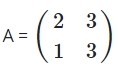
Find the determinant of the matrix A = (2133)
- A.4
- B.2
- C.5
- D.3
To find the determinant of a 2x2 matrix, we use the formula `ad - bc`, which means we multiply the elements of the leading diagonal and subtract the product of the elements of the other diagonal. From the matrix A shown in the image, we have a=2, b=3, c=1, and d=3. Therefore, the determinant is - , which simplifies to 6 - 3 = 3.
Common mistake: A common mistake is to add the elements of the leading diagonal , leading to the incorrect option C, instead of subtracting the product of the diagonals.
Evaluate
- A.3.0
- B.4.5
- C.3.5
- D.2.5
To evaluate Log₂ , we first express both 8 and as powers of the base 2. We know that 8 is 2³ and the square root of 2 is 2¹/². Using the law of indices, we multiply these terms by adding their powers, so becomes 2³ * 2¹/² = 2⁽³ ⁺ ¹/²⁾ = 2⁷/². Therefore, the expression becomes Log₂ 2⁷/², and since the log base and the number base are the same, the answer is simply the power, which is or 3.5.
Common mistake: The most common mistake is to only evaluate Log₂ 8 to get 3 and completely ignore the part of the expression, leading to the incorrect choice of 3.0.
The locus of points equidistant from a fixed point.
- A.circle
- B.perpendicular lines
- C.straight line
- D.bisector
The term 'locus' refers to the path traced by a point that moves according to a specific rule. In this case, the rule is that the point must always stay the same distance (equidistant) from one single fixed point. Imagine a pin stuck in a paper (the fixed point) and a pencil tied to it with a string; the path the pencil draws as it moves around the pin is a perfect circle, where the fixed point is the center and the string's length is the radius.
Common mistake: Students may confuse this with the locus of points equidistant from two fixed points, which is a straight line known as a perpendicular bisector.
What will be the result obtained when the numerator of is decreased by 37.5% and its denominator decreased by 20%.
- A.1.5
- B.
- C.
- D.0.5
First, find the new numerator by decreasing 96 by 37.5%. The decrease is * 96 = 36, so the new numerator is 96 - 36 = 60. Next, find the new denominator by decreasing 50 by 20%, which is * 50 = 10, making the new denominator 50 - 10 = 40. The new fraction is , which simplifies to , and as a decimal is 1.5.
Common mistake: A common mistake is to only perform one of the percentage decreases, for example, only decreasing the denominator to 40 and then calculating = 2.4, which is not among the options.
A poultry farmer realized 200 eggs from his birds and sold crates of eggs. What percentages of eggs are left?
- A.82.5%
- B.15%
- C.17.5%
- D.85%
First, you must know that one standard crate contains 30 eggs. The farmer sold 5 and a half (5.5) crates, which is 5.5 multiplied by 30, giving 165 eggs sold. To find the eggs left, subtract the sold eggs from the total: 200 - 165 = 35 eggs. The percentage of eggs left is calculated as x 100%, which equals 17.5%.
Common mistake: A common mistake is to calculate the percentage of eggs sold (82.5%) instead of the percentage of eggs left, which the question asks for.
If + = 3, then the angle θ is equal to?
- A.90°
- B.30°
- C.45°
- D.60°
To solve this problem, we use the trigonometric identity which states that sec²θ = 1 + tan²θ. Substitute this into the original equation to get (1 + tan²θ) + tan²θ = 3. Simplifying this gives 1 + 2tan²θ = 3, and then 2tan²θ = 2, which means tan²θ = 1. Taking the square root of both sides, we find that tanθ = 1, and the angle whose tangent is 1 is 45°.
Common mistake: A common mistake is incorrectly simplifying the equation or forgetting the value of special angles, leading a student to choose 60° (Option D) by mistakenly thinking tan 60° is 1.
x 3 + 6 x −<!-- − --> 7 x −<!-- − --> 1
find the limit of y = as x tends to 1
- A.9
- B.8
- C.0
- D.7
To solve this limit problem, direct substitution of x=1 into the expression gives , which is an indeterminate form. We can apply L'Hôpital's rule by differentiating the numerator and the denominator separately. The derivative of the numerator (x³ + 6x - 7) is 3x² + 6, and the derivative of the denominator (x - 1) is 1. Now, we find the limit of (3x² + 6)/1 as x tends to 1, which gives 3(1)² + 6 = 9.
Common mistake: Students might mistakenly choose 0 because direct substitution gives 0 in the numerator, not realizing that a result is indeterminate and requires further calculation.
Find the equation of a straight line parallel to the line 2x - y = 5 and having intercept of 5
- A.2x + y = 5
- B.2x + y = -5
- C.2x - y = -5
- D.2x - y = 5
First, find the gradient of the line 2x - y = 5 by rewriting it as y = 2x - 5, which shows the gradient is 2. A parallel line will have the same gradient, so the new line's equation starts as y = 2x + c. Since the line has an intercept of 5, this means the y-intercept (c) is 5, giving the equation y = 2x + 5. Rearranging this to match the options' format gives 2x - y = -5.
Common mistake: A common mistake is to correctly find the new equation y = 2x + 5 but then make a sign error when rearranging it, leading to the incorrect choice of 2x - y = 5.
Calculate the median of 14, 17, 10, 13, 18 and 10
- A.12.5
- B.13.5
- C.13.2
- D.14.5
To find the median, you must first arrange the numbers in order from smallest to largest: 10, 10, 13, 14, 17, 18. Since there is an even number of values (6 values), the median is the average of the two middle numbers. The two middle numbers are 13 and 14, so their average is / 2, which equals 27 / 2 or 13.5.
Common mistake: A common mistake is to forget to arrange the numbers in order first, which is a critical step before identifying the middle value or values.
The equivalent of in base 10 is?
- A.26.325
- B.24.372
- C.42.443
- D.22.375
To convert a binary number like (10110.011)₂ to base 10, you handle the whole number and the fraction parts separately. For the whole number part (10110), multiply each digit by 2 raised to the power of its position, starting from the right with power 0, which gives (1x2⁴) + (0x2³) + (1x2²) + (1x2¹) + (0x2⁰) = 16 + 0 + 4 + 2 + 0 = 22. For the fractional part (.011), multiply each digit by 2 raised to a negative power, starting from the left with power -1, which gives (0x2⁻¹) + (1x2⁻²) + (1x2⁻³) = 0 + + = 0.375. Adding both parts together, you get 22 + 0.375 = 22.375.
Common mistake: A common mistake is incorrectly assigning the powers to each digit, especially for the fractional part where negative powers must be used, or making a simple arithmetic error during the summation.
See all 39 JAMB Mathematics 2022 questions
Sign up free to unlock every question in this paper — with the verified answer and Beta's worked explanation on each one. No card needed to begin.
Start free