JAMB Mathematics 2023 Past Questions & Answers
49 JAMB Mathematics 2023 questions with verified answers and worked explanations. Here are the first 10 — sign up free to practise the full paper.
How many different 8 letter words are possible using the letters of the word SYLLABUS?
- A.!
- B.8!/2!
- C.8!/2!2!
- D.8!
The question asks for the number of unique arrangements of the letters in the word SYLLABUS. There are 8 letters in total, so we start with 8!. However, because some letters are repeated, we must divide to avoid overcounting. The letter 'S' appears 2 times and the letter 'L' also appears 2 times, so we must divide 8! by the factorial of each repetition count, which gives the formula 8!/(2!2!).
Common mistake: Students often choose 8!/2! because they correctly identify one repeated letter but forget to also divide by the factorial for the second repeated letter.
Evaluate: × ×
- A.2
- B.0
- C.
- D.
First, use the law of indices to combine the terms with base 16: × = = . Next, express 16 as a power of 2 so that all terms have the same base. The expression becomes × , which simplifies to × . Finally, add the powers again to get = , which is 2.
Common mistake: Students may make an arithmetic error with the decimal powers that results in a final power of 0, leading them to incorrectly choose .
Let '*' and '^' be two binary operations such that a * b = and a ^ b = 2a + b. Find ^ (7 * -1).
- A.-49
- B.64
- C.113
- D.15
To solve this, we first evaluate the expressions inside the brackets according to the given rules. For the first bracket, , we use the rule a * b = a²b, which gives (-4)² × 2 = 16 × 2 = 32. For the second bracket, (7 * -1), we use the same rule to get (7)² × (-1) = 49 × -1 = -49. Finally, we combine these results using the second operation, '^', where a ^ b = 2a + b, so we calculate 32 ^ -49 = 2(32) + (-49) = 64 - 49 = 15.
Common mistake: A common mistake is to ignore the negative sign when calculating the final step, leading to 64 + 49 = 113 (Option C) instead of the correct 64 - 49.
∫<!-- ∫ --> 0 1 4 x −<!-- − --> 6 x 2 3 d x
Evaluate
- A.-
- B.
- C.
- D.
To evaluate the definite integral, first integrate the expression term by term using the power rule ∫xⁿ dx = xⁿ⁺¹/(n+1). The integral of 4x is 2x², and the integral of 6x²/³ is . So, we evaluate from 0 to 1. Substituting the upper limit (1) gives 2 - , and substituting the lower limit (0) gives 0, resulting in - 0 = - = .
Common mistake: Students may make a sign error during the final subtraction, calculating - 2 to get (Option C) instead of the correct 2 - .
The population of a village decreased from 1,230 to 1,040 due to breakout of an epidemic. What is the percentage decrease in the population?
- A.15.44%
- B.15.43%
- C.15.42%
- D.15.45%
To find the percentage decrease, first calculate the actual decrease in population, which is 1230 - 1040 = 190. Then, divide this decrease by the original population and multiply by 100 to get the percentage. The calculation is x 100 = 15.447%, which is correctly rounded to two decimal places as 15.45%.
Common mistake: Students may incorrectly round the answer 15.447% down to 15.44% (Option A) instead of correctly rounding up to 15.45%.
The interior angle of a regular polygon is five times the size of its exterior angle. Identify the polygon.
- A.dodecagon
- B.enneadecagon
- C.icosagon
- D.hendecagon
For any regular polygon, the sum of an interior angle and its corresponding exterior angle is 180 degrees. If we let the exterior angle be 'x', the interior angle is '5x', so x + 5x = 180. This gives 6x = 180, which means the exterior angle x is 30 degrees. The number of sides of a regular polygon is found by dividing 360 by the exterior angle, so the number of sides is = 12. A polygon with 12 sides is called a dodecagon.
Common mistake: Students might mistakenly use the interior angle (150°) instead of the exterior angle (30°) in the formula n = 360/exterior angle, leading to an incorrect number of sides.
The area A of a circle is increasing at a constant rate of 1.5 cm . Find, to 3 significant figures, the rate at which the radius r of the circle is increasing when the area of the circle is 2 .
- A.0.200
- B.0.798
- C.0.300
- D.0.299
This is a related rates problem. First, write the formula for the area of a circle, A = πr². Differentiate both sides with respect to time t, which gives dA/dt = 2πr(dr/dt). When the area A is 2 cm², the radius is r = . Substitute the given rate dA/dt = 1.5 and the calculated radius r into the differentiated equation to solve for dr/dt, which is 1.5 / ≈ 0.299 cms⁻¹.
Common mistake: The most common mistake is calculating the radius 'r' when the area is 2 cm² (which is approximately 0.798 cm) and incorrectly choosing this value (Option B) as the final answer for the rate of change of the radius.
Make x the subject of the formula: y = (3x−9c)/(4x+5d)
- A.x = −(9c−5dy)/4y−3
- B.x = 9c + 5dy/4y − 3
- C.x = 9c−5dy/4y−3
- D.x = −(9c+5dy)/4y−3
To make x the subject, first multiply both sides by the denominator (4x+5d) to get y(4x+5d) = 3x−9c. Expand the bracket to get 4xy + 5dy = 3x - 9c. Next, gather all terms containing x on one side and the rest on the other side: 4xy - 3x = -5dy - 9c. Factor out x to get x(4y - 3) = -(5dy + 9c), and finally, divide both sides by (4y - 3) to isolate x, which gives x = -(9c+5dy)/(4y-3).
Common mistake: Students often make sign errors when moving terms across the equals sign, for instance, moving '+5dy' to the other side but forgetting to change it to '-5dy', which can lead to an incorrect numerator like in option A.
Solve for x: 3(x – 1) ≤ 2 (x – 3)
- A.x ≤ -3
- B.x ≥ -3
- C.x ≤ 3
- D.x ≥ 3
To solve this inequality, first expand the brackets on both sides to get 3x - 3 ≤ 2x - 6. Next, you need to bring all the terms with 'x' to one side and the constant numbers to the other side. This gives you 3x - 2x ≤ -6 + 3. Finally, simplifying both sides of the inequality results in x ≤ -3.
Common mistake: Students often make a sign error when collecting like terms, for example, calculating -6 + 3 as 3 instead of -3, which leads to the incorrect answer x ≤ 3.
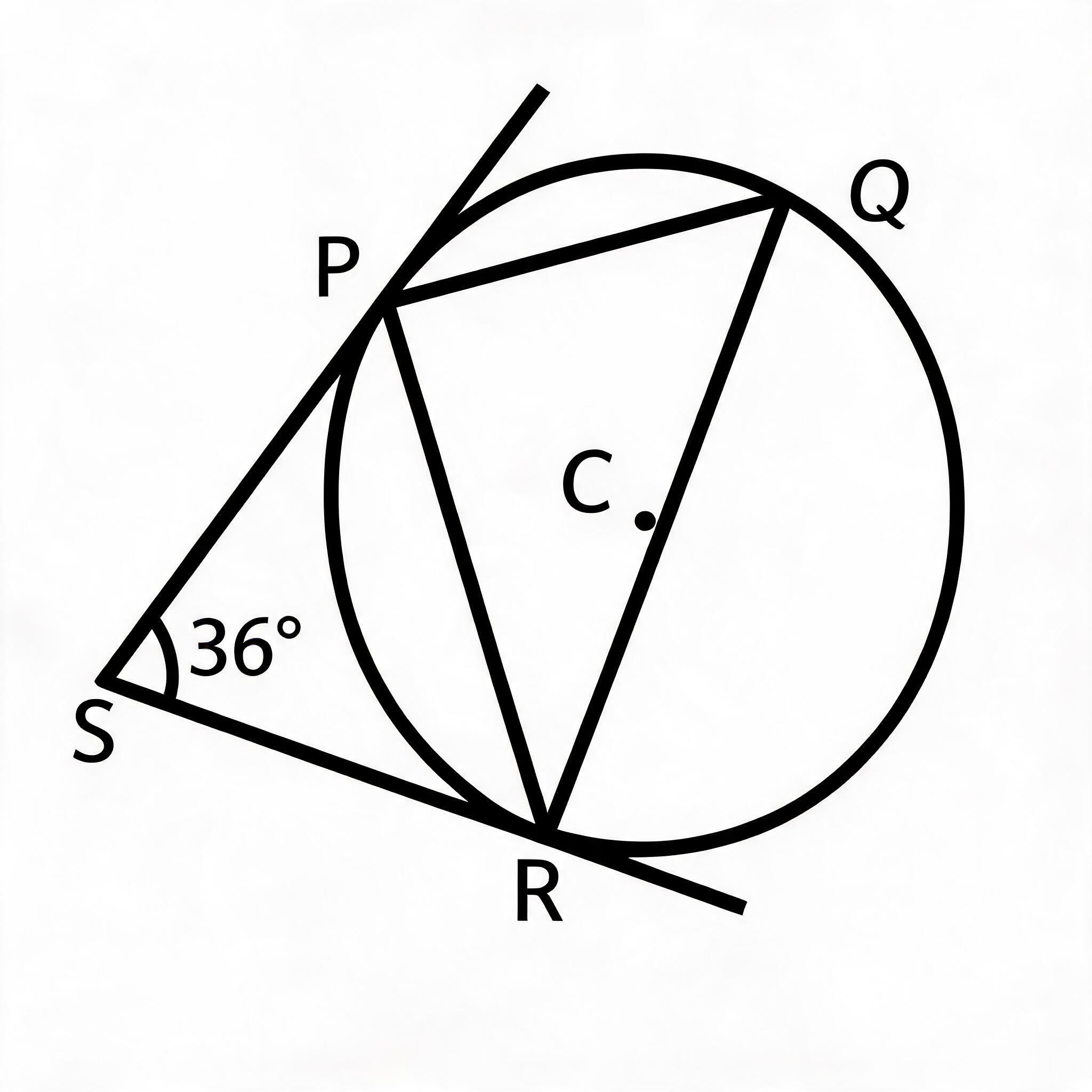
The diagram above is a circle with centre C. P, Q and S are points on the circumference. PS and SR are tangents to the circle. ∠PSR = . Find ∠PQR
- A.
- B.
- C.
- D.
Since SP and SR are tangents from the same external point S, the triangle PSR is an isosceles triangle. The base angles are equal, so ∠SPR = ∠SRP = (180° - 36°)/2 = 72°. By the alternate segment theorem, the angle between the tangent SR and the chord PR is equal to the angle in the alternate segment, which is ∠PQR. Therefore, ∠PQR = ∠SRP = 72°.
Common mistake: A common mistake is to assume that the figure PQRS is a cyclic quadrilateral and incorrectly calculate the opposite angle as 180° - 36° = 144°, which is wrong because point S is outside the circle.
See all 49 JAMB Mathematics 2023 questions
Sign up free to unlock every question in this paper — with the verified answer and Beta's worked explanation on each one. No card needed to begin.
Start free