JAMB Mathematics 2017 Past Questions & Answers
48 JAMB Mathematics 2017 questions with verified answers and worked explanations. Here are the first 25 — sign up free to practise the full paper.
Given T = even numbers from 1 to 12 N = common factors of 6, 8 and 12 Find T ∩ N
- A.2, 3
- B.2, 3, 4
- C.3, 4, 6
- D.2
First, list the elements of each set. Set T contains the even numbers from 1 to 12, so T = 2, 4, 6, 8, 10, 12. Set N contains the common factors of 6, 8, and 12; the factors are 1, 2 for all three numbers, so N = 1, 2. The intersection symbol '∩' means we should find the elements that are in BOTH set T and set N. The only number that appears in both sets is 2, so the correct answer is 2.
Common mistake: A common mistake is to incorrectly identify the common factors, for example by including 3 (which is a factor of 6 and 12, but not 8) or 4 (which is a factor of 8 and 12, but not 6).
What is the next number in the series 2, 1, , ...
- A.
- B.
- C.
- D.
This series is a Geometric Progression (GP) because each term is found by multiplying the previous term by a constant number. To find this constant, called the common ratio (r), we divide a term by the one before it, so 1 ÷ 2 = . To get the next number, we multiply the last term by the common ratio , which gives × = .
Common mistake: A common mistake is choosing option B , which simplifies to , as some students may incorrectly think the last term repeats instead of continuing the progression.
If U = x : x is an integer and 1 ≤ x ≤ 20 E1 = x: x is a multiple of 3 E2 = x: x is a multiple of 4 and an integer is picked at random from U, find the probability that it is not in E2
- A.
- B.
- C.
- D.
The universal set U contains integers from 1 to 20, so the total number of possible outcomes is 20. The set E2 contains multiples of 4 within this range, which are 4, 8, 12, 16, 20, meaning there are 5 elements in E2. The question asks for the probability of picking a number that is *not* in E2, so we find the number of integers not in E2, which is 20 - 5 = 15. Therefore, the probability is the number of favourable outcomes (15) divided by the total number of outcomes (20), which simplifies to = .
Common mistake: Students might mistakenly calculate the probability of picking a number that *is* in E2 , forgetting the question asks for the probability of the number *not* being in E2.
The curved surface area of a cylinder 5cm high is 110cm2. Find the radius of its base π =
- A.2.6cm
- B.3.5cm
- C.3.6cm
- D.7.0cm
The formula for the curved surface area (CSA) of a cylinder is 2πrh. We are given that the CSA is 110cm², the height (h) is 5cm, and π is . Substituting these values into the formula gives 110 = 2 * * r * 5. To find the radius (r), we rearrange the equation: r = / . This simplifies to r = 770 / 220, which equals 3.5cm.
Common mistake: A common mistake is using the formula for the total surface area of the cylinder (2πrh + 2πr²) instead of just the curved surface area, which leads to a wrong answer.
If two graphs Y = + q and y = − 1 intersect at x =2, find the value of p in terms of q
- A.q −
- B.7 − q/4
- C.8 − q/2
- D.7 + q/8
At the point where the two graphs intersect, their y-values are equal. Therefore, we can set the two equations equal to each other: px² + q = 2x² − 1. Since the intersection occurs at x = 2, we substitute 2 for x: p(2)² + q = 2(2)² − 1. This simplifies to 4p + q = 8 − 1, which gives 4p + q = 7. To find p in terms of q, we make p the subject of the formula: 4p = 7 − q, and finally, p = (7 − q)/4.
Common mistake: Students might incorrectly calculate p(2)² as 2p and also forget to subtract the 1 on the right side, leading to an incorrect equation like 2p + q = 8, which results in option C.
Evaluate (sin45° + sin30° ) in surd form
- A.
- B. −
- C.
- D.
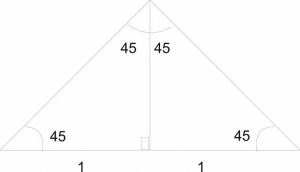
To solve this, you need to know the values of sine for the special angles 45° and 30° in surd form. The value of sin45° is and the value of sin30° is . Adding these two values gives + . Since they have a common denominator of 2, you can combine the numerators to get .
Common mistake: A common mistake is to incorrectly add the numerators, for example, treating + 1 as , which is mathematically wrong.
If y = x Sin x, find dy/dx when x = π/2
- A.−π/2
- B.-1
- C.1
- D.π/2
To find dy/dx for y = x Sin x, we must use the product rule because it is a product of two functions, x and Sin x. The product rule is dy/dx = u(dv/dx) + v(du/dx), where u = x and v = Sin x. This gives us dy/dx = x(Cos x) + (Sin x)(1). We then substitute the value x = π/2 into the derivative. Since Cos(π/2) = 0 and Sin(π/2) = 1, the expression becomes (π/2)(0) + 1, which equals 1.
Common mistake: Students may incorrectly apply the product rule with a minus sign (like the quotient rule), leading them to calculate (π/2)(0) - 1 = -1, which is option B.
If temperature t is directly proportional to heat h, and when t = 20oC, h = 50 J, find t when h = 60J
- A.24°C
- B.20°C
- C.34°C
- D.30°C
Since temperature (t) is directly proportional to heat (h), we can write the relationship as t = kh, where k is a constant. First, we find the value of k using the given values: 20 = k × 50, which gives k = = . Now, we use this constant to find the new temperature when h = 60, so t = × 60, which equals 24°C.
Common mistake: Students might mistakenly think the change is additive, adding the 10J increase in heat directly to the temperature , instead of using the correct proportional relationship.
Evaluate 1 - +
- A.4
- B.3
- C.
- D.
To solve this, we follow the order of operations, which is BODMAS (Brackets, Of, Division, Multiplication, Addition, Subtraction). First, we solve the expressions inside the brackets: becomes , and becomes . The problem is now 1 - + . We find the Lowest Common Multiple (LCM) of the denominators, which is 15, and convert each term: - + . Finally, we calculate the numerator which gives 98, so the answer is .
Common mistake: Students might make a mistake by not following the order of operations (BODMAS), for instance, by performing subtraction before the multiplication inside the brackets.
Given m = make T the subject of the formula
- A.NSL/M
- B.
- C.
- D.
To make T the subject, first isolate the square root term by dividing both sides by N, which gives m/N = . Next, square both sides of the equation to remove the square root, resulting in (m/N)² = SL/T, which simplifies to m²/N² = SL/T. Finally, cross-multiply and rearrange the equation to solve for T, giving T = N²SL/m².
Common mistake: A common mistake is choosing option D, which happens when a student correctly squares 'm' but forgets to also square the 'N' in the denominator when squaring the fraction m/N.
27 n + 1 81 n
Simplify ×
- A.
- B.9
- C.
- D.
To solve this, first express all the numbers (27 and 81) as powers of the smallest base, which is 3. So, 27 becomes 3³ and 81 becomes 3⁴. Substitute these into the expression to get 3ⁿ⁻¹ × (3³)ⁿ⁺¹ / (3⁴)ⁿ. Using the laws of indices, this simplifies to 3ⁿ⁻¹ × 3³ⁿ⁺³ / 3⁴ⁿ. Finally, add the powers in the numerator and subtract the power in the denominator, which gives 3⁽ⁿ⁻¹⁺³ⁿ⁺³⁾⁻⁴ⁿ = 3², and the answer is 9.
Common mistake: A common mistake is incorrectly simplifying the final exponent, for example, calculating (4n+2) - 4n as 'n' instead of 2, which leads to the wrong answer 3ⁿ.
The locus of a point which is equidistant from the line PQ forms a
- A.circle centre P
- B.pair of parallel lines each opposite to PQ
- C.circle centre Q
- D.perpendicular line to PQ
The locus of a point is the path it traces based on a rule. The question asks for the path of a point that is always the same distance from point P as it is from point Q. This specific path forms the perpendicular bisector of the line segment PQ. A perpendicular bisector is a straight line that cuts another line segment into two equal parts at a 90° angle.
Common mistake: Students often confuse being equidistant from two points (P and Q) with being a constant distance from a single point (like P), which would incorrectly lead them to choose a circle.
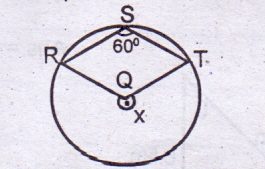
Given the quadrilateral RSTO inscribed in the circle with O as centre. Find the size angle x and given RST = 60°
- A.100o
- B.140°
- C.120°
- D.10°
According to a key circle theorem, the angle that an arc of a circle subtends at the center is double the angle it subtends at any point on the remaining part of the circumference. In the given diagram, the major arc RT subtends the reflex angle x at the center and the angle ∠RST = 60° at the circumference. Therefore, the angle at the center (x) is twice the angle at the circumference, which means x = 2 × 60° = 120°.
Common mistake: A common mistake is to confuse this theorem with the property of cyclic quadrilaterals, incorrectly assuming the angle at the center and the angle at the circumference are supplementary (add up to 180°).
Find the sum of the range and the mode of the set of numbers 10, 9, 10, 9, 8, 7, 7, 10, 8, 10, 8, 4, 6, 9, 10, 9, 7, 10, 6, 5
- A.16
- B.14
- C.12
- D.10
First, find the mode, which is the number that appears most frequently in the set; the number 10 appears 6 times, so the mode is 10. Next, find the range by subtracting the lowest value from the highest value; the highest is 10 and the lowest is 4, so the range is 10 - 4 = 6. The question asks for the sum of the range and the mode, which is 6 + 10 = 16.
Common mistake: A common mistake is to correctly find the mode, which is 10, and then select option D without adding the range as the question requires.
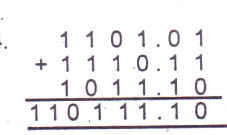
The base in which the operation was performed was
- A.6
- B.2
- C.4
- D.5
To find the base used in the addition, we can examine a single column from the image. In the rightmost column, the sum is 1 + 1 + 0 = 2. The answer for this column is 0, which means there was a carry-over to the next column. This pattern, where a sum of 2 is written as '10' (write 0, carry 1), is the rule for addition in base 2 (binary). Therefore, the operation was performed in base 2.
Common mistake: A common mistake is to try and convert all the numbers to base 10 to verify the sum, which is time-consuming and would be confusing because the final sum printed in the image contains an error.
The value of x + x ( xx) when x = 2 is
- A.16
- B.10
- C.18
- D.24
To solve this, substitute the value of x = 2 into the expression x + x(xx). This gives 2 + 2(2 x 2). According to the order of operations (BODMAS), we first solve the calculation inside the bracket, which is 2 x 2 = 4. The expression then becomes 2 + 2(4), and we perform the multiplication next, giving 2 + 8. Finally, adding the numbers gives the answer 10.
Common mistake: A common mistake is to add the first two terms before multiplying by the value in the bracket, which incorrectly leads to 4 x 4 = 16 (Option A).
In a regular polygon, each interior angle doubles its corresponding exterior angle. Find the number of sides of the polygon
- A.8
- B.6
- C.4
- D.3
Let the exterior angle be E. The question states that the interior angle is double the exterior angle, so the interior angle is 2E. Since the sum of an interior angle and its corresponding exterior angle is 180°, we have E + 2E = 180°. This simplifies to 3E = 180°, which means the exterior angle E is 60°. The number of sides of a regular polygon (n) is found by dividing 360° by the exterior angle, so n = 360° / 60°, which gives 6 sides.
Common mistake: A common mistake is reversing the relationship, making the exterior angle double the interior (E = 2I), which leads to an incorrect answer of 3 sides.
A cylindrical tank has a capacity of 3080m3. What is the depth of the tank if the diameter of its base is 14m? Take pi = .
- A.23m
- B.25m
- C.20m
- D.22m
The capacity of the cylindrical tank is its volume, which is calculated using the formula V = πr²h, where 'h' is the depth. First, find the radius (r) by dividing the diameter by 2, which gives 14m / 2 = 7m. Substitute the given values into the formula: 3080 = × 7² × h, which simplifies to 3080 = 154h. Finally, divide both sides by 154 to find the depth (h), so h = 3080 / 154 = 20m.
Common mistake: A common mistake is using the diameter (14m) directly in the volume formula instead of first calculating the radius (7m).
Simplify + −
- A.7
- B.-7
- C.
- D.
To simplify the expression, first break down each surd into its simplest form by finding the largest perfect square factor. For example, becomes which is , becomes which is , and becomes which is . Substituting these back gives + - , which simplifies to + - . Finally, add and subtract the coefficients of the like surds: = .
Common mistake: Students may make an arithmetic error when combining the coefficients , possibly calculating it as -7, which leads to the incorrect option C.
A man covered a distance of 50 miles on his first trip, on a later trip he traveled 300 miles while going 3 times as fast. His new time compared with the old distance was?
- A.three times as much
- B.the same
- C.twice as much
- D.half as much
This problem relates speed, distance, and time using the formula: Time = Distance / Speed. For the first trip, let the time be T1 and speed be S, so T1 = 50/S. For the second trip, the distance is 300 miles and the speed is 3S, so the new time T2 = 300 / (3S) = 100/S. To compare the new time with the old time, we find the ratio T2 / T1 = (100/S) / (50/S), which simplifies to = 2. Therefore, the new time is twice as much as the old time.
Common mistake: A common mistake is to only focus on the speed increasing by 3 times and incorrectly assume the time must decrease by a factor of 3, without properly calculating the effect of the new, longer distance.
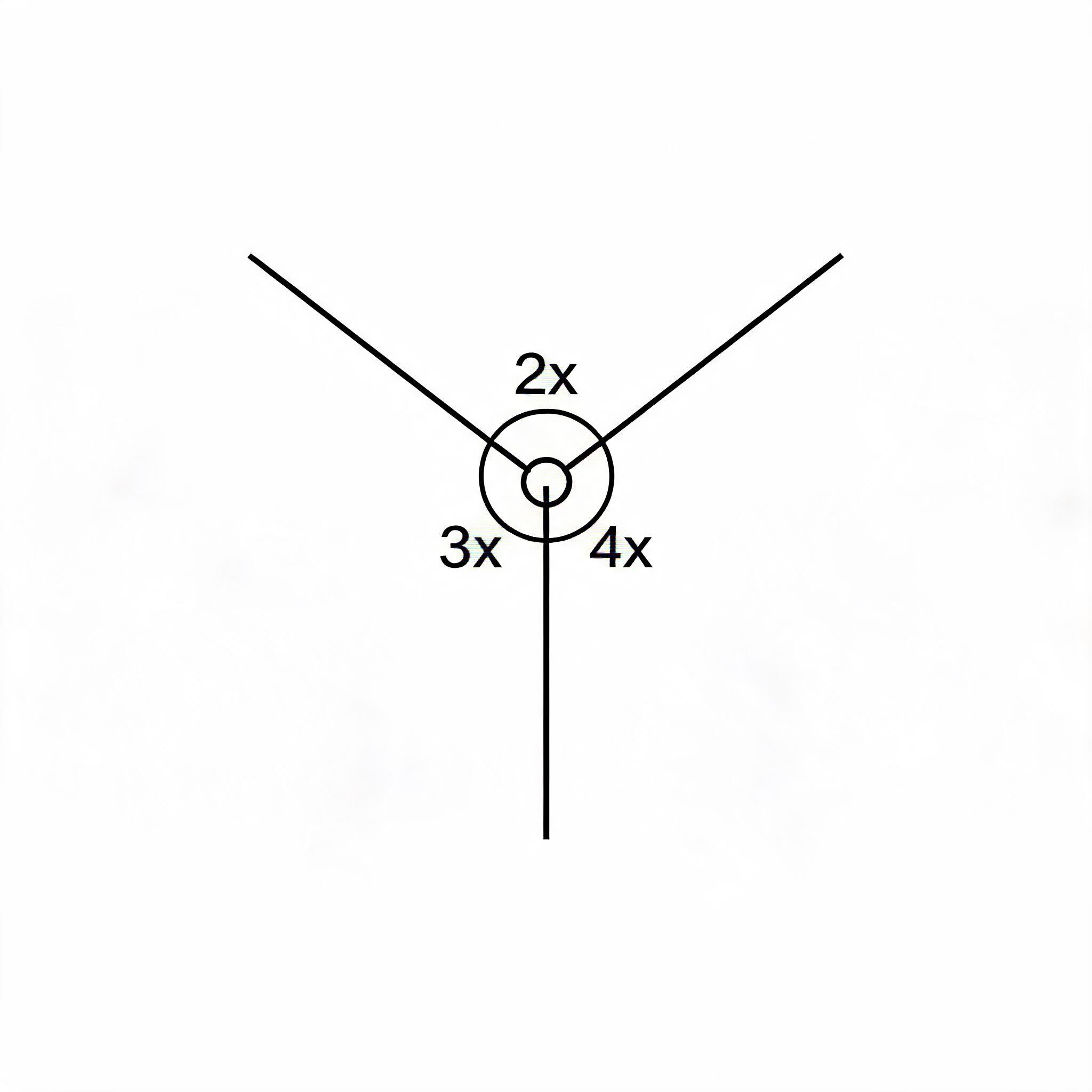
In the figure, find x
- A.40°
- B.55°
- C.50°
- D.60°
The sum of angles around a point is 360°. From the figure, the angles 2x, 3x, and 4x are all around a single point. Therefore, their sum must be 360°, which gives the equation 2x + 3x + 4x = 360°. Solving this, we get 9x = 360°, and dividing by 9 gives x = 40°.
Common mistake: A common mistake is a simple calculation error when dividing 360 by 9, which could lead a student to incorrectly choose 50°.
Divide - 3x + 1 by 2x - 1
- A. -x + 1
- B. - x -1
- C. + x + 1
- D. + x -1
To solve this, we use the long division method for polynomials, assuming the question intended to have 4x³ (as 4x²³ would not yield the given options). First, divide the leading term of the dividend (4x³) by the leading term of the divisor (2x) to get 2x². Multiply 2x² by the divisor (2x - 1) and subtract the result from the dividend. This process is repeated with the remainder until you get a final remainder of 0, giving the quotient 2x² + x - 1.
Common mistake: Students often make sign errors during the subtraction step of long division, for example, when subtracting a negative term, they might forget it becomes an addition, leading to an incorrect term in the quotient.
A car dealer bought a second-hand car for 250,000 and spent N 70,000 refurbishing it. He then sold the car for N400,000. What is the percentage gain?
- A.60%
- B.32%
- C.25%
- D.20%
First, find the total cost price by adding the buying price and the refurbishing cost, which is N250,000 + N70,000 = N320,000. The gain is the selling price minus the total cost price, so N400,000 - N320,000 = N80,000. To find the percentage gain, divide the gain by the total cost price and multiply by 100, which is x 100%, giving you 25%.
Common mistake: A common mistake is to correctly find the profit (N80,000) but then divide by the original buying price (N250,000) instead of the total cost price (N320,000), which incorrectly gives 32%.
Find the number of ways that the letters of the word EXCELLENCE be arranged
- A.(10!2!2!)/2!
- B.(10!4!)/2!
- C.10!/4!2!2!
- D.10!/2!2!
To find the number of ways to arrange the letters, we use the formula for permutations with repeated items. First, count the total number of letters in 'EXCELLENCE', which is 10. Next, count how many times each letter is repeated: 'E' appears 4 times, 'L' appears 2 times, and 'C' appears 2 times. The formula is the total factorial divided by the factorial of each repeat count, which gives us 10! / (4! * 2! * 2!).
Common mistake: A common mistake is to only divide by the factorials of some repeated letters, like in option D, forgetting to also account for the 4 repeated 'E's.
Evaluate and leave the answer in standard form
- A.3.3 x
- B.3.3 x
- C.3.3 x
- D.3.3 x
First, express both numbers in standard form: 0.00000231 becomes 2.31 x 10⁻⁶ and 0.007 becomes 7 x 10⁻³. Next, divide the numbers and then divide the powers of ten using the laws of indices (10⁻⁶ ÷ 10⁻³ = 10⁻⁶⁻⁽⁻³⁾ = 10⁻³). This gives an intermediate answer of 0.33 x 10⁻³. To put this in proper standard form, we must make the number part (0.33) be between 1 and 10, so we change it to 3.3, which means we must also adjust the power, resulting in the final answer 3.3 x 10⁻⁴.
Common mistake: Students often correctly calculate the division to get 0.33 x 10⁻³ but then mistakenly choose option B because it contains 10⁻³, forgetting to adjust the result into proper standard form.
See all 48 JAMB Mathematics 2017 questions
Sign up free to unlock every question in this paper — with the verified answer and Beta's worked explanation on each one. No card needed to begin.
Start free