JAMB Mathematics 2019 Past Questions & Answers
49 JAMB Mathematics 2019 questions with verified answers and worked explanations. Here are the first 25 — sign up free to practise the full paper.
m n a 2 −<!-- − --> p q b 2 = 1
Make q the subject of the formula in the equation = 1
- A.
- B.
- C.
To make q the subject, first isolate the term containing it by rearranging the equation to get mn/a² - 1 = pq/b². Next, combine the terms on the left side by finding a common denominator, which gives (mn - a²)/a² = pq/b². To finally get q alone, multiply both sides by b² and divide by p, which results in q = b²(mn - a²)/(a²p).
Common mistake: A common mistake is an error in algebraic rearrangement, such as getting the sign wrong when combining the terms on the left side, which can lead to an answer that is the negative of the correct one.
The angle of elevation of the top of a tree from a point on the ground 60m away from the foot of the tree is 78°. Find the height of the tree correct to the nearest whole number.
- A.148 m
- B.382 m
- C.282 m
- D.248 m
This problem forms a right-angled triangle where the height of the tree is the 'opposite' side and the distance on the ground (60m) is the 'adjacent' side. Using the SOH CAH TOA trigonometric ratios, we use the tangent (tan) which relates the opposite and adjacent sides: tan(angle) = Opposite / Adjacent. So, tan(78°) = height / 60. To find the height, we calculate height = 60 × tan(78°), which is approximately 282.276m. Rounding to the nearest whole number gives 282m.
Common mistake: A common mistake is using the wrong trigonometric ratio, such as sine or cosine, instead of the tangent which correctly relates the opposite and adjacent sides given in the question.
A binary operation ⊗ is defined by m ⊗ n = mn + m − n on the set of real numbers, for all m, n ∈ R. Find the value of 3 ⊗ (2⊗ 4).
- A.6
- B.25
- C.15
- D.18
To solve this, we must first evaluate the expression inside the bracket according to the order of operations (BODMAS). For (2 ⊗ 4), we let m = 2 and n = 4 in the given formula m ⊗ n = mn + m − n, which gives (2)(4) + 2 - 4 = 8 + 2 - 4 = 6. Now the problem becomes 3 ⊗ 6, so we let m = 3 and n = 6, which gives (3)(6) + 3 - 6 = 18 + 3 - 6 = 15.
Common mistake: A common mistake is to ignore the brackets and calculate from left to right, finding (3 ⊗ 2) first, which is incorrect because the order of operations (BODMAS) must be followed.
The table above shows the number of pupils in a class with respect to their ages. If a pie chart is constructed to represent the age, the angle corresponding to 8 years old is

- A.48.6°
- B.56.3°
- C.46.8°
- D.13°
To find the angle for the 8-year-old pupils in a pie chart, first calculate the total number of pupils in the class. From the table, the total is 4 + 13 + 30 + 44 + 9 = 100 pupils. The number of pupils who are 8 years old is 13. The angle is then calculated by the formula (Number of 8-year-olds / Total pupils) × 360°, which gives × 360°. This simplifies to 0.13 × 360°, resulting in 46.8°.
Common mistake: A common mistake is to choose the frequency of the category (13) as the answer, forgetting to calculate its proportion of the total angle (360°).
In a class of 50 students, 40 students offered Physics and 30 offered Biology. How many offered both Physics and Biology?
- A.42
- B.20
- C.70
- D.54
This is a problem about the union and intersection of sets. Let the number of students who offered Physics be n(P) = 40 and Biology be n(B) = 30, with the total class size being 50. Using the formula n(P U B) = n(P) + n(B) - n(P ∩ B), where n(P ∩ B) is the number who offered both, we get 50 = 40 + 30 - n(P ∩ B). This simplifies to 50 = 70 - n(P ∩ B), so the number who offered both is 70 - 50 = 20.
Common mistake: The most common mistake is to simply add the number of students in both subjects , forgetting that this approach double-counts the students who are in both groups.
2 + 3 2 −<!-- − --> 3
Rationalize
- A.
- B.−5 +
- C.5 −
- D.5 +
To rationalize the expression, multiply both the numerator and the denominator by the conjugate of the denominator, which is . The numerator becomes , which expands to 2 + + 3 = 5 + . The denominator becomes , which is a difference of two squares, resulting in - = 2 - 3 = -1. Dividing the new numerator by the new denominator gives / -1, which simplifies to -5 - .
Common mistake: Students often correctly calculate the numerator as 5 + but make a sign error in the denominator, calculating 3 - 2 = 1 instead of 2 - 3 = -1, which leads them to incorrectly choose option D.
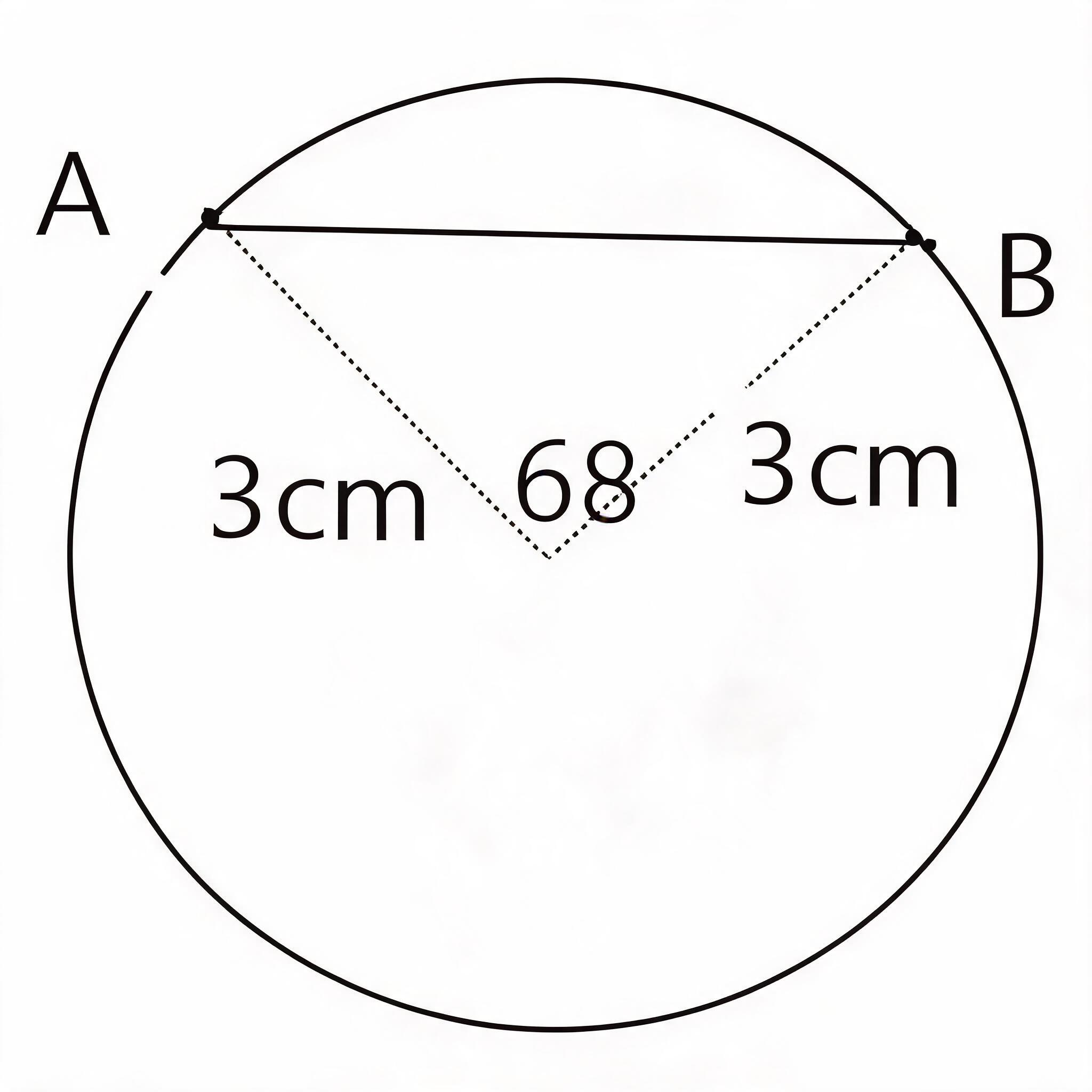
Find the length of the chord |AB| in the diagram shown above.
- A.4.2 cm
- B.4.3 cm
- C.3.2 cm
- D.3.4 cm
The diagram shows an isosceles triangle formed by two radii (3cm each) and the chord AB, with the angle between the radii being 68°. To find the length of the chord |AB|, we use the Cosine Rule: |AB|² = 3² + 3² - 2(3)(3)cos(68°). This calculates to |AB|² = 18 - 18(0.3746) ≈ 11.257. Taking the square root gives |AB| ≈ 3.355 cm, which is approximately 3.4 cm.
Common mistake: A common mistake is to incorrectly apply Pythagoras' theorem, which is only valid for right-angled triangles, instead of using the Cosine Rule for this non-right-angled triangle.
Given sin58° = cos p°, find p.
- A.48°
- B.58°
- C.32°
- D.52°
This question tests your knowledge of complementary angles in trigonometry. The rule for complementary angles states that the sine of an angle is equal to the cosine of its complement (90° minus the angle), so sin(θ) = cos(90° - θ). Therefore, sin(58°) is equal to cos(90° - 58°). Since the question gives sin(58°) = cos(p°), it means that p must be equal to 90° - 58°, which is 32°.
Common mistake: A common mistake is to choose option B, wrongly assuming that if sin(58°) = cos(p°), then p must be equal to 58° without applying the complementary angle rule.
2 3 ÷<!-- ÷ --> 4 5 1 4 + 3 5 −<!-- − --> 1 3
- A.
- B.
- C.
- D.
First, solve the numerator by changing the division to multiplication and inverting the second fraction, which gives × = , simplified to . Next, solve the denominator by finding the LCM of 4, 5, and 3, which is 60, to get = . Finally, divide the result of the numerator by the result of the denominator: ÷ = × = .
Common mistake: A common mistake is to incorrectly divide the final two fractions, perhaps by calculating (denominator) ÷ (numerator) which results in (Option A).
SOLUTION: x 2 −<!-- − --> x −<!-- − --> 1 ) 6 x 3 + 2 x 2 −<!-- − --> 5 x + 1 6 x 3 −<!-- − --> 6 x 2 −<!-- − --> 6 x _<!-- _ --> 8 x 2 + x + 1 8 x 2 −<!-- − --> 8 x −<!-- − --> 8 _<!-- _ --> ¯<!-- ¯ --> 6 x + 8 9 x + 9 The remainder is 9 x + 9
if divides , find the remainder.
- A.9x + 9
- B.2x + 6
- C.6x + 8
- D.5x - 3
To find the remainder, you must perform polynomial long division. First, divide the leading term of the dividend (6x³) by the leading term of the divisor (x²) to get 6x. Multiply the divisor (x²−x−1) by 6x and subtract the result from the dividend to get a new polynomial, 8x²+x+1. Repeat the process by dividing 8x² by x² to get 8, then multiply the divisor by 8 and subtract again, which gives (8x²+x+1) - (8x²-8x-8), resulting in the remainder 9x+9.
Common mistake: A common mistake is to choose the quotient (6x + 8) instead of the remainder, or to make sign errors during the subtraction steps of the long division.
If a fair coin is tossed 3 times, what is the probability of getting at least two heads?
- A.
- B.
- C.
- D.
When a fair coin is tossed 3 times, the total number of possible outcomes is , which equals 8. The favourable outcomes of getting 'at least two heads' are getting either two heads (HHT, HTH, THH) or three heads (HHH). This gives a total of 4 favourable outcomes. The probability is calculated as the number of favourable outcomes divided by the total number of outcomes, which is , simplifying to .
Common mistake: A common mistake is to miscalculate the total number of outcomes as 6 instead of 8 (2x2x2), which would lead to the incorrect answer of or .
In how many ways can the word MATHEMATICIAN be arranged?
- A.6794800 ways
- B.2664910 ways
- C.6227020800 ways
- D.129729600 ways
To find the number of ways to arrange the word MATHEMATICIAN, we use the formula for permutations with repetitions. First, count the total number of letters, which is 13, and then count the repeated letters: M (2 times), A (3 times), T (2 times), and I (2 times). The formula is the total factorial divided by the product of the factorials of the repetitions: 13! / (2! × 3! × 2! × 2!). This calculation gives 6,227,020,800 / 48, which equals 129,729,600.
Common mistake: A common mistake is to calculate only 13! (which is option C) and forget to divide by the factorials of the repeated letters.
Find the mean of the data.

- A.3.26
- B.4.91
- C.6.57
- D.3.0
To find the mean from a frequency table, first calculate the total frequency (Σf) by summing the 'Freq (f)' row: 5 + 7 + 3 + 7 + 11 + 6 + 7 = 46. Next, find the sum of the products of each score and its frequency (Σfx): + + + + + + = 0 + 7 + 6 + 21 + 44 + 30 + 42 = 150. The mean is then Σfx divided by Σf, which is 150 ÷ 46 ≈ 3.26.
Common mistake: A common mistake is to find the average of the scores (0 to 6) while ignoring the frequencies, which incorrectly gives = 3, leading to option D.
Find the variance

- A.3.42
- B.4.69
- C.4.85
- D.3.72
To find the variance from the frequency table, we use the formula (Σfx² / Σf) - (Σfx / Σf)². First, calculate the total frequency Σf = = 46. Next, find Σfx = = 150. Then, calculate Σfx² = (0²*5)+(1²*7)+(2²*3)+(3²*7)+(4²*11)+(5²*6)+(6²*7) = 660. Plugging these values into the formula gives - , which is 14.348 - (3.261)² ≈ 14.348 - 10.634 = 3.714, which is approximately 3.72.
Common mistake: A common mistake is to calculate the standard deviation instead of the variance, or to make a calculation error when finding the sums Σfx and Σfx².
The locus of a point which moves so that it is equidistant from two intersecting straight lines is the
- A.bisector of the two lines
- B.line parallel to the two lines
- C.angle bisector of the two lines
- D.perpendicular bisector of the two lines
A locus is the path traced by a point that moves according to a given set of rules. In this question, the rule is that the point must always be the same distance (equidistant) from two lines that intersect. This path forms a new line that perfectly splits the angle between the two original lines into two equal parts, which is the definition of an angle bisector.
Common mistake: Students often confuse the locus of a point equidistant from two lines with the locus of a point equidistant from two points, which is a perpendicular bisector (option D).
From the cyclic quadrilateral MNOP above, find the value of x.
- A.16°
- B.25°
- C.42°
- D.39°
A key property of a cyclic quadrilateral is that its opposite angles sum up to 180 degrees. In the given figure, the angles (2x)° and (x + 63)° are opposite each other. Therefore, we can form the equation 2x + (x + 63) = 180. Simplifying this gives 3x + 63 = 180, which leads to 3x = 117. Dividing both sides by 3 gives the final answer, x = 39°.
Common mistake: A common mistake is to wrongly assume that opposite angles in a cyclic quadrilateral are equal, like in a parallelogram, which would lead to an incorrect calculation.
If , find the value of x, when 0° ≤ x ≤ 90°
- A.90°
- B.45°
- C.60°
- D.30°
To solve the equation, first rearrange it to find the value of sin(x). Start with 4sin²x - 3 = 0, which becomes 4sin²x = 3, and then sin²x = . Take the square root of both sides to get sin(x) = / 2. The angle between 0° and 90° whose sine is / 2 is 60°, which is a standard trigonometric value.
Common mistake: A common mistake is to mix up the special angles and choose 30°, forgetting that sin(60°) is while sin(30°) is .
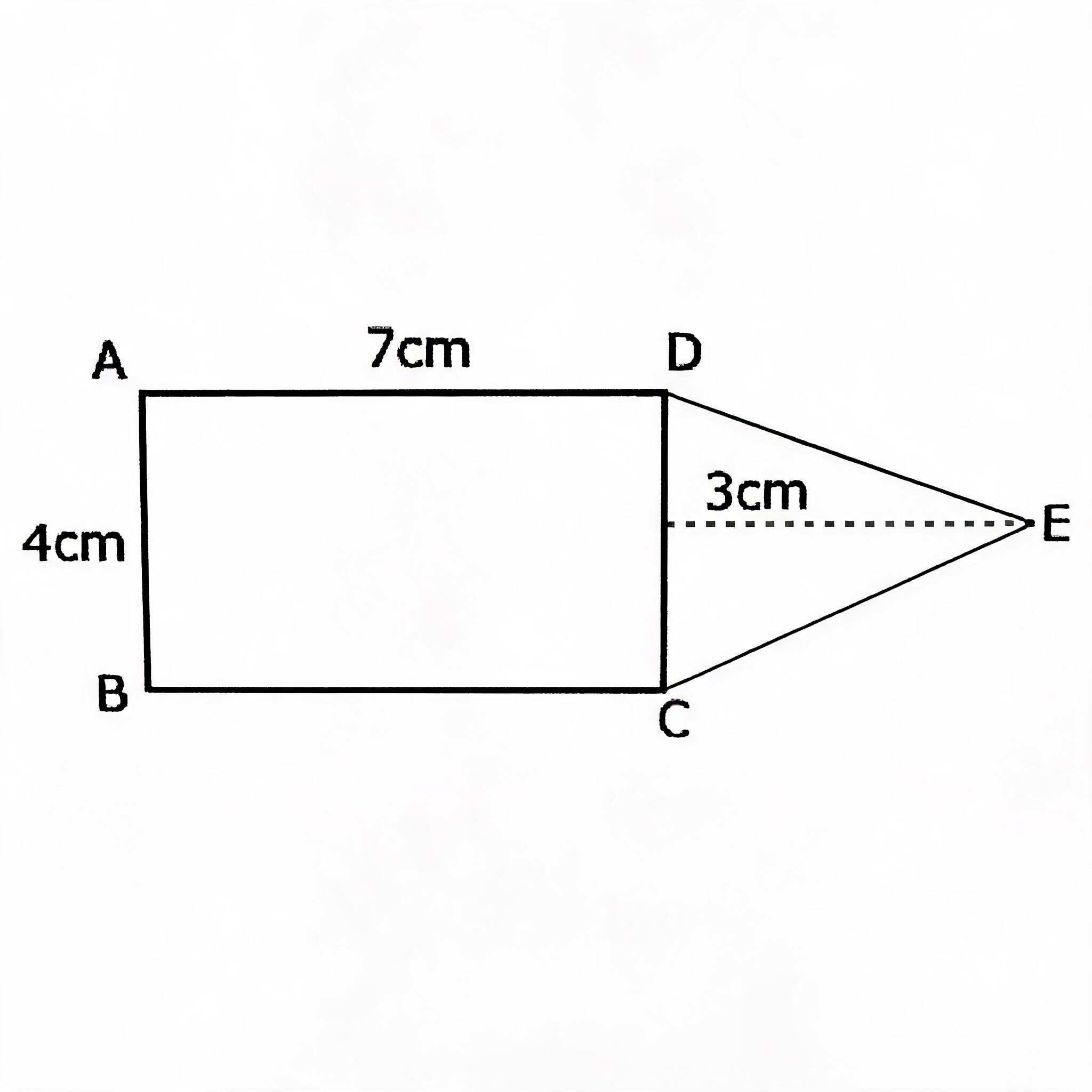
In the figure above, |CD| is the base of the triangle CDE. Find the area of the figure to the nearest whole number.
- A.56
- B.24
- C.42
- D.34
The figure is a composite shape made of a rectangle (ABCD) and a triangle (CDE). First, find the area of the rectangle using length × width, which is 7 cm × 4 cm = 28 cm². Next, find the area of the triangle using ½ × base × height. The base |CD| is opposite to side |AB|, so its length is 4 cm, and the height is given as 3 cm, making the area ½ × 4 cm × 3 cm = 6 cm². Finally, add the two areas together to get the total area of the figure: 28 cm² + 6 cm² = 34 cm².
Common mistake: A common mistake is to incorrectly use the rectangle's dimensions for the triangle's area, for example, by calculating it as ½ × 7 cm × 4 cm = 14 cm², and then adding this to the rectangle's area (28 cm²) to get the wrong answer of 42 cm².
The marks scored by 30 students in a Mathematics test are recorded in the table below: What is the total number of marks scored by the children?

- A.82
- B.15
- C.63
- D.75
To find the total number of marks, you must multiply each score by the number of students who achieved it and then sum these values. Based on the table, the calculation is + + + + + . This gives us 0 + 3 + 14 + 24 + 24 + 10, which adds up to a total of 75 marks.
Common mistake: A common mistake is to simply add the different scores shown in the table , which ignores how many students got each score.
If given two points A(3, 12) and B(5, 22) on a x-y plane. Find the equation of the straight line with intercept at 2.
- A.y = 5x + 2
- B.y = 5x + 3
- C.y = 12x + 2
- D.y = 22x + 3
First, find the gradient (slope) of the line using the two points A(3, 12) and B(5, 22). The formula for the gradient 'm' is (y2 - y1) / (x2 - x1), which gives / = 10 / 2 = 5. The equation of a straight line is y = mx + c, where 'm' is the gradient and 'c' is the y-intercept. Since the gradient is 5 and the question gives the intercept as 2, the equation becomes y = 5x + 2.
Common mistake: Students might mistakenly use the y-coordinate of the first point (12) as the gradient instead of calculating it, leading them to incorrectly choose option C.
If P(2, m) is the midpoint of the line joining Q(m, n) and R(n, -4), find the values of m and n.
- A.m = 0, n = 4
- B.m = 4, n = 0
- C.m = 2, n = 2
- D.m = -2, n = 4
The midpoint formula states that the coordinates of the midpoint are the average of the endpoint coordinates. For the x-coordinates, we get 2 = (m + n)/2, which simplifies to m + n = 4. For the y-coordinates, we get m = (n - 4)/2, which simplifies to n = 2m + 4. Substituting the second equation into the first gives m + (2m + 4) = 4, which leads to 3m = 0, so m = 0. Putting m = 0 back into n = 2m + 4 gives n = 4.
Common mistake: Students often mix up the final values for m and n, leading them to incorrectly choose option B where the values are swapped.
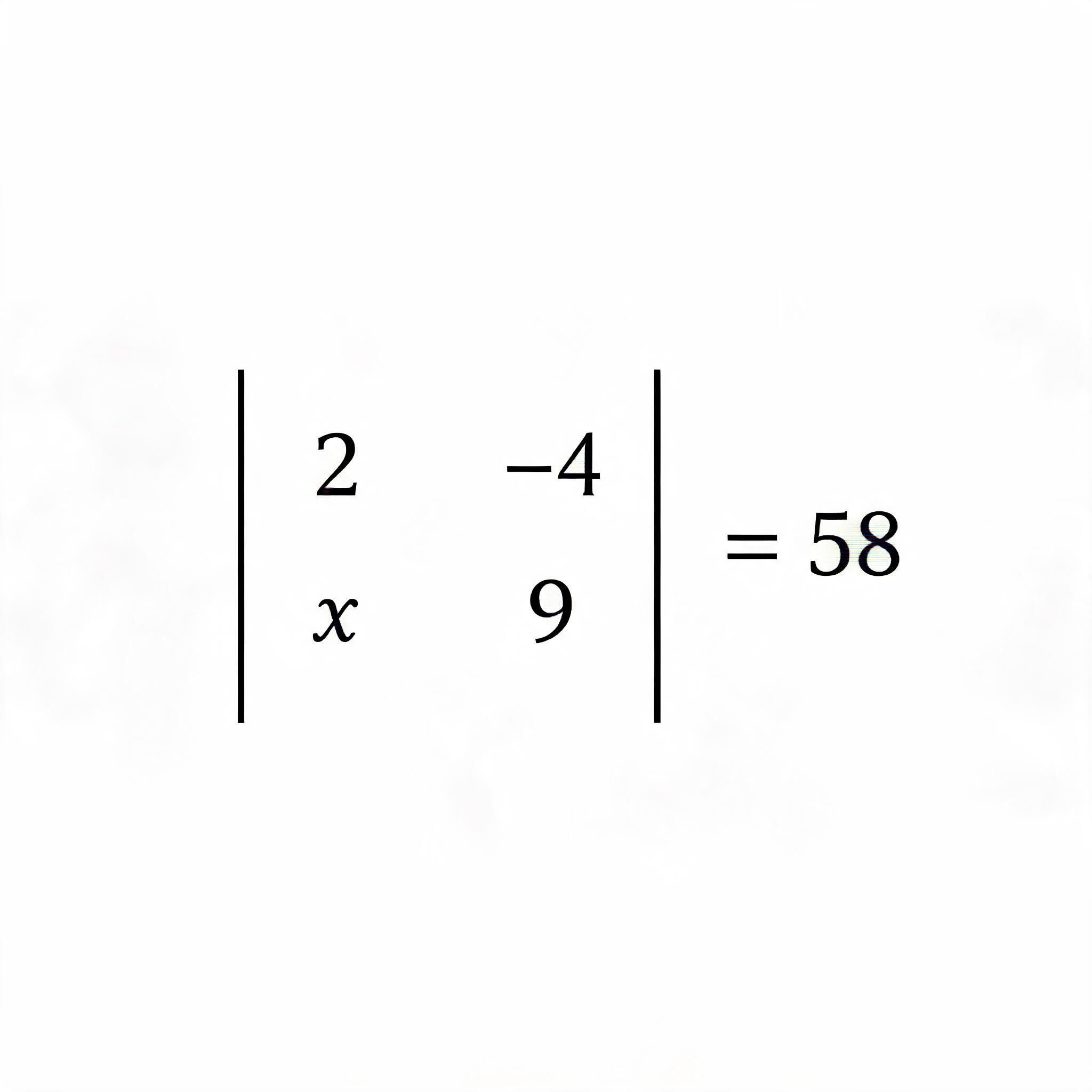
| 2 −<!-- − --> 4 x 9 | = 58
If ∣∣∣2x−49∣∣∣=58 , find the value of x.
- A.10
- B.30
- C.14
- D.28
The question requires you to find the value of x by solving the determinant of a 2x2 matrix. The determinant is calculated by multiplying the elements of the main diagonal and subtracting the product of the elements of the other diagonal. This gives the equation - (-4 × x) = 58. Simplifying this, we get 18 + 4x = 58. To find x, subtract 18 from both sides to get 4x = 40, then divide by 4 to get x = 10.
Common mistake: A common mistake is mishandling the signs, for example, calculating - (4 × x) instead of - (-4 × x), which leads to an incorrect answer.
y = 6 x 3 + 2 x −<!-- − --> 2 −<!-- − --> x −<!-- − --> 3
If - , find dy/dx .
- A. -
- B.dy/dx = 6x + -
- C. +
- D. +
To find dy/dx, we differentiate the function y = 6x³ + 2x⁻² - x⁻³ term by term using the power rule. For a term axⁿ, its derivative is n*axⁿ⁻¹. Applying this, the derivative of 6x³ is = 18x². The derivative of 2x⁻² is = -4x⁻³. Finally, the derivative of -x⁻³ is (-3 * -1)x⁻³⁻¹ = +3x⁻⁴. Combining these results gives dy/dx = 18x² - 4x⁻³ + 3x⁻⁴.
Common mistake: Students often make sign errors when differentiating terms with negative powers, for example, incorrectly calculating the derivative of -x⁻³ as -3x⁻⁴ instead of the correct +3x⁻⁴.
d d x [ log <!-- --> ( 4 x 3 −<!-- − --> 2 x ) ]
d/dx is equal to
- A.
- B.
- C.
- D.
To solve this, we use the chain rule for differentiation. The rule for differentiating log(u) is (1/u) multiplied by the derivative of u (du/dx). In this question, u = 4x³ - 2x, and its derivative (du/dx) is 12x² - 2. Therefore, the final answer is (1/(4x³ - 2x)) * (12x² - 2), which simplifies to (12x² - 2) / (4x³ - 2x).
Common mistake: A common mistake is to incorrectly apply the power rule when differentiating the inner function, for example getting 12x instead of 12x², which leads to an incorrect numerator.
f ( x ) = 3 x 3 + 4 x 2 + x −<!-- − --> 8
if - 8, what is the value of f(-2)?
- A.-24
- B.30
- C.-18
- D.-50
To find the value of f(-2), you need to substitute -2 for every 'x' in the given function f(x) = 3x³ + 4x² + x - 8. This gives you f(-2) = 3(-2)³ + 4(-2)² + (-2) - 8. Remember that (-2)³ is -8 and (-2)² is 4. So, the expression becomes 3(-8) + 4(4) - 2 - 8, which simplifies to -24 + 16 - 10. Calculating this gives the final answer of -18.
Common mistake: Students often make a mistake with the signs, for example, by calculating (-2)³ as 8 instead of -8, which leads to the incorrect answer of 30 (Option B).
See all 49 JAMB Mathematics 2019 questions
Sign up free to unlock every question in this paper — with the verified answer and Beta's worked explanation on each one. No card needed to begin.
Start free