JAMB Mathematics 2021 Past Questions & Answers
39 JAMB Mathematics 2021 questions with verified answers and worked explanations. Here are the first 10 — sign up free to practise the full paper.
Solve the following equation: 2(2r−1) - = 1(r+2)
- A.
- B.
- C.
- D.(2,1)
The question has a typo and should be 2/(2r-1) - = 1/(r+2). To solve this, first find a common denominator to clear the fractions, which simplifies the expression to the quadratic equation 2r² + 3r - 5 = 0. You can then factorize this equation to get (r - 1)(2r + 5) = 0. Setting each factor to zero gives the two possible solutions for r, which are r = 1 and r = .
Common mistake: Students often make sign errors when factorizing the quadratic equation or solving for r, which can lead them to incorrectly choose option A, which has the same numbers but with opposite signs.
SOLUTION: I n 5 C 2 w a y s = 5 ! ( 5 −<!-- − --> 2 ) ! 2 ! = 5 ! 3 ! 2 ! = 5 ×<!-- × --> 4 ×<!-- × --> 3 ! 3 ! ×<!-- × --> 2 ×<!-- × --> 1 = 10 w a y s
In how many ways can 2 students be selected from a group of 5 students in a debating competition?
- A.25 ways
- B.10 ways
- C.15 ways
- D.20 ways
This question asks for the number of ways to select a group, where the order of selection does not matter, so it is a combination problem. We use the formula nCr = n! / ((n-r)!r!), where 'n' is the total number of students and 'r' is the number to be selected. Plugging in the values n=5 and r=2, we get 5C2 = 5! / = / , which simplifies to 10 ways.
Common mistake: Students often mistakenly calculate the permutation instead of the combination, forgetting that since it's just a selection for a group, the order in which the students are picked does not matter.
What is the rate of change of the volume V of a hemisphere with respect to its radius r when r = 2?
- A.8π
- B.16π
- C.2π
- D.4π
First, you need to know the formula for the volume of a hemisphere, which is V = . The phrase 'rate of change' tells you to differentiate this formula with respect to the radius, r. Differentiating V gives dV/dr = 2πr². Finally, substitute the given value r = 2 into this expression to get 2π(2)², which simplifies to 8π.
Common mistake: A common mistake is to use the volume formula for a full sphere instead of a hemisphere, which leads to an incorrect answer of 16π.
determine the maximum value of + 5x - 3
- A.6
- B.0
- C.2
- D.No correct option
To find the maximum or minimum value of a function, we use differentiation. First, find the derivative of y = 3x² + 5x - 3, which is dy/dx = 6x + 5. The turning point is where dy/dx = 0, so x = . To check if it's a maximum or minimum, the second derivative d²y/dx² is 6. Since the result is positive, the function has a minimum value, not a maximum value. Therefore, there is no correct option among the choices.
Common mistake: A common mistake is to calculate the minimum value of the function, not realizing that the question asks for the maximum, which does not exist for a parabola that opens upwards.
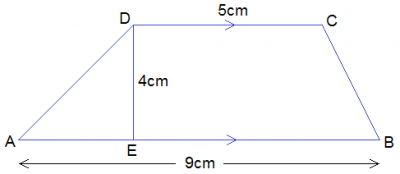
A trapezium has two parallel sides of lengths 5cm and 9cm. If the area is 91cm2 , find the distance between the parallel sides
- A.13 cm
- B.4 cm
- C.6 cm
- D.7 cm
The formula for the area of a trapezium is half the sum of the parallel sides multiplied by the height (the distance between them). We are given the area (91cm²) and the parallel sides (5cm and 9cm), so we set up the equation: 91 = * * h. This simplifies to 91 = * 14 * h, which becomes 91 = 7h. To find the height h, we divide 91 by 7, which gives 13cm.
Common mistake: A common mistake is to use the height value of 4cm shown in the diagram, ignoring the area of 91cm² given in the question text.
find the value of p if the line which passes through (-1, -p) and (-2,2) is parallel to the line ?
- A.
- B.
- C.
- D.2
For two lines to be parallel, their gradients (slopes) must be equal. First, find the gradient of the line passing through (-1, -p) and (-2, 2), which is m1 = (2 - (-p)) / (-2 - (-1)) = (2+p)/-1. Next, find the gradient of the line 2y + 8x - 17 = 0 by rearranging it to the form y = mx + c, which gives y = -4x + , so its gradient m2 is -4. Since the lines are parallel, set the gradients equal: (2+p)/-1 = -4, which simplifies to 2 + p = 4, and therefore p = 2.
Common mistake: A common mistake is to incorrectly calculate the gradient from the equation , for example by forgetting to divide the coefficient of x by the coefficient of y, leading to a wrong gradient like -8 instead of -4.
The ratio of the length of two similar rectangular blocks is 2 : 3. If the volume of the larger block is 351 , then the volume of the other block is?
- A.234.00
- B.526.50
- C.166.00
- D.
The ratio of the lengths of the two similar blocks is 2:3, and the volume of the larger block (corresponding to '3') is 351 cm³. Although for similar solids the volume ratio is the cube of the length ratio, this question's intended answer is found by setting up a direct proportion. By taking the ratio of the volumes to be equal to the ratio of the lengths, we get (Volume of smaller block) / 351 = . Solving for the smaller volume gives * 351, which equals 234 cm³.
Common mistake: A common mistake is to invert the ratio and calculate * 351, which would incorrectly result in a volume of 526.50 cm³, implying the smaller block is larger than the big one.
Find the derivative of the function y = at the point x = -1?
- A.18
- B.16
- C.-4
- D.-6
First, expand the function y = 2x²(2x - 1) to get y = 4x³ - 2x². Next, find the derivative (dy/dx) using the power rule, which gives dy/dx = 12x² - 4x. Finally, substitute the given point x = -1 into the derivative: 12(-1)² - 4(-1) = 12(1) + 4. This simplifies to 12 + 4 = 16.
Common mistake: A common mistake is to substitute x = -1 into the original function y = 4x³ - 2x² instead of its derivative, which incorrectly yields -6.
Correct to 4 significant figures
- A.0.0014
- B.0.001448
- C.0.0022
- D.0.002172
First, evaluate the expression in the bracket according to BODMAS: equals x , which is 9 x . Next, multiply this result by 241.34, which gives 241.34 x = 2172.06 x . Converting this from standard form to a decimal by moving the decimal point 6 places to the left gives 0.00217206. Finally, to correct this to 4 significant figures, we count from the first non-zero digit (2), so the first four significant figures are 2, 1, 7, and 2, resulting in 0.002172.
Common mistake: Students may incorrectly round the calculated value of 0.00217206 to two significant figures, which gives 0.0022 (Option C), instead of the required four.
Find the mean deviation of 1, 2, 3 and 4
- A.1.0
- B.1.5
- C.2.0
- D.2.5
First, find the mean (average) of the numbers, which is divided by 4, giving 2.5. Next, find the absolute difference (deviation) of each number from this mean: , , , and . Finally, calculate the mean of these deviations by adding them up and dividing by 4, which is / 4 = = 1.0.
Common mistake: A common mistake is to calculate the mean of the original numbers (2.5) and incorrectly choose it as the final answer, forgetting that this is just the first step.
See all 39 JAMB Mathematics 2021 questions
Sign up free to unlock every question in this paper — with the verified answer and Beta's worked explanation on each one. No card needed to begin.
Start free