JAMB Mathematics 2024 Past Questions & Answers
50 JAMB Mathematics 2024 questions with verified answers and worked explanations. Here are the first 25 — sign up free to practise the full paper.
Evaluate the determinant of the matrix M =
- A.20
- B.25
- C.30
- D.35
To evaluate the determinant of the 3x3 matrix M, we use the cofactor expansion method along the first row. This involves calculating 3 multiplied by the determinant of its minor, minus 4 multiplied by its minor's determinant, plus 6 multiplied by its minor's determinant. This gives 3(8) - 4(9) + 6(7), which simplifies to 24 - 36 + 42. Performing the final arithmetic, 24 - 36 + 42 = 30.
Common mistake: A common mistake is making sign errors during the cofactor expansion or arithmetic errors when calculating the 2x2 determinants, especially with negative numbers, which can lead to incorrect options like 25 or 35.
Find the amount if simple interest is paid yearly at 5% per annum for 3 years, on a principal of # 200,000.00
- A.# 23, 000.00
- B.# 30,000.00
- C.# 300,000.00
- D.# 230,000.00
To find the amount, first calculate the simple interest (SI) using the formula SI = (Principal × Rate × Time) / 100. Given Principal = #200,000, Rate = 5%, and Time = 3 years, the simple interest is / 100 = #30,000. The total amount is the Principal plus the Simple Interest, which is #200,000 + #30,000 = #230,000.
Common mistake: Many students calculate only the simple interest (#30,000) and mistakenly choose option B, forgetting to add it to the principal to find the final amount.
y is inversely proportional to x and y = 4, when x = , find x when y = 10
- A.2
- B.10
- C.
- D.
Since y is inversely proportional to x, we write the relationship as y = k/x, where k is the constant of proportionality. First, we find k using the given values: 4 = k / . To find k, we multiply 4 by , which gives k = 2. Now the specific equation is y = 2/x. To find x when y = 10, we substitute 10 for y, giving 10 = 2/x. By cross-multiplying, we get 10x = 2, and solving for x gives x = , which simplifies to .
Common mistake: Students often forget to calculate the constant of proportionality (k) and mistakenly assume the relationship is simply y = 1/x, leading them to choose when y is 10.
Find the angle subtended by an arc 33cm long of a circle of diameter 28cm.
- A.105
- B.115
- C.120
- D.135
First, find the radius of the circle by dividing the diameter by 2, which gives 14cm. Use the arc length formula L = rθ, where L is the arc length, r is the radius, and θ is the angle in radians. Substitute the values: 33 = 14 * θ, so θ = radians. To convert radians to degrees, multiply by (180/π). Using π ≈ , the angle in degrees is * = 135 degrees.
Common mistake: A common mistake is forgetting to convert the angle from radians to degrees, or making calculation errors when simplifying fractions involving pi.
Solve 16 = 0.25
- A.-
- B.
- C.-
- D.
To solve = 0.25, first convert 0.25 to a fraction, which is . Next, express both sides of the equation with a common base, preferably 4. So, 16 becomes and becomes . The equation then transforms to = , which simplifies to = . Since the bases are equal, the exponents must be equal, so 2x = -1, leading to x = .
Common mistake: Students often make errors with negative exponents or incorrectly convert to a power of 4, leading to incorrect signs or values for x, such as instead of .
The ratio of men to women in a 20-member committee is 3:1. How many women must be added to the committee to make the ratio of men to women 3:2?
- A.2
- B.5
- C.7
- D.8
First, calculate the initial number of men and women: total members = 20, ratio 3:1. Men = * 20 = 15, Women = * 20 = 5. Next, let 'x' be the number of women added. The number of men remains 15, and the new number of women is 5 + x. The new ratio is 15 / (5 + x) = 3 / 2. Cross-multiplying gives 30 = 3(5 + x), which simplifies to 30 = 15 + 3x. Solving for x, we get 15 = 3x, so x = 5. Therefore, 5 women must be added.
Common mistake: Students often miscalculate the initial number of men and women or incorrectly set up the proportion for the new ratio, leading to an incorrect number of women to be added.
If p * q = 2p + pq + q, find p when ( p * 2) - (p * 1) = 40
- A.39
- B.40
- C.41
- D.42
This question tests your understanding of binary operations. First, you need to apply the given rule to each part of the equation. For (p * 2), substitute q=2 into the formula to get 2p + p(2) + 2, which simplifies to 4p + 2. Next, for (p * 1), substitute q=1 to get 2p + p(1) + 1, which simplifies to 3p + 1. Finally, set up the equation (4p + 2) - (3p + 1) = 40, which simplifies to p + 1 = 40, giving p = 39.
Common mistake: A common mistake is to incorrectly simplify the equation after substitution, for example by ignoring the constants, which could lead to an answer of p = 40.
Which of the following is a measure of central tendency?
- A.Standard deviation
- B.Range
- C.Variance
- D.Mean
Measures of central tendency are statistical values that represent the center or typical value of a dataset. The three main measures are the mean, median, and mode. The 'Mean' is the average of all the numbers in a set, making it a key measure of central tendency. The other options (Standard deviation, Range, and Variance) are measures of dispersion, which describe how spread out the data is, not its center.
Common mistake: Students often confuse measures of central tendency with measures of dispersion like standard deviation and range, as they are all common statistical terms.
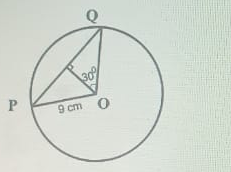
From the figure above, find the length of Chord PQ
- A.17cm
- B.18cm
- C.7cm
- D.9cm
To find the length of Chord PQ, we typically use the properties of a circle. A radius drawn to an endpoint of the chord and the perpendicular distance from the center to the chord form a right-angled triangle. By applying the Pythagorean theorem to this triangle, we can find half the length of the chord, and then double it to get the full length of PQ.
Common mistake: A common mistake is to forget to double the length of the half-chord found using Pythagoras theorem, leading to an incorrect shorter length.
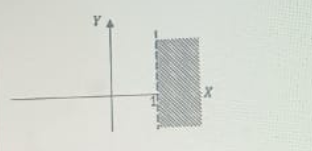
Identify the equation of the shaded region in the given graph
- A.y > 1
- B.x < 1
- C.X > 1
- D.y < 1
The question asks to identify the inequality representing a shaded region on a graph. Assuming the graph shows a vertical line at x=1 and the region to its right is shaded, all points in this region have an x-coordinate greater than 1. Therefore, the correct inequality is x > 1.
Common mistake: Students often confuse the x and y axes, or the direction of the inequality sign, leading them to incorrectly choose options like y > 1 or x < 1.
In how many ways can 6 people sit around a table
- A.120
- B.240
- C.60
- D.30
The question asks for the number of ways to arrange distinct items (people) in a circle. This is a problem of circular permutation. For 'n' distinct items arranged in a circle, the number of ways is given by the formula (n-1)!. In this case, n = 6 people, so the number of ways is ! = 5! = 5 × 4 × 3 × 2 × 1 = 120.
Common mistake: A common mistake is to confuse circular permutations with linear permutations and incorrectly calculate 6! (720), or to misremember the formula and divide 5! by 2, leading to 60 (Option C).
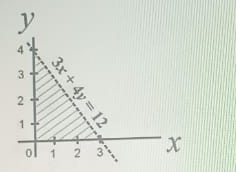
The graph above represents inequalities
- A.3x +4y ≥12, x >0, y > 0
- B.3x + 4y 12, x ≥ 0, y ≥ 0
- C.3x + 4y <12, x 0, y ≥ 0
- D.3x + 4y < 12, x ≥ 0, y ≥ 0
The boundary line on the graph is 3x + 4y = 12. Since the line is broken or dashed, it represents a strict inequality (), which eliminates options with ≤ or ≥. The shaded region is below the line, representing 'less than', so the correct inequality is 3x + 4y < 12. The solution is also in the first quadrant, which is defined by x ≥ 0 and y ≥ 0.
Common mistake: Students often choose option B, confusing the 'less than or equal to' (≤) sign, which requires a solid line, with the strict 'less than' (<) sign represented by the broken line.
Let A = and B = . Find A + 2B
- A.
- B.
- C.
- D.
To find A + 2B, first perform scalar multiplication on matrix B by multiplying each of its elements by 2. This gives 2B = . Next, add matrix A to 2B by adding their corresponding elements: . This results in , which matches option A.
Common mistake: Students often make arithmetic errors, especially with negative numbers, during the element-wise addition, such as incorrectly calculating 5 + (-6) as 7 instead of -1, which could lead to option C.
The sum to infinity of a GP is 100, find its first term if the common ratio is -
- A.150
- B.155
- C.160
- D.165
The formula for the sum to infinity of a Geometric Progression (GP) is S∞ = a / (1 - r), where 'a' is the first term and 'r' is the common ratio. We are given that the sum to infinity (S∞) is 100 and the common ratio (r) is . Substituting these values into the formula gives 100 = a / . This simplifies to 100 = a / , and solving for the first term 'a' gives a = 100 × , which equals 150.
Common mistake: A common mistake is incorrectly handling the double negative in the denominator, calculating 1 - instead of 1 - , which changes the result.
PQR is a triangle such that |PQ| = |QR| = 8cm and QPR = 60º. Find the area of PQR
- A.16
- B.16
- C.8
- D.16
The triangle PQR is isosceles with |PQ| = |QR| and angle QPR = 60°. This implies angle QRP is also 60°, making angle PQR = 180° - (60° + 60°) = 60°. Thus, PQR is an equilateral triangle with all sides equal to 8cm. The area of the triangle can be found using the formula Area = * ab * sin(C), which gives * 8 * 8 * sin(60°) = 32 * = cm².
Common mistake: A common mistake is incorrectly identifying the included angle for the area formula or miscalculating the value of sin(60°).
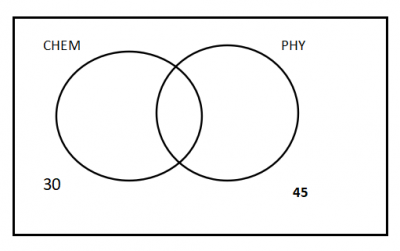
The Venn diagram above shows the number of students offering physics and chemistry in a class of 65. What is the probability that a student selected from the class offers physics and chemistry if every students offers at least one subject?
- A.
- B.
- C.
- D.
The question asks for the probability of selecting a student who offers both physics and chemistry. From the Venn diagram (implied by the problem context), we identify the number of students in the intersection of physics and chemistry. If there are 10 students offering both subjects in a class of 65, the probability is calculated as the number of favorable outcomes (10) divided by the total number of outcomes (65), which simplifies to .
Common mistake: A common mistake is to use the number of students offering only one subject instead of the number offering both subjects, leading to option B.
From the top of a building 10m high, the angle of elevation of a fruit on top of a tree 25m is 30º. Calculate the horizontal distance between the building and the tree.
- A.15m
- B.5m
- C.25m
- D.30m
This problem involves a right-angled triangle formed by the line of sight. The side opposite the 30° angle is the difference in height between the tree and the building, which is 25m - 10m = 15m. Using the tangent ratio (tan θ = opposite/adjacent), we get tan(30°) = 15 / horizontal distance. Since tan(30°) is , the distance is 15 / , which simplifies to .
Common mistake: A common mistake is using the full height of the tree (25m) as the opposite side instead of the height difference above the building (15m), which leads to the incorrect answer .
A boy bought Oranges at the rate of #24.00 for 5 and sold it at the rate of # 30.00 for 4 Oranges. Find the profit made of the ones sold
- A.# 24.00
- B.#30.00
- C.# 10.80
- D.#20.00
First, calculate the cost price of one orange: #24.00 divided by 5 oranges equals #4.80 per orange. The question states that 4 oranges are sold for #30.00. To find the profit on these 4 oranges, calculate their cost price: 4 oranges multiplied by #4.80/orange equals #19.20. Finally, subtract the cost price of these 4 oranges from their selling price: #30.00 - #19.20 = #10.80, which is the profit made.
Common mistake: A common mistake is to calculate the profit per orange and then not know what quantity to apply it to, or to incorrectly assume the profit is for 5 oranges instead of 4.
Differentiate y = (5x + 1)
- A.20 (5x + 1)
- B.4(5x + 1)
- C.5(5x + 1)
- D.(5x)
To differentiate y = , we use the chain rule. First, differentiate the outer function (power rule) to get . Then, multiply by the derivative of the inner function (5x + 1), which is 5. So, dy/dx = * 5 = .
Common mistake: Many students forget to multiply by the derivative of the inner function (5x + 1), leading to option B, .
Simplify
- A.17 -
- B.4 -
- C.7 -
- D.15 -
To simplify the expression, we rationalize the denominator by multiplying both the numerator and denominator by the conjugate of the denominator, which is . This gives / . Expanding the numerator yields = , and the denominator becomes = 2. Therefore, the simplified expression is / 2 = 4 - .
Common mistake: Students often make errors when expanding the brackets in the numerator or denominator, or forget to multiply both parts of the fraction by the conjugate.
Find the perimeter of a triangle whose vertices pass through ( 3, 2), (4, 5) and (6, 2) in surd form.
- A.3 +
- B.3 -
- C.3 +
- D.3 -
To find the perimeter of a triangle given its vertices, we must first calculate the length of each side using the distance formula: d = . After calculating the lengths of all three sides , we sum them up to get the perimeter. The sum 3 + + matches option C.
Common mistake: Students often make calculation errors when applying the distance formula, leading to incorrect surds for the side lengths, or they might make sign errors in the final summation.
Find the 7 term of the sequence -10, 50, -250 ...........
- A.165250
- B.156250
- C.-156250
- D.-165,250
The given sequence is a Geometric Progression (GP) because each term is obtained by multiplying the previous term by a constant ratio. The first term (a) is -10 and the common ratio (r) is 50 / -10 = -5. Using the formula for the nth term of a GP, = a * , the 7th term is = -10 * = -10 * = -10 * 15625 = -156250.
Common mistake: A common mistake is to incorrectly calculate as a negative number or to forget the initial negative sign of the first term, leading to options A or B.
The scores of students in a test are recorded as follows: 4, 3, 3, 2, 1, 2, 5, 7, 8, 3, and 5. Find the mode of the mark.
- A.2
- B.3
- C.4
- D.5
The mode of a set of data is the value that appears most frequently. In the given scores (4, 3, 3, 2, 1, 2, 5, 7, 8, 3, 5), the number 3 appears three times, which is more than any other score. Therefore, the mode of the marks is 3.
Common mistake: Students might incorrectly count the frequency of each number or confuse the mode with the median or mean, leading them to choose other options like 2 or 5.
P(x, 4) and Q( 10, 8) are two points joined by a straight line in a plane. If the midpoint of the line is (9, 6), find the value of x.
- A.12
- B.9
- C.8
- D.7
To find the x-coordinate of the midpoint of a line segment, we use the formula (x1 + x2) / 2. Given the points P(x, 4) and Q(10, 8), and the midpoint (9, 6), we set up the equation (x + 10) / 2 = 9. Multiplying both sides by 2 gives x + 10 = 18. Subtracting 10 from both sides yields x = 8.
Common mistake: Students might incorrectly apply the midpoint formula, for example, by subtracting the x-coordinates instead of adding them, leading to an incorrect answer.
Find x if
- A.3
- B.- 3
- C.5
- D.- 5
To solve this problem, first express all the numbers as powers of a common base, like base 4. So, 16 becomes 4², 4 is 4¹, and 64 is 4³. The equation then becomes . Using the laws of indices, this simplifies to , which is . Since the bases are now the same, you can equate the powers: 3 + 2x = 3x, which gives x = 3.
Common mistake: Students may mistakenly add the powers on the left side instead of subtracting when dividing, leading to the equation 5 + 2x = 3x, which incorrectly gives x = 5 (Option C).
See all 50 JAMB Mathematics 2024 questions
Sign up free to unlock every question in this paper — with the verified answer and Beta's worked explanation on each one. No card needed to begin.
Start free