JAMB Mathematics 2018 Past Questions & Answers
49 JAMB Mathematics 2018 questions with verified answers and worked explanations. Here are the first 10 — sign up free to practise the full paper.
In a class of 40 students, 32 offer Mathematics, 24 offer Physics and 4 offer neither Mathematics nor Physics. How many offer both Mathematics and Physics?
- A.4
- B.8
- C.16
- D.20
First, find the number of students who offer at least one of the subjects by subtracting those who offer neither from the total: 40 - 4 = 36. This number represents the union of the sets for Mathematics (M) and Physics (P). Using the set theory formula, n(M U P) = n(M) + n(P) - n(M ∩ P), we can find the number who offer both, which is the intersection n(M ∩ P). Substituting the values gives 36 = 32 + 24 - n(M ∩ P), which simplifies to 36 = 56 - n(M ∩ P). Therefore, the number of students offering both subjects is 56 - 36 = 20.
Common mistake: Students often mistakenly use the total number of students (40) as the union of the two sets, leading to the incorrect calculation 32 + 24 - 40 = 16.
Find the values of x for which (x+2)/4 - (2x−3)/3 < 4
- A.x < 8
- B.x > -6
- C.x < 4
- D.x > -3
To solve the inequality, first clear the fractions by multiplying all terms by the LCM of the denominators 4 and 3, which is 12. This gives 3(x+2) - 4(2x-3) < 48. Expanding the brackets results in 3x + 6 - 8x + 12 < 48, which simplifies to -5x + 18 < 48. After subtracting 18 from both sides, we get -5x < 30, and dividing by -5 requires flipping the inequality sign, leading to the final answer x > -6.
Common mistake: The most common mistake is forgetting to reverse the inequality sign from '<' to '>' when dividing both sides by the negative coefficient -5.
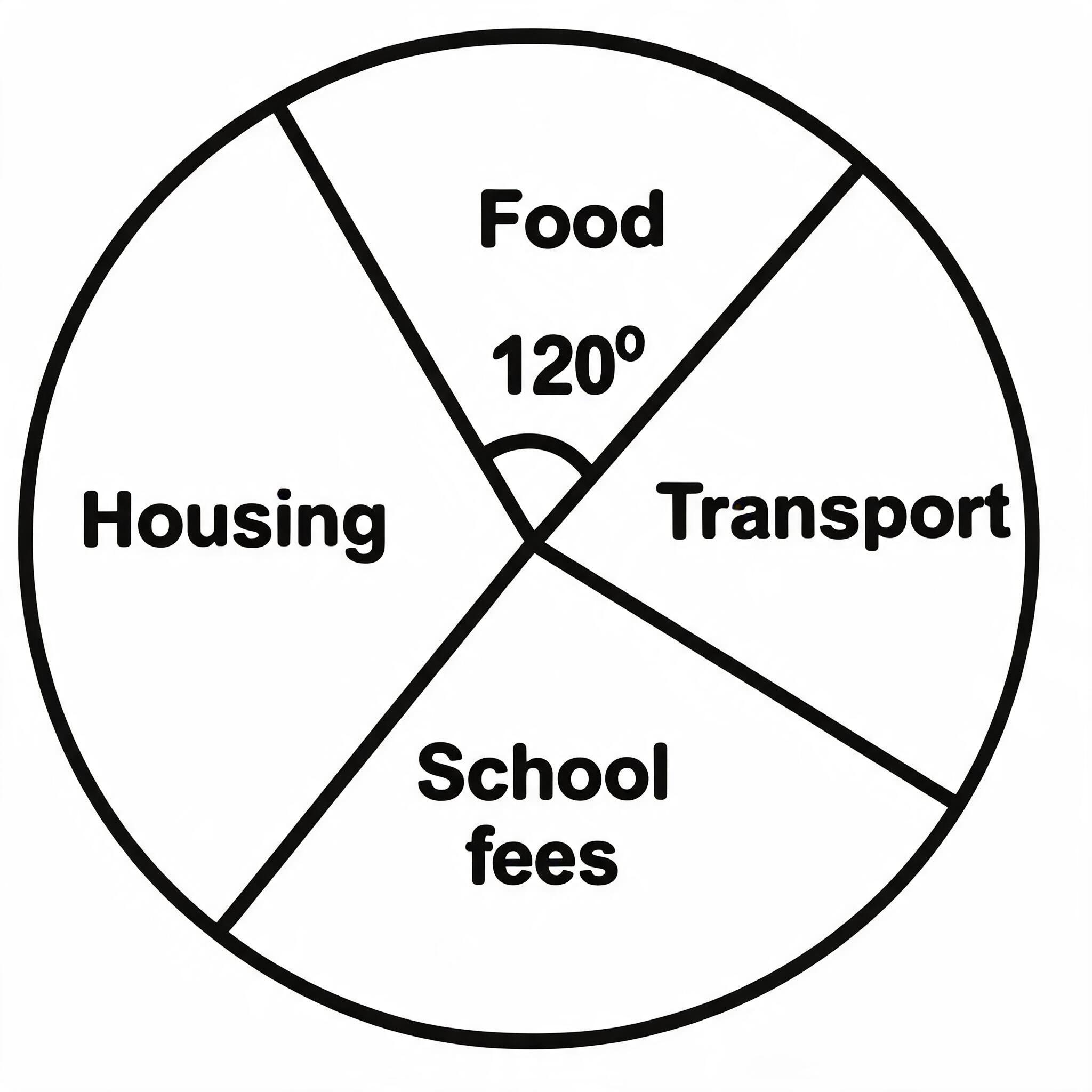
The pie chart shows the monthly expenditure of a public servant. The monthly expenditure on housing is twice that of school fees. How much does the worker spend on housing if his monthly income is N7200?
- A.1000
- B.2000
- C.3000
- D.4000
To solve this, we first find the angle for housing. The total angle in a pie chart is 360°. From the image, the angle for Food is 120° and the angle for Transport is a right angle (90°). Let the angle for Housing be H and for School fees be S. The question states H = 2S. Since all angles sum to 360°, we have 120° + 90° + H + S = 360°, which simplifies to H + S = 150°. Substituting H = 2S, we get 3S = 150°, so S = 50° and H = 100°. The amount spent on housing is its share of the total income, which is (100°/360°) × N7200 = N2000.
Common mistake: The most common mistake is to correctly calculate the expenditure for school fees as N1000 and select option A, instead of proceeding to find the expenditure for housing.
A trader realises 10x - Naira profit from the sale of x bags of corn. How many bags will give him the maximum profit?
- A.7
- B.6
- C.5
- D.4
To find the maximum profit, we need to use differentiation on the profit function, P = 10x - x². The derivative of the function with respect to x is dP/dx = 10 - 2x. At the maximum point, the derivative is equal to zero, so we set 10 - 2x = 0. Solving this equation gives 2x = 10, which means x = 5.
Common mistake: Students might try to substitute the options into the equation and find that both 4 and 6 bags give a profit of 24 Naira, leading them to get confused and pick one of those instead of finding the true maximum.
If y = + , find y, leaving your answer in base two
- A.1110
- B.10111
- C.11101
- D.111100
First, convert both numbers to base ten. 23 in base five is + = 13, and 101 in base three is + + = 9 + 0 + 1 = 10. Next, add the base ten results together: y = 13 + 10 = 23. Finally, convert 23 from base ten to base two by successive division, which gives 10111 in base two.
Common mistake: A common mistake is to read the remainders in the wrong order (from top to bottom instead of bottom to top) after converting to base two, which would lead to the incorrect answer 11101.
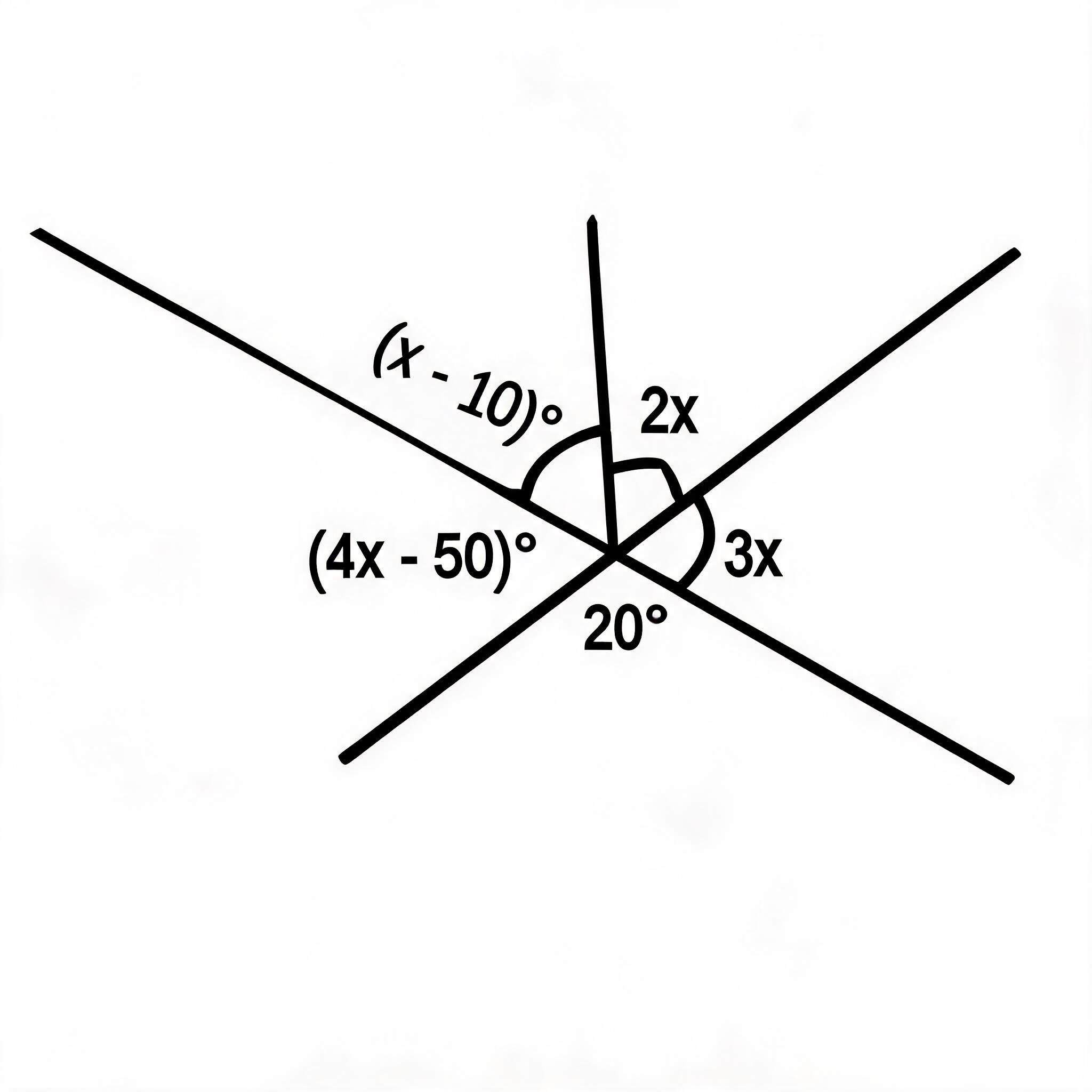
Find the value of x in the diagram
- A.10°
- B.28°
- C.36°
- D.40°
The diagram shows several angles around a single point. The rule is that the sum of angles at a point is always 360°. By adding all the angles shown, we get the equation: (x - 10) + (4x - 50) + 20 + 3x + 2x = 360. Simplifying this by collecting like terms gives 10x - 40 = 360. To find x, we solve the equation: 10x = 360 + 40, which is 10x = 400, and therefore x = 40°.
Common mistake: A common mistake is to set the sum of the angles to 180° (angles on a straight line) instead of the correct 360° for angles around a point.
Solve for t in the equation t + 13 (21 - t) = 11
- A.
- B.
- C.5
- D.
The question presents a linear equation, which is a first-degree polynomial. To solve for t, first clear the fractions by multiplying the entire equation by the LCM of the denominators (4 and 3), which is 12. This gives 9t + 4(21 - t) = 132. Next, expand the bracket to get 9t + 84 - 4t = 132. Collect the like terms to get 5t = 48. Finally, divide both sides by 5 to find that t equals , which is 9 and as a mixed number.
Common mistake: A common mistake is incorrectly expanding the bracket, for example, calculating 4(21 - t) as 84 - t instead of 84 - 4t, which leads to an incorrect final answer.
A school girl spends of her pocket money on books and on dress. What fraction remains?
- A.
- B.
- C.
- D.
First, calculate the total fraction of money spent by adding the fraction spent on books and the fraction spent on her dress. The total spent is + . To add these, find the lowest common multiple (LCM) of the denominators 4 and 3, which is 12, giving = . The whole pocket money is represented as 1, so the fraction remaining is 1 - , which equals .
Common mistake: A common mistake is to choose option B , which is the total fraction spent, without subtracting it from the whole to find what remains.
If x/(a+1) + y/b = 1. Make y the subject of the relation.
- A.b(a+1−x)/(a+1)
- B.(a+1)/b(a−x+1)
- C.a(b−x+1)/(b+1)
- D.b/(a(b−x+1))
To make 'y' the subject of the formula, first isolate the term containing 'y' by moving 'x/(a+1)' to the right side, which gives 'y/b = 1 - x/(a+1)'. Next, combine the terms on the right side into a single fraction by finding a common denominator, resulting in 'y/b = (a+1-x)/(a+1)'. Finally, multiply both sides by 'b' to get 'y' by itself, which gives the correct answer 'y = b(a+1-x)/(a+1)'.
Common mistake: A common mistake is to incorrectly handle the fractional subtraction, for example by writing '1 - x/(a+1)' as '(1-x)/(a+1)', which ignores the need for a common denominator.
Calculate the total surface area of a cupboard which measures 12cm by 10cm by 8cm
- A.
- B.
- C.
- D.
The cupboard is a cuboid with length (l) = 12cm, width (w) = 10cm, and height (h) = 8cm. The formula for the total surface area of a cuboid is 2(lw + wh + hl). Substituting the given values, we get 2 x ((12 x 10) + (10 x 8) + (8 x 12)). This simplifies to 2 x , which is 2 x (296). Therefore, the total surface area is 592cm².
Common mistake: Students might mistakenly calculate the sum of the areas of only three faces (lw + wh + hl) which gives 296cm², forgetting to multiply by 2 for all six faces of the cuboid.
See all 49 JAMB Mathematics 2018 questions
Sign up free to unlock every question in this paper — with the verified answer and Beta's worked explanation on each one. No card needed to begin.
Start free