JAMB Mathematics 2025 Past Questions & Answers
55 JAMB Mathematics 2025 questions with verified answers and worked explanations. Here are the first 10 — sign up free to practise the full paper.
From the diagram above, find the area of the triangle PQR
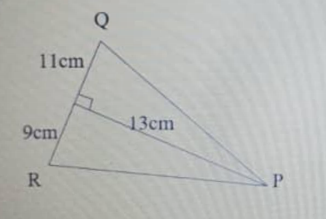
- A.143cm
- B.120cm
- C.130cm
- D.117cm
The question asks for the area of a triangle, which is a direct application of mensuration principles. Mensuration involves calculating the measurements of geometric figures, such as the area of a triangle. Depending on the information provided in the diagram (e.g., base and height, or side lengths and angles), the appropriate area formula would be applied.
Common mistake: Students often make errors in identifying the correct base and corresponding height, or they might use an incorrect formula for the area of a triangle, leading to calculation mistakes.
The set 1,2,3,4,5 is equivalent to
- A.2,3,1,4
- B.1,2,3,4,5,5
- C.1,2,3,4
- D.4,3,1,5,2
Two sets are considered equivalent if they have the same number of elements. The given set 1,2,3,4,5 has five distinct elements. The correct option D, 4,3,1,5,2, also has five distinct elements, even though they are arranged in a different order. Since both sets have five elements, they are equivalent.
Common mistake: Students may mistakenly choose option C, 1,2,3,4, because it looks very similar to the original set, but they fail to notice it only has four elements and is therefore not equivalent.
Solve the simultaneous equation - = 1 and y - = 8
- A.x = 10, y = -6
- B.x = 10, y = 6
- C.x = 6, y = 10
- D.x = 10, y = 6
First, clear the fractions in both equations. Multiply the first equation by 10 to get 5x - 2y = 10, and multiply the second equation by 3 to get 3y - x = 24. From the second new equation, make x the subject: x = 3y - 24. Substitute this into the first new equation to get 5(3y - 24) - 2y = 10, which simplifies to 13y = 130, so y = 10. Finally, substitute y = 10 back into x = 3y - 24 to find x = 3(10) - 24 = 6.
Common mistake: Students often correctly find the values 6 and 10 but mistakenly assign them to the wrong variables, choosing x=10 and y=6 instead of the correct answer.
Solve the inequality 2x + 3 > 5x + 8
- A.x > 1
- B.x > -1
- C.x < -1
- D.x < 1
To solve the inequality 2x + 3 > 5x + 8, first subtract 2x from both sides to get 3 > 3x + 8. Next, subtract 8 from both sides, which gives -5 > 3x. Finally, divide both sides by 3 to isolate x, resulting in > x, which is equivalent to x < or x < -1 .
Common mistake: Students often make errors in transposing terms or incorrectly handling negative signs, which could lead to an incorrect direction of the inequality sign or a positive value for x, such as x > -1 (Option B).
Given that a * b = + (a - b). Find the value of 3 * 2
- A.-6
- B.
- C.
- D.-1
The question defines a binary operation where 'a * b' means you should calculate raca + bab and add the result to (a - b). To find 3 * 2, we substitute a = 3 and b = 2 into the given formula. This gives us rac3 + 23 × 2 + , which simplifies to rac56 + 1. Adding the two parts together, we get rac56 + rac66 = rac116.
Common mistake: Students might incorrectly apply negative signs to both parts of the expression, calculating -( raca+bab) - (a-b) which leads to -( rac56) - 1 = - rac116, corresponding to option D.
Simplify 125−1/3 × 49−1/2 × 10
- A.
- B.
- C.350
- D.35
To solve this, we apply the laws of indices to each term. First, 125 to the power of is the same as 1 divided by the cube root of 125, which gives . Next, 49 to the power of is 1 divided by the square root of 49, which is . Finally, any number raised to the power of zero is 1, so 10 to the power of 0 is 1. Multiplying these results gives × × 1, which equals .
Common mistake: A common mistake is to ignore the negative signs in the powers, which leads to calculating 5 × 7 × 1 to get 35.
Find the coordinates of the midpoint of line PQ given P(-3, 4) and Q(5, 6).
- A.(1, 4)
- B.(4, 1)
- C.(5, 1)
- D.(1, 5)
To find the midpoint of a line segment with endpoints (x1, y1) and (x2, y2), we use the formula: ((x1 + x2)/2, (y1 + y2)/2). For points P(-3, 4) and Q(5, 6), the midpoint is . This simplifies to , which gives the coordinates (1, 5).
Common mistake: Students often make errors in arithmetic, such as incorrect addition or division, or they might swap the x and y coordinates in the final answer, leading to options like (4, 1).
Given that Cos A = for 0 ≤ A ≤ 90º, find Tan A.
- A.
- B.
- C.
- D.
Since Cos A is given as Adjacent/Hypotenuse, we can say the adjacent side is 12 and the hypotenuse is 13. Using Pythagoras' theorem, we find the opposite side by calculating , which gives = 5. The formula for Tan A is Opposite/Adjacent, so Tan A is .
Common mistake: Students might mistakenly calculate Sin A (Opposite/Hypotenuse) which is (Option C), instead of Tan A (Opposite/Adjacent).
Which of the following angles cannot be constructed using a protractor, a compass, and a sharpened pencil?
- A.135°
- B.90°
- C.145°
- D.60°
The question tests knowledge of angles that can be constructed using a compass and a straightedge (represented by a sharpened pencil). Angles like 60°, 90°, and 45° (and combinations like 135° = 90° + 45°) are fundamental constructible angles. An angle of 145° cannot be constructed using only a compass and a straightedge because it is not a multiple of 3 degrees and cannot be derived from basic constructible angles through bisection or simple addition/subtraction.
Common mistake: Students often confuse the ability to measure an angle with a protractor with the ability to construct it using only a compass and straightedge, leading them to think all given options are constructible.
Find the number of permutations of the letters of the word SCHOOL.
- A.600
- B.360
- C.480
- D.300
The word SCHOOL has 6 letters in total. To find the number of permutations or arrangements, we first calculate the factorial of the total number of letters, which is 6! . However, since the letter 'O' is repeated twice, we must divide by the factorial of the number of repetitions, which is 2! . Therefore, the total number of unique permutations is 720 divided by 2, which equals 360.
Common mistake: A common mistake is to calculate the permutation for 6 distinct letters (6! = 720) and forget to divide by 2! to account for the two identical 'O's.
See all 55 JAMB Mathematics 2025 questions
Sign up free to unlock every question in this paper — with the verified answer and Beta's worked explanation on each one. No card needed to begin.
Start free