JAMB Mathematics 2010 Past Questions & Answers
48 JAMB Mathematics 2010 questions with verified answers and worked explanations. Here are the first 10 — sign up free to practise the full paper.
( 81 16 ) −<!-- − --> 1 4 ×<!-- × --> 2 −<!-- − --> 1 = 1 ( 81 16 ) 1 4 ×<!-- × --> 1 2 = ( 16 81 ) 1 4 ×<!-- × --> 1 2 = ( 2 3 ) 4 ×<!-- × --> 1 4 = 2 3 ×<!-- × --> 1 2 = 1 3
Evaluate ×
- A.
- B.3
- C.6
- D.
First, apply the law of negative indices, which states that a⁻ⁿ = 1/aⁿ. This changes to and 2⁻¹ to . Next, evaluate the fourth root, so becomes because 2⁴ is 16 and 3⁴ is 81. Finally, multiply the results: × equals , which simplifies to .
Common mistake: A common mistake is to ignore the negative exponents, calculating as and then multiplying by 2 instead of , which leads to the wrong answer 3.
2 3 + 5 5 −<!-- − --> 3
Rationalize
- A. / 2
- B.3 15 -11
- C. / 2
- D.3 15 +11
To rationalize the expression, you multiply both the numerator and the denominator by the conjugate of the denominator, which is . The numerator becomes = + 2(3) + 5 + , which simplifies to + 11. The denominator becomes a difference of two squares, - = 5 - 3 = 2, so the final answer is / 2.
Common mistake: Students often choose option D because they correctly calculate the numerator but forget to divide it by the result from rationalizing the denominator.
Express the product of 0.21 and 0.34 in standard form
- A.7.14 x
- B.7.14 x
- C.7.14 x
- D.7.14 x 10sup>-4
To solve this, first multiply 0.21 by 0.34, which gives 0.0714. Standard form requires writing a number as a value between 1 and 10 multiplied by a power of 10. To change 0.0714 into 7.14, you must move the decimal point two places to the right. Because the decimal point was moved two places to the right, the power of 10 becomes -2, giving the final answer as 7.14 x 10⁻².
Common mistake: A common mistake is miscounting the number of places to move the decimal point, which can lead to choosing option A (7.14 x 10⁻³) if a student incorrectly shifts the point three times.
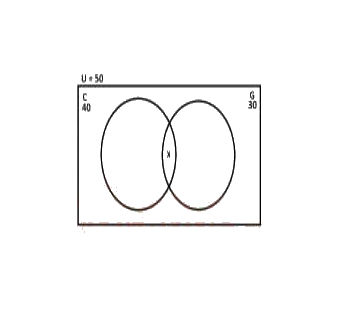
In a survey of 50 newspaper readers, 40 read Champion and 30 read Guardian, how many read both papers?
- A.10
- B.5
- C.15
- D.20
This is a problem about sets, as shown by the Venn diagram in the image. Let the number of people who read both papers be x. Using the formula for the union of two sets, Total = n(Champion) + n(Guardian) - n(Both), we get 50 = 40 + 30 - x. This simplifies to 50 = 70 - x, and solving for x gives x = 70 - 50 = 20.
Common mistake: A common mistake is to simply subtract the number of Champion readers from the total , which incorrectly calculates those who do not read Champion, rather than those who read both papers.
x 3 + 3 x 2 −<!-- − --> 10 x 2 x 2 −<!-- − --> 8
Factorize completely
- A.x(x-5)/2(x+2)
- B.x(x-5)/2(x-2)
- C.x(x+5)/2(x+2)
- D.
To solve this, first factorize the numerator, x³+3x²-10x. Take out the common factor x to get x(x²+3x-10), which then factorizes to x(x+5)(x-2). Next, factorize the denominator, 2x²-8, by taking out the common factor 2 to get 2(x²-4), which is a difference of two squares, 2(x-2)(x+2). The expression becomes [x(x+5)(x-2)] / [2(x-2)(x+2)]. Finally, cancel out the common term (x-2) from the top and bottom to get the final answer, x(x+5)/2(x+2).
Common mistake: Students often make a sign error when factorizing the quadratic x²+3x-10, getting (x-5)(x+2) instead of (x+5)(x-2), which leads to an incorrect option like B after cancellation.
If y varies directly as the square root of x and y = 3 when x = 16. Calculate y when x = 64
- A.12
- B.6
- C.3
- D.5
The statement 'y varies directly as the square root of x' is written as the equation y = , where k is the constant of variation. First, we find k using the given values: y = 3 when x = 16. Substituting these gives 3 = , which simplifies to 3 = 4k, so k = . Now we use this constant to find y when x = 64 by putting it back into the equation: y = = * 8 = 6.
Common mistake: Students might mistakenly ignore the 'square root' part and set up a simple direct variation (y = kx), which would lead them to incorrectly calculate y = 12.
If x * y = x + , find then value of
- A.36
- B.25
- C.11
- D.55
This question tests your understanding of binary operations. First, you must solve the operation inside the bracket, which is . Using the rule x * y = x + y², we get 2 * 3 = 2 + 3² = 2 + 9 = 11. Now, we use this result for the next step: becomes . Applying the rule again, 11 * 5 = 11 + 5² = 11 + 25 = 36.
Common mistake: Students may mistakenly choose option C by only calculating the value of the expression in the bracket and forgetting to complete the second operation with 5.
If p and q are two non zero numbers and 18(p+q) = (18+p)q, which of the following must be true?
- A.q = 18
- B.p <1
- C.p = 18
- D.q < 1
To solve this, first expand the brackets in the equation 18(p+q) = (18+p)q to get 18p + 18q = 18q + pq. Next, subtract 18q from both sides of the equation, which simplifies it to 18p = pq. Since the question states that p is a non-zero number, we can divide both sides by p. This gives us 18 = q, so it must be true that q = 18.
Common mistake: Students may incorrectly simplify the equation 18p = pq and conclude that p = 18 by mixing up the variables, leading them to choose option C.
If ∣∣∣x237∣∣∣ = 15, find the value of x

- A.3
- B.4
- C.5
- D.2
The vertical bars in the image indicate the determinant of the 2x2 matrix. To find the determinant, you multiply the numbers on the main diagonal and subtract the product of the numbers on the other diagonal. This gives the equation (x * 7) - = 15, which simplifies to 7x - 6 = 15. Adding 6 to both sides gives 7x = 21, and finally, dividing both sides by 7 gives x = 3.
Common mistake: A common mistake is to add the cross-products instead of subtracting, or to make a simple arithmetic error when solving the final linear equation for x.
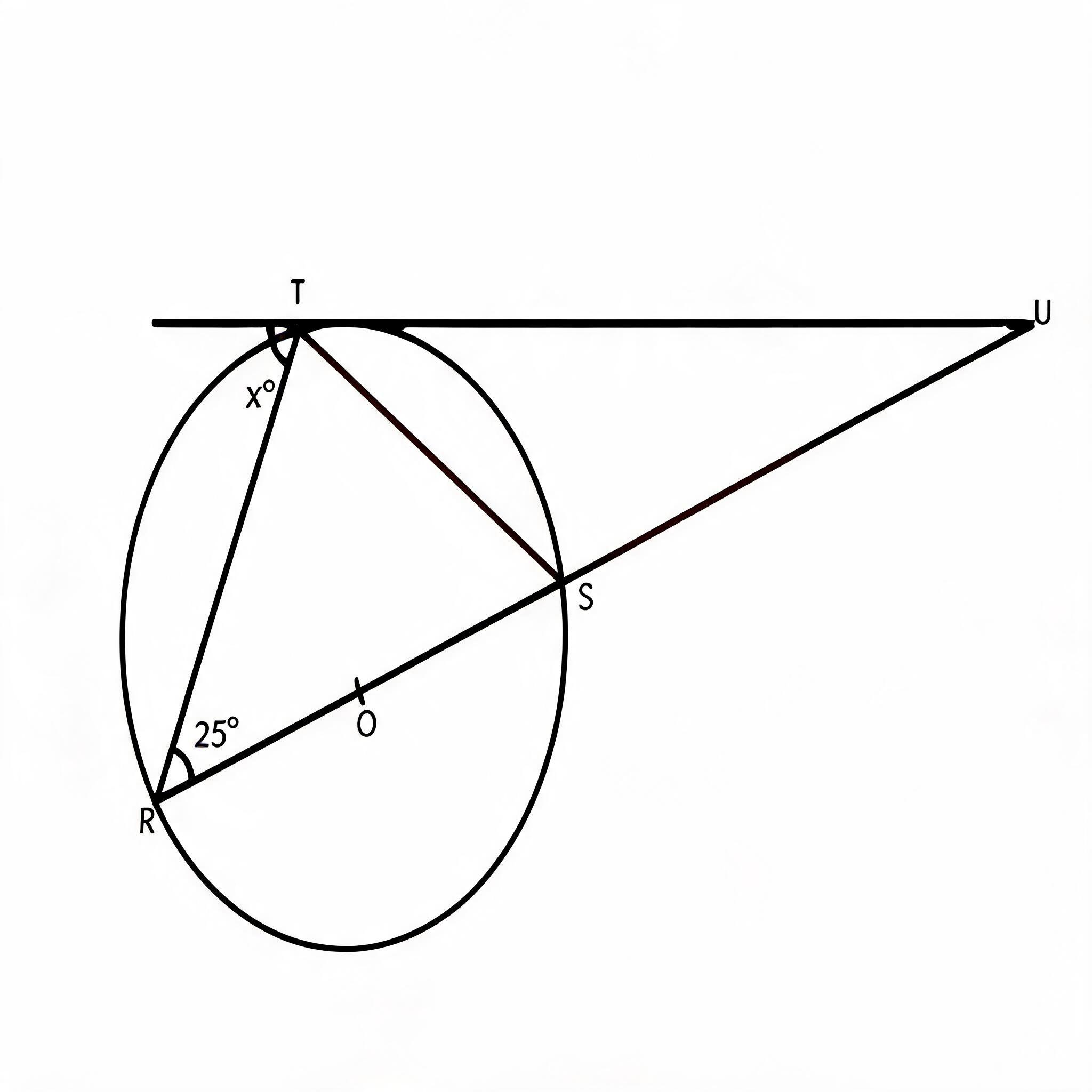
From the diagram above, find x
- A.65°
- B.50°
- C.75°
- D.55°
In the diagram, the line RS passes through the center O, making it a diameter. The angle subtended by a diameter at any point on the circumference is 90°, so angle RTS = 90°. Since the sum of angles in a triangle is 180°, we find angle TSR in triangle RTS by calculating 180° - 90° - 25° = 65°. By the alternate segment theorem, the angle between the tangent (UT) and the chord (TR), which is x, is equal to the angle in the alternate segment (angle TSR). Therefore, x is equal to 65°.
Common mistake: A common mistake is to incorrectly apply the alternate segment theorem and assume x is equal to the other given angle in the triangle, 25°, without first calculating the correct corresponding angle.
See all 48 JAMB Mathematics 2010 questions
Sign up free to unlock every question in this paper — with the verified answer and Beta's worked explanation on each one. No card needed to begin.
Start free