JAMB Mathematics 2008 Past Questions & Answers
50 JAMB Mathematics 2008 questions with verified answers and worked explanations. Here are the first 25 — sign up free to practise the full paper.
Add and
- A.
- B.
- C.
- D.
To add these binary numbers, arrange them vertically and add column by column from right to left, remembering that in base 2, 1 + 1 = 10 (write 0, carry 1). Starting from the right, the first column is 1 + 1 + 1 = 3, which is 11 in base 2, so you write 1 and carry 1. The second column is 0 + 1 + 1 plus the carried 1, which is 3 again (11 in base 2), so you write 1 and carry 1. Continuing this process for the remaining columns gives the final result of 101011₂.
Common mistake: The most likely error is mishandling the carrying process, especially when the sum of a column is greater than 2, or simply adding incorrectly as if they were base 10 numbers.
If = find x
- A.2
- B.3
- C.4
- D.5
First, convert 125 base x to base 10, which gives (1 × x²) + (2 × x¹) + (5 × x⁰) = x² + 2x + 5. We are given that this equals 20 base 10, so we form the equation x² + 2x + 5 = 20. This simplifies to the quadratic equation x² + 2x - 15 = 0, which factors to (x + 5)(x - 3) = 0. Since a number base cannot be negative, the only valid solution is x = 3.
Common mistake: Students may incorrectly factor the quadratic equation, for example getting (x - 5)(x + 3) = 0, which would lead them to wrongly choose x = 5.
( 3 8 ÷<!-- ÷ --> 1 2 + 1 2 ) ( 1 8 ×<!-- × --> 2 3 + 1 3 )
Evaluate
- A.
- B.
- C.
- D.3
To solve this, we follow the order of operations (BODMAS). First, evaluate the numerator: ÷ becomes × = , then add to get + = . Next, evaluate the denominator: × = = , then add to get + = . Finally, divide the result of the numerator by the denominator: ÷ which is × , giving an answer of 3.
Common mistake: A common mistake is not following the order of operations (BODMAS), for instance, adding + in the numerator before performing the division.
Express 123456 to 3 significant figures
- A.123000
- B.124000
- C.125000
- D.126000
To express 123456 to 3 significant figures, we first identify the first three digits, which are 1, 2, and 3. We then look at the fourth digit, which is 4. Since 4 is less than 5, we round down, meaning the third digit (3) does not change. Finally, we replace the remaining digits (4, 5, and 6) with zeros to keep the number's value, giving us 123000.
Common mistake: A common mistake is to incorrectly round up the third digit '3' to '4' because the fourth digit is '4', leading to the wrong answer 124000.
calculate the simple interest on N7,500 for 8 years at 5% per annum.
- A.N3,000
- B.N600
- C.N300
- D.N150
To find the simple interest, we use the formula: Simple Interest = Principal × Rate × Time. The Principal is N7,500, the Rate is 5% , and the Time is 8 years. So, the interest is calculated as N7,500 × × 8, which simplifies to 75 × 5 × 8, giving a final answer of N3,000.
Common mistake: A common mistake is a calculation error, such as misplacing a decimal or dropping a zero during multiplication, which could lead to an incorrect answer like N300.
The cost of kerosene per liter increased from N60 to N85. What is the percentage rate of increase?
- A.42%
- B.41%
- C.40%
- D.25%
First, find the actual increase in price, which is the new price minus the old price: N85 - N60 = N25. To find the percentage increase, you must divide this increase by the original price and then multiply by 100. So, the calculation is (N25 / N60) × 100%, which equals 41.67%. Rounding this to the nearest whole number as given in the options gives 42%.
Common mistake: A common mistake is to choose 25% (Option D), which represents the actual increase in Naira (N25), not the percentage rate of increase.
SOLUTION: 16 −<!-- − --> 1 2 ×<!-- × --> 4 −<!-- − --> 1 2 ×<!-- × --> 27 1 3 = 1 16 1 2 ×<!-- × --> 1 4 1 2 ×<!-- × --> 27 1 3 = 1 16 ×<!-- × --> 1 4 ×<!-- × --> s q r t [ 3 ] 27 = 1 4 ×<!-- × --> 1 2 ×<!-- × --> 3 1 = 3 8
simplify ×
- A.
- B.
- C.
- D.
To solve this, we apply the laws of indices. A negative power means to find the reciprocal, so 16 to the power of becomes 1 divided by 16 to the power of . A fractional power of means square root and means cube root. The expression therefore becomes (1 over the square root of 16) multiplied by (1 over the square root of 4) multiplied by (the cube root of 27), which simplifies to × × 3. Multiplying these values together gives the final answer, .
Common mistake: A common mistake is to incorrectly handle one of the negative powers, for example, calculating 4 to the power of as 2 instead of , which leads to the wrong answer .
= 3, find the value of x
- A.4
- B.16
- C.32
- D.64
To solve this, we first change the logarithm equation to its index form. The equation log₍ₓ¹/²⁾64 = 3 becomes (x¹/²)³ = 64. Using the law of indices, this simplifies to x³/² = 64. To find x, we raise both sides to the power of , which gives x = 64²/³. This is the same as the cube root of 64, all squared, so x = (4)² which equals 16.
Common mistake: A common mistake is to see the number 64 in the question and incorrectly choose it as the answer without properly applying the laws of logarithms and indices.
If is expressed in the form of find the values of x and y
- A.(-3, -2)
- B.. (-2, 3)
- C.(3,2)
- D.(2,-3)
To solve this, you must rationalize the denominator by multiplying the numerator and denominator by the conjugate of the denominator, which is . This gives / . Expanding the numerator gives 1 + + 2 = 3 + , and the denominator becomes 1 - 2 = -1. The expression simplifies to , which is -3 - . Comparing this to , we find that x = -3 and y = -2.
Common mistake: Students often correctly calculate the numerator as 3 + but forget that the denominator equals -1, leading them to incorrectly choose option C.
If X = and Y = n+1:n=2,3,5, find X∩Y.
- A.1,3
- B.5,10
- C.0
- D.4,6
First, find the elements of set X using the rule n² + 1 for n = 0, 2, 3. This gives X = 0²+1, 2²+1, 3²+1 which simplifies to X = 1, 5, 10. Next, find the elements of set Y using the rule n+1 for n = 2, 3, 5, which gives Y = or Y = 3, 4, 6. The intersection, X∩Y, is the set of elements that are common to both X and Y. Comparing the two sets, we see there are no common elements, so the intersection is an empty set, which contains 0 elements.
Common mistake: A common mistake is to confuse intersection (∩) with union (∪), which would involve combining all elements from both sets instead of finding only the common ones.
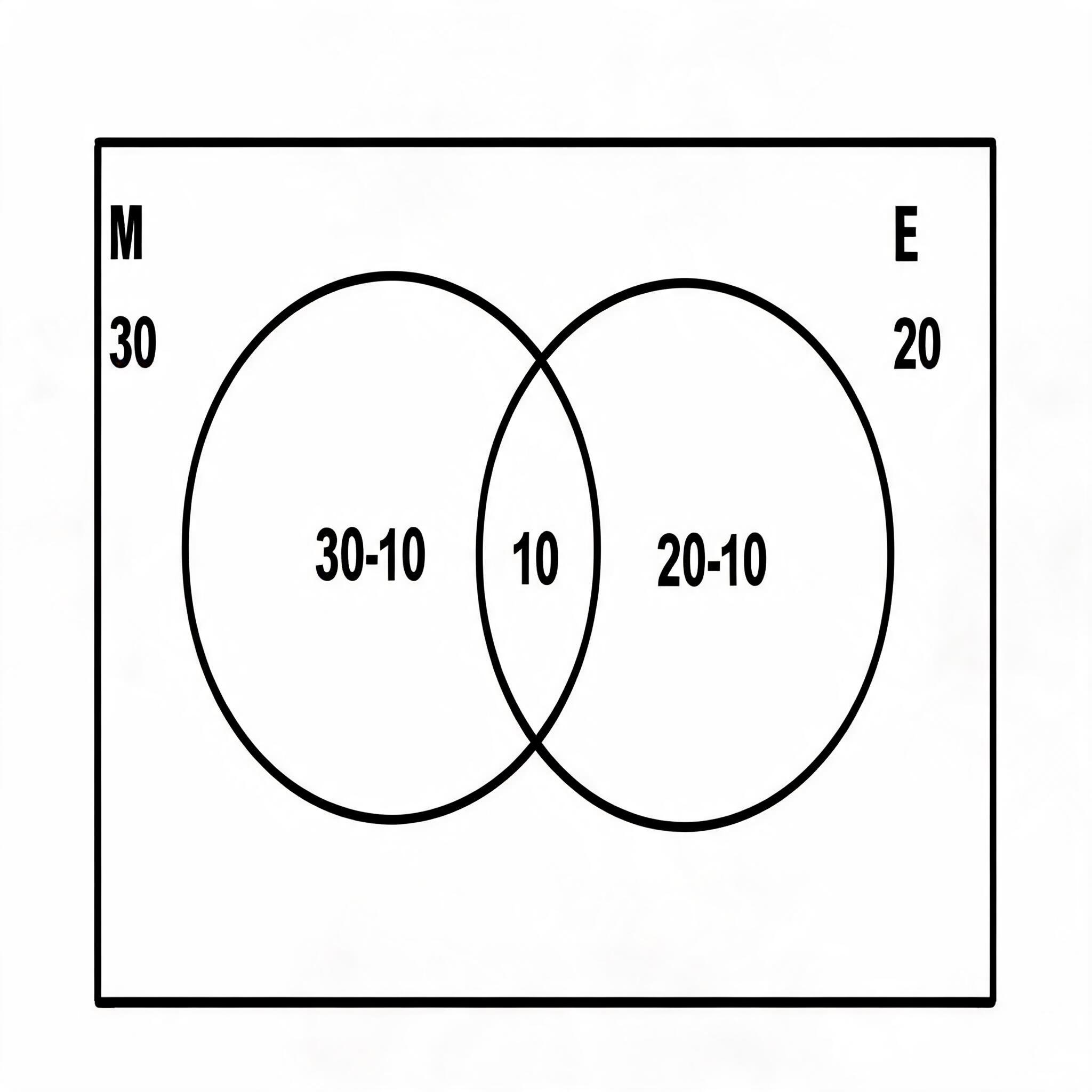
A book seller sells Mathematics and English books. If 30 customers buy Mathematics books, 20 customers buy English books and 10 customers buy the two books. How many customers has he altogether?
- A.30
- B.40
- C.50
- D.60
This is a problem about sets, which can be solved using the provided Venn diagram. To find the total number of customers, we add the number of customers who bought only Mathematics, only English, and both books. Customers who bought only Maths is 30 - 10 = 20, and customers who bought only English is 20 - 10 = 10, so the total is 20 (Maths only) + 10 (English only) + 10 (both) = 40.
Common mistake: The most common mistake is to simply add the number of Mathematics and English customers , which incorrectly counts the 10 customers who bought both books twice.
Make Q the subject of formula when L =
- A.
- B.
- C.
- D. P
To make Q the subject of the formula, first isolate the square root term. Multiply both sides by 3 and divide by 4M to get 3L/4M = . Next, square both sides to remove the square root, which results in (3L/4M)² = PQ, simplifying to 9L² / 16M² = PQ. Finally, to get Q by itself, divide both sides by P, giving the final answer Q = (9L²)/(16M²P).
Common mistake: A common mistake is incorrectly squaring the fraction, for instance forgetting to square the numbers (3 and 4) as well as the variables, or making an error in the final step by multiplying by P instead of dividing.
If - kx - 12 is divisible by x-4, Find the value of k
- A.4
- B.5
- C.6
- D.7
According to the Factor Theorem, if a polynomial is divisible by (x - a), then substituting x = a into the polynomial will result in zero. Since 2x² - kx - 12 is divisible by x - 4, we can set x = 4 and equate the expression to zero. This gives us 2(4)² - k(4) - 12 = 0, which simplifies to 32 - 4k - 12 = 0. Solving the equation, we get 20 - 4k = 0, which means 4k = 20, and therefore k = 5.
Common mistake: A common mistake is to incorrectly use x = -4 instead of x = 4 from the factor (x - 4), leading to a sign error in the calculation.
Factorize completely; -
- A.(x+5y)(7x+y)
- B.(x+5y)(7x-y)
- C.(x-5y)(7x+y)
- D.(x-5y)(7x-y)
This question uses the difference of two squares formula, which is a² - b² = (a+b)(a-b). In this problem, 'a' is (4x+3y) and 'b' is (3x-2y). Substituting these into the formula gives [(4x+3y) + (3x-2y)][(4x+3y) - (3x-2y)]. Simplifying the first bracket by collecting like terms gives (7x+y), and simplifying the second bracket gives (x+5y), which matches option A.
Common mistake: A common mistake is a sign error during the subtraction step, for example calculating `(4x+3y) - (3x-2y)` incorrectly, which can lead to the wrong sign on the '5y' term, resulting in option C.
If x - 3 is directly proportional to the square of y and x = 5 when y =2, find x when y = 6.
- A.30
- B.21
- C.16
- D.12
The statement 'x - 3 is directly proportional to the square of y' is written as the equation x - 3 = ky², where k is the constant of variation. First, we find k using the given values x = 5 and y = 2, which gives 5 - 3 = k(2)², so 2 = 4k, and k = . Now we have the full relationship: x - 3 = . To find x when y = 6, we substitute y = 6 into the equation: x - 3 = = = 18. Finally, solving for x gives x = 18 + 3 = 21.
Common mistake: A common mistake is to forget to square y, setting up the relationship as x - 3 = ky instead of x - 3 = ky², which leads to an incorrect answer.
If p varies inversely as the square of q and p=8 when q=4, find q when p =32
- A.± 16
- B.± 8
- C.± 4
- D.± 2
The statement 'p varies inversely as the square of q' is written as the equation p = k/q², where k is a constant. First, we find k using the given values: 8 = k/4², which gives 8 = k/16, so k = 128. Now we have the full relationship p = 128/q², and we can find q when p = 32 by solving 32 = 128/q². This simplifies to q² = = 4, so q is the square root of 4, which is ±2.
Common mistake: A common mistake is to set up a direct variation (p = kq²) instead of an inverse one, which would incorrectly lead to the answer ±8.
Find the range of values of x which satisfy the inequalities 4x - 7 ≤ 3x and 3x - 4 ≤ 4x
- A.-4 ≤ x ≤ 7
- B.-7 ≤ x ≤ 4
- C.x ≥ -7
- D.-7 ≤ x ≤ 6
To solve this problem, you need to handle each inequality separately and then combine the results. For the first inequality, 4x - 7 ≤ 3x, subtracting 3x from both sides and adding 7 gives x ≤ 7. For the second inequality, 3x - 4 ≤ 4x, subtracting 3x from both sides gives -4 ≤ x. Combining these two results means x must be greater than or equal to -4 AND less than or equal to 7, which is written as -4 ≤ x ≤ 7.
Common mistake: Students often make sign errors when moving terms across the inequality, for instance getting -7 ≤ x from the first inequality and x ≤ 4 from the second, which leads to the incorrect option B.
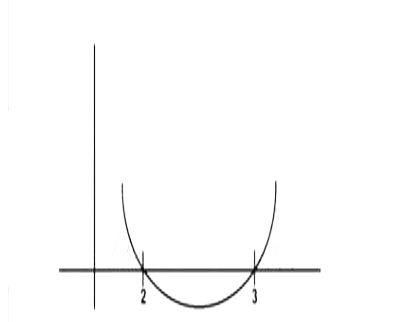
Solve the quadratic inequalities - 5x + 6 ≥ 0
- A.x ≤ 2, x ≥ 3
- B.x ≤ 3, x ≥ 2
- C.x ≤ -2, x ≥ -3
- D.x ≤-3, x ≥ 2
To solve the quadratic inequality x² - 5x + 6 ≥ 0, first find the roots of the related equation x² - 5x + 6 = 0. By factoring, we get (x - 2)(x - 3) = 0, so the roots are x = 2 and x = 3. These roots are the points where the U-shaped parabola shown in the image cuts the x-axis. The inequality '≥ 0' asks for the values of x where the graph is on or above the x-axis, which, according to the graph, occurs when x ≤ 2 or x ≥ 3.
Common mistake: Students often find the correct roots 2 and 3 but then incorrectly choose the region between them (2 ≤ x ≤ 3), which is the solution for the opposite inequality, x² - 5x + 6 ≤ 0.
The fifth term of an A.P is 24 and the eleventh term is 96. Find the first term.
- A.12
- B.4
- C.-12
- D.-24
The formula for the nth term of an Arithmetic Progression (A.P.) is = a + (n-1)d. From the question, the 5th term is 24, so a + 4d = 24 (Equation 1), and the 11th term is 96, so a + 10d = 96 (Equation 2). Subtracting Equation 1 from Equation 2 gives 6d = 72, so the common difference 'd' is 12. To find the first term 'a', substitute d = 12 into Equation 1: a + 4(12) = 24, which simplifies to a + 48 = 24, giving a = -24.
Common mistake: Students may mistakenly choose 12 (Option A) because it is the value of the common difference 'd', but the question asks for the first term 'a'.
A binary operation * is defined on the set of positive integers is such x*y = 2x-3y+2 for all positive integers x and y. The binary operation is?
- A.commutative and close on the set of positive integers
- B.neither commutative nor closed on the set of positive integers
- C.commutative but not closed on the set of positive integers
- D.not cummutative but closed on the set of positive integers
To check if the operation is commutative, we test if x*y equals y*x. Here, x*y = 2x-3y+2 while y*x = 2y-3x+2, which are not the same, so it is not commutative. To check for closure on positive integers, we see if the answer is always a positive integer. If we pick x=1 and y=2, then = 2(1)-3(2)+2 = -2, which is not a positive integer, so the set is not closed. Therefore, the operation is neither commutative nor closed.
Common mistake: Students may incorrectly believe the operation is closed by testing only a few examples that give a positive result, without realizing that just one counter-example is enough to prove it is not closed.
A binary operation on the real set of numbers excluding -1 is such that for all m, n ∈ R, mΔn = m+n+mn. Find the identity element of the operation.
- A.1
- B.0
- C.
- D.-1
The identity element, let's call it 'e', is the special number that doesn't change another number 'm' when you operate with it. This means that mΔe must be equal to m. Using the rule given in the question, mΔe = m + e + me. So, we set m + e + me = m, and then we solve for e. Subtracting m from both sides gives e + me = 0, and factoring out e gives e(1 + m) = 0, which means e must be 0.
Common mistake: A common mistake is to assume the identity element is 1, which is the identity for normal multiplication, without applying the specific rule given for the binary operation Δ.
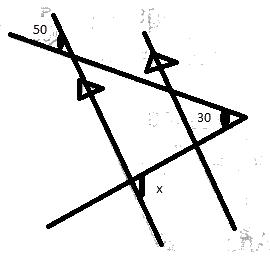
In the diagram above, PQ//RS. The size of the angle marked x is?
- A.100°
- B.80°
- C.50°
- D.30°
This problem is solved using the 'zig-zag' theorem for parallel lines, which states that the sum of the interior angles pointing in one direction equals the sum of the interior angles pointing in the opposite direction. In the diagram, the angles 50° and 30° are pointing to the left side. The angle marked 'x' is pointing to the right side, so it must be equal to the sum of the other two angles. Therefore, x = 50° + 30° = 80°.
Common mistake: Students often mistakenly assume that x and 50° are alternate interior angles and choose 50°, forgetting that the angles are formed by two different transversal lines.
Find the exterior angle of a 12 sided regular polygon
- A.12°
- B.24°
- C.25°
- D.30°
The sum of the exterior angles of any regular polygon is always 360 degrees. To find the size of one exterior angle, you divide 360 degrees by the number of sides the polygon has. For a 12-sided polygon, the calculation is 360° divided by 12, which equals 30°.
Common mistake: A common mistake is to confuse the formula for the exterior angle with the formula for the interior angle, which is ((n-2) x 180°)/n, leading to an incorrect calculation.
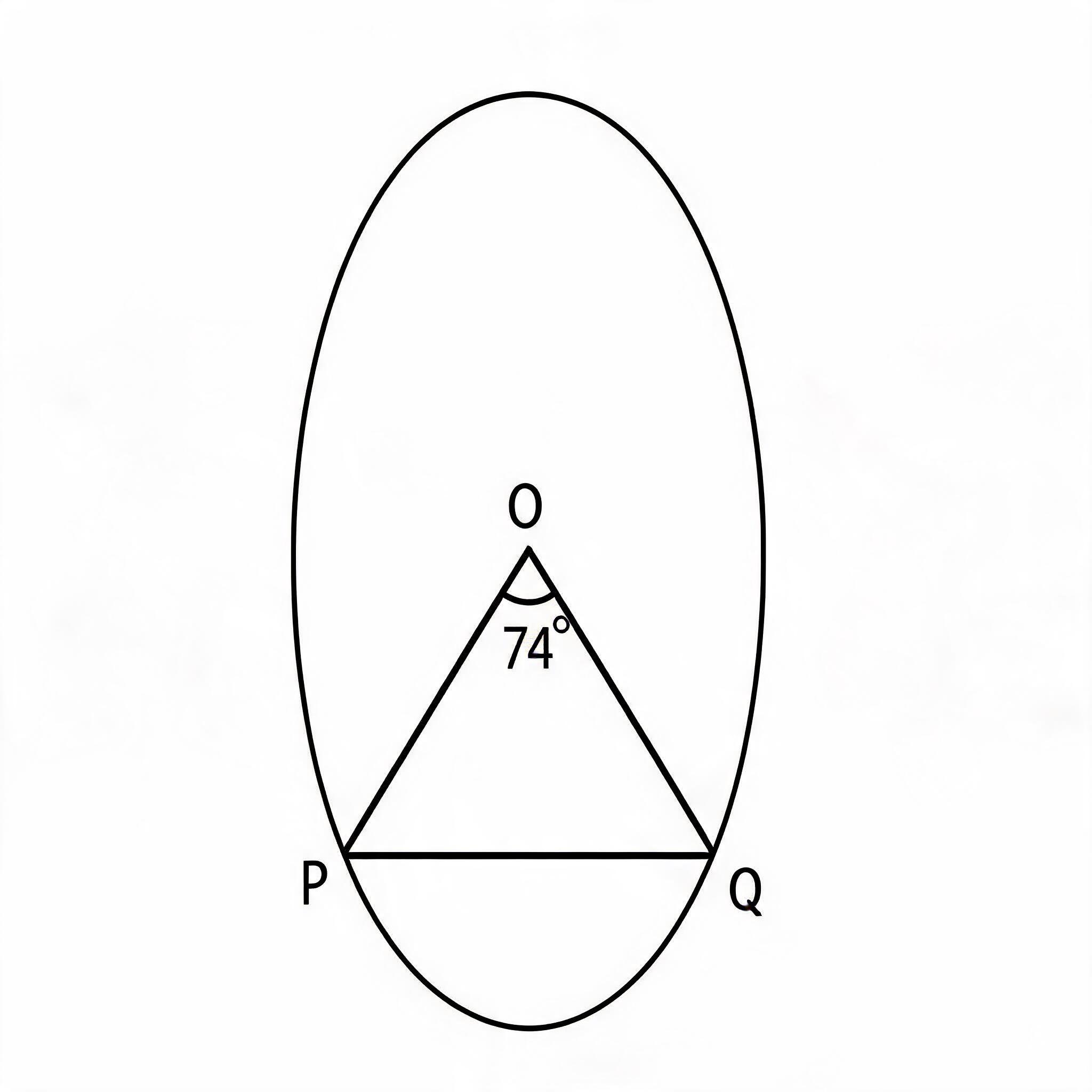
In the diagram above ∠ OPQ is
- A.90°
- B.53°
- C.36°
- D.26°
In the diagram, the lines OP and OQ are both radii of the circle, which means they are equal in length. This makes the triangle OPQ an isosceles triangle, so the base angles ∠OPQ and ∠OQP must be equal. Since the sum of angles in a triangle is 180°, we can find the sum of the two base angles by subtracting the given angle from 180° (180° - 74° = 106°). To find one of the base angles, ∠OPQ, we divide this result by 2, which gives 106° / 2 = 53°.
Common mistake: A common mistake is failing to identify that triangle OPQ is an isosceles triangle because its sides OP and OQ are radii, which leads to incorrect calculations.
Find the area of the figure above
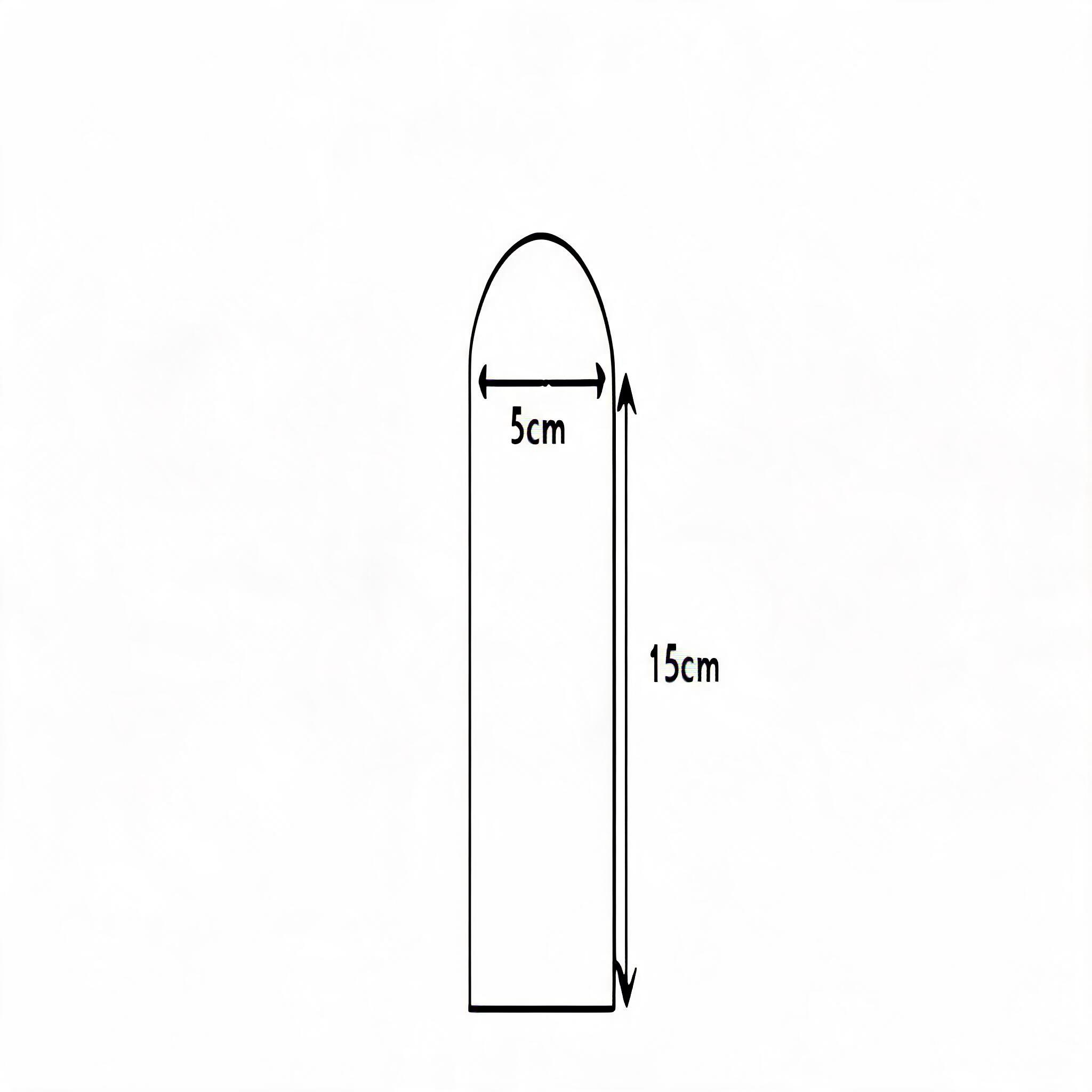
- A.12.5 cm2
- B.75.0 cm2
- C.78.5 cm2
- D.84.8 cm2
The figure is a composite shape made of a rectangle and a semicircle. First, find the area of the rectangle, which is length times width (15 cm × 5 cm = 75 cm²). Next, find the area of the semicircle on top; its diameter is 5 cm, so its radius is 2.5 cm. The area of the semicircle is = × × (2.5)² ≈ 9.82 cm². Finally, add the two areas together: 75 cm² + 9.82 cm² = 84.82 cm², which is approximately 84.8 cm².
Common mistake: Students might mistakenly calculate only the area of the rectangular part (15 cm x 5 cm = 75 cm²) and choose option B, forgetting to add the area of the semicircle.
See all 50 JAMB Mathematics 2008 questions
Sign up free to unlock every question in this paper — with the verified answer and Beta's worked explanation on each one. No card needed to begin.
Start free