JAMB Mathematics 2006 Past Questions & Answers
50 JAMB Mathematics 2006 questions with verified answers and worked explanations. Here are the first 25 — sign up free to practise the full paper.
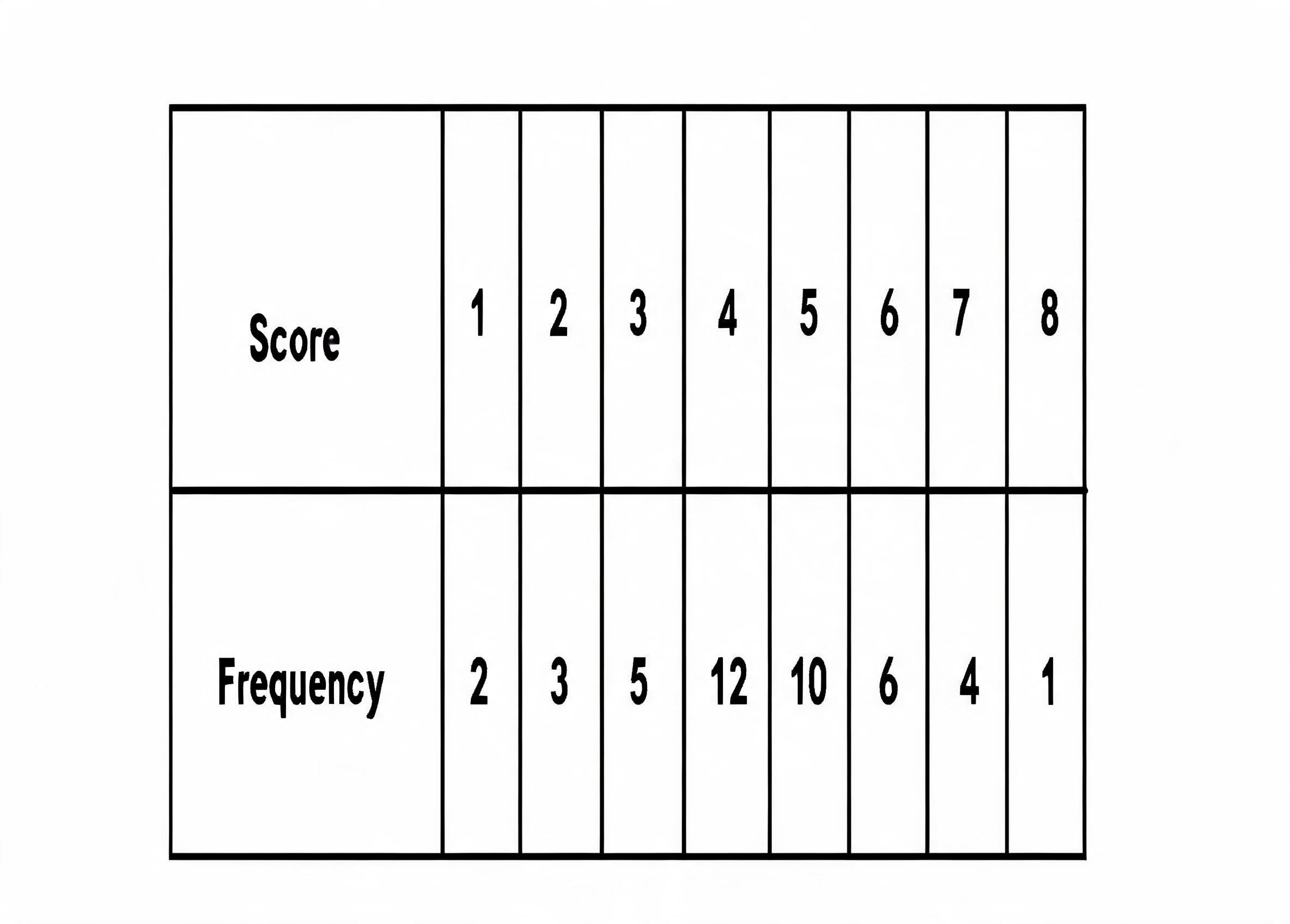
The table above shows the scores of a group of students in a physics test. If the mode is m and the number of students who scored 4 or more is n, what is (n, m)?
- A.(33, 4)
- B.(22, 4)
- C.(33, 12)
- D.(12, 4)
The mode (m) is the score with the highest frequency. From the table, the highest frequency is 12, which corresponds to a score of 4, so m = 4. The number of students who scored 4 or more (n) is the sum of the frequencies for scores 4, 5, 6, 7, and 8, which is n = 12 + 10 + 6 + 4 + 1 = 33. Therefore, the required pair (n, m) is (33, 4).
Common mistake: A common mistake is to confuse the mode with the highest frequency, leading to m=12 instead of the score 4, which results in the incorrect option C.
SOLUTION : 5 C 4 = 6 ! ( 6 −<!-- − --> 4 ) ! 4 ! = 6 ! 2 ! 4 ! = 6 ×<!-- × --> 5 ×<!-- × --> 4 ! 2 ×<!-- × --> 1 ×<!-- × --> 4 ! = 15 w a y s
A final examination requires that a student answer any 4 out of 6 questions. In how many ways can this be done?
- A.15
- B.20
- C.30
- D.45
This is a combination problem because the order in which the student chooses the questions does not matter. We need to find the number of ways to choose 4 questions from a total of 6, which is calculated using the combination formula ⁶C₄. The formula is n! / ((n-r)! * r!), so we have 6! / which simplifies to / = 15.
Common mistake: The most common mistake is to confuse this with a permutation, which is used when the order of selection is important, leading to an incorrect calculation.
Solution: ( a + a + 1 + a + 2 + a + 3 + a + 4 ) 5 30 = 5 a + 10 5 30 × 5 = 5 a + 10 5 a = 150 − 10 5 a = 140 a = 28 ∴ a + 4 = 28 + 4 = 32
If the mean of five consecutive integers is 30, find the largest of the numbers
- A.28
- B.30
- C.32
- D.34
The mean of an odd set of consecutive numbers is always the middle number. Since there are five consecutive integers and their mean is 30, the middle (third) number must be 30. The five integers are therefore 28, 29, 30, 31, and 32, which makes the largest number 32.
Common mistake: A common mistake is to solve for the smallest integer (28) and select it as the answer, instead of finding the largest integer as requested by the question.
A bag contains 5 black, 4 white and x red marbles. If the probability of picking a red marble is , find the value of x
- A.8
- B.10
- C.4
- D.6
The total number of non-red marbles is 5 (black) + 4 (white) = 9. The question implies a ratio of red marbles to non-red marbles is 2 to 3, so we can set up a proportion: (number of red marbles) / (number of non-red marbles) = x/9 = . To find x, we cross-multiply to get 3 * x = 9 * 2, which means 3x = 18. Dividing both sides by 3 gives x = 6.
Common mistake: A common mistake is to correctly set up the probability formula as x/(9+x) = , which results in x=18, an answer not listed in the options, indicating a likely error in the question's wording.
Find the variance of 2x, 2x-1 and 2x+1
- A.
- B.2
- C.
- D.1
First, find the mean (average) of the numbers: (2x + (2x-1) + (2x+1)) / 3 = 6x / 3 = 2x. Next, calculate the variance, which is the average of the squared differences from the mean. The differences from the mean are (2x - 2x) = 0, = -1, and = 1. So, the variance is (0² + (-1)² + 1²) / 3 = / 3 = .
Common mistake: Students often mistakenly calculate the standard deviation, which is the square root of the variance, leading them to choose option C.
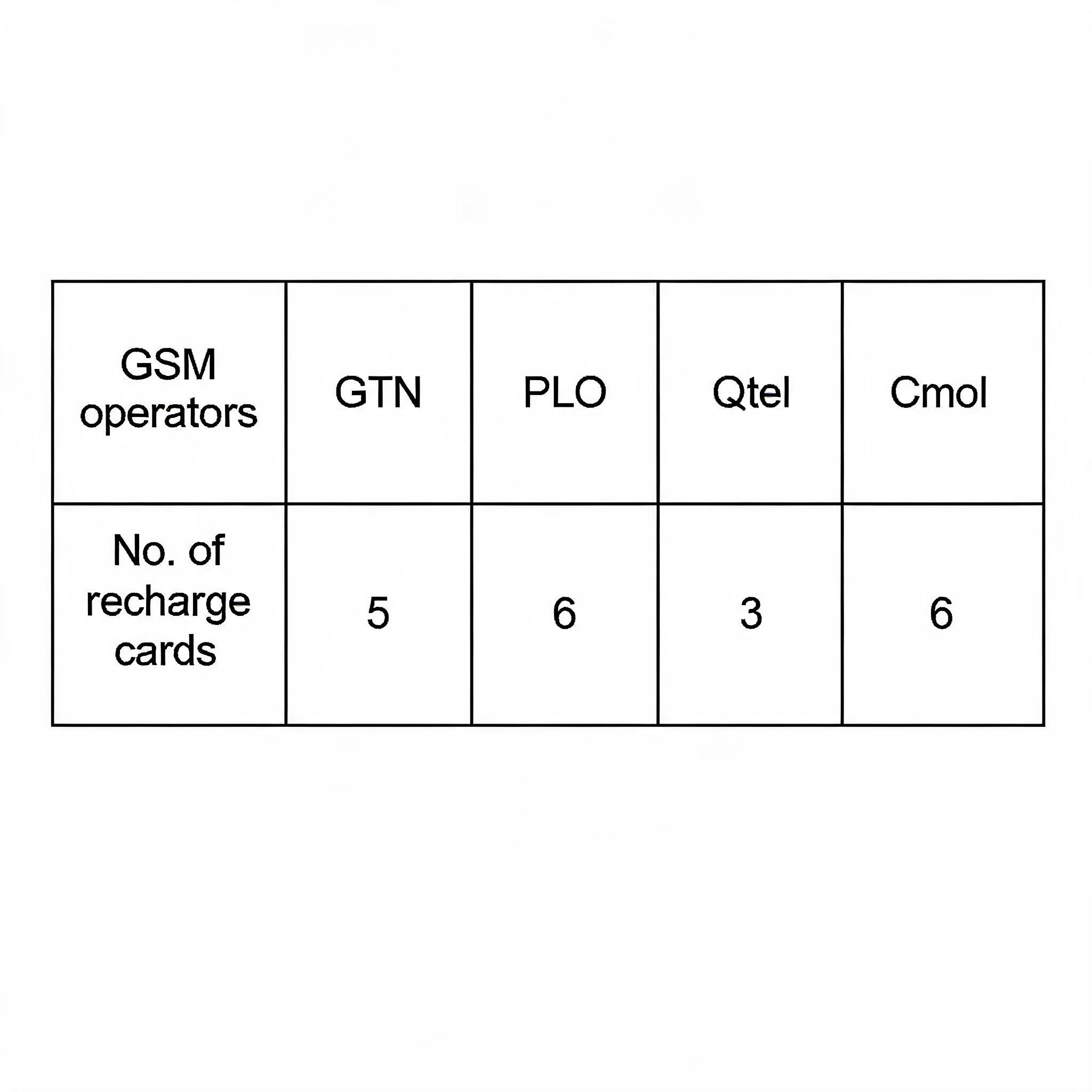
The table above shows the distribution of recharge cards of four major GSM operators. What is the probability that a recharge card selected at random will be GTN or Qtel?
- A.
- B.
- C.
- D.
First, find the total number of recharge cards by adding the numbers for all operators shown in the table: 5 + 6 + 3 + 6 = 20 cards. The number of favorable outcomes is the number of GTN cards plus the number of Qtel cards, which is 5 + 3 = 8. The probability of selecting a GTN or Qtel card is the number of favorable outcomes divided by the total number of cards, which is . Simplifying this fraction by dividing both the numerator and denominator by 4 gives the final answer, .
Common mistake: A common mistake is to only calculate the probability for GTN and forget to add the probability for Qtel as the question asks for 'GTN or Qtel'.
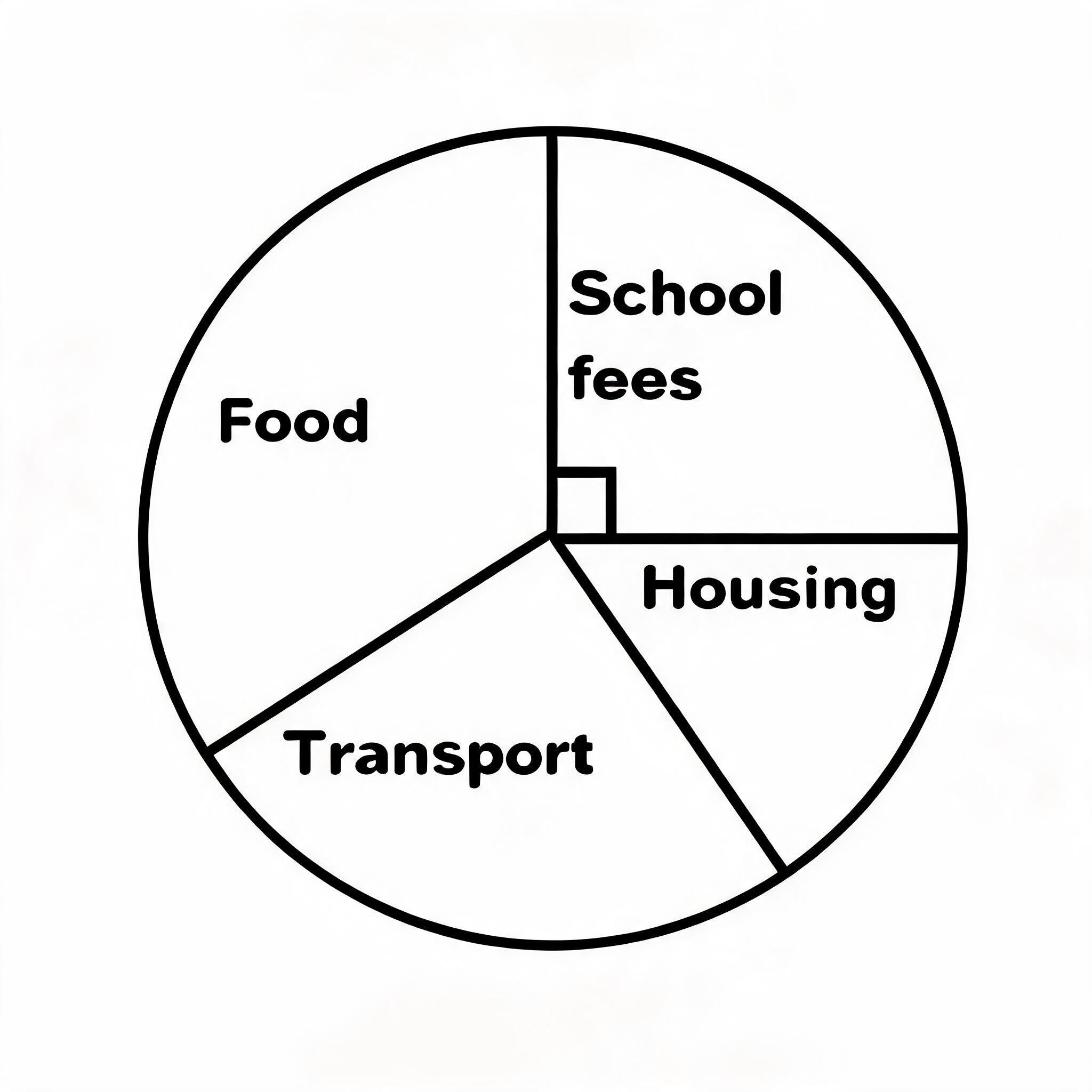
The pie chart above shows the expenditure of a family whose income is N30,000. If the expenditure on food is twice that on housing and that on school fees is twice that on transport, how much does the family spend on food?
- A.N 28 000
- B.N 25 500
- C.N15 000s
- D.N 12 500s
The pie chart shows a right angle for school fees, which is 90 degrees. Since school fees expenditure is twice that of transport, the angle for transport is = 45 degrees. The remaining angle for food and housing is 360 - 90 - 45 = 225 degrees. As food expenditure is twice that of housing, we divide this remaining angle in a 2:1 ratio, giving food an angle of * 225 = 150 degrees. Therefore, the amount spent on food is of the total income, which is * N30,000 = N12,500.
Common mistake: Students might mistakenly subtract only the 90° for school fees from 360°, forget about transport, and then calculate the food angle as of 270°, leading to an incorrect answer of N15,000.
For what of n is = ?
- A.6
- B.5
- C.4
- D.3
This question is about combinations, which uses the formula ⁿCᵣ = n! / (r!(n-r)!). Applying this to the equation gives (n+1)! / (3!(n-2)!) = 4 * [n! / (3!(n-3)!)]. After expanding the factorials and cancelling common terms on both sides, the equation simplifies to a linear one: n+1 = 4(n-2). Solving for n, we get n+1 = 4n - 8, which gives 3n = 9, and therefore n = 3.
Common mistake: The most common mistake is incorrectly expanding or cancelling the factorial terms, which leads to a wrong linear equation and an incorrect value for n.
The gradient of a curve is 2x + 7 and the curve passes through point (2, 0). find the equation of the curve.
- A.y = + 7x + 9
- B.y = + 7x - 18
- C.y = + 7x + 18
- D.y = + 14x + 11
To find the equation of a curve from its gradient, you must integrate the gradient function. Integrating the gradient, 2x + 7, gives the equation y = x² + 7x + C, where C is the constant of integration. To find C, substitute the given point (2, 0) into the equation, which means 0 = (2)² + 7(2) + C. This simplifies to 0 = 4 + 14 + C, or 0 = 18 + C, so C = -18, making the final equation y = x² + 7x - 18.
Common mistake: A common mistake is incorrectly solving for the constant of integration, C, by getting C = +18 instead of C = -18, which leads to choosing option C.
Differentiate with respect to x
- A. - 4x - 2/x
- B. - 2 + 2/x3
- C. - 2 - 2/x3
- D. - 3x + 2/x
To solve this, it is best to first expand the expression (x² - 1/x)², which gives x⁴ - 2x + 1/x². Rewrite this as x⁴ - 2x + x⁻² to make differentiation easier. Applying the power rule to each term, the derivative of x⁴ is 4x³, the derivative of -2x is -2, and the derivative of x⁻² is -2x⁻³. The result is 4x³ - 2 - 2/x³, which means the correct option C has a typo and should start with 4x³ instead of 4x².
Common mistake: A common mistake is making a sign error when differentiating the x⁻² term, getting +2x⁻³ instead of -2x⁻³, which would lead to choosing the incorrect option B.
Find the value of x for which the function - 9x is minimum
- A.zero
- B.2
- C.3
- D.5
To find the minimum point of a function, you must find its derivative and set it to zero. The question likely contains a typo and was intended to be f(x) = 3x³ - 9x². The derivative is f'(x) = 9x² - 18x, and setting it to zero gives 9x(x-2)=0, so the turning points are x=0 or x=2. Using the second derivative test, f''(x) = 18x - 18, we find that f''(2) is positive, which confirms that x=2 gives the minimum value.
Common mistake: A common mistake is to find the turning points but forget to perform the second derivative test to distinguish between the maximum (at x=0) and the minimum (at x=2).
If dy/dx = x + cos x, find y
- A. - sin x + c
- B. + sin x + c
- C. - sin x + c
- D. + sin x + c
To find the function y from its derivative dy/dx, you need to integrate the expression with respect to x. We integrate each term separately: the integral of x is x²/2, and the integral of cos x is sin x. Since this is an indefinite integral, we must add a constant of integration, 'c', to the final result. Therefore, y = x²/2 + sin x + c.
Common mistake: Students often choose option C by mistakenly recalling the derivative of cos x (which is -sin x) instead of its integral (which is sin x).
Differentiate
- A.-2 cos 2θ
- B.-2 sin2θ
- C.1 - 2 cos 2θ
- D.1 - 2 sin 2θ
To solve this, first expand the expression (cos θ - sin θ)². This gives cos²θ - 2sinθcosθ + sin²θ. Using the trigonometric identity cos²θ + sin²θ = 1 and the double angle identity 2sinθcosθ = sin 2θ, the expression simplifies to 1 - sin 2θ. Now, we differentiate this simplified expression with respect to θ. The derivative of a constant (1) is 0, and the derivative of -sin 2θ is -2cos 2θ, giving a final answer of -2 cos 2θ.
Common mistake: Students often choose option B by incorrectly simplifying the initial expression to cos 2θ and then differentiating it to get -2 sin 2θ.
Evaluate
- A.-16
- B.-20
- C.20
- D.10
To evaluate the definite integral, we first find the integral of the function , which is x - x². Next, we evaluate this result at the upper limit (0) and subtract the result from the lower limit (-4). This gives us [0 - (0)²] - [(-4) - (-4)²], which simplifies to 0 - . The final calculation is 0 - (-20), which equals 20.
Common mistake: Students often make a sign error during the final subtraction, calculating 0 - (-20) as -20 instead of 20, leading them to choose option B.
Simolify
- A.
- B.
- C.
- D.
First, simplify the numerator: - becomes = . Next, simplify the denominator by following BODMAS, which means you must do the division first: ÷ is the same as * , which equals . Then, add this result to , so + = = . Finally, divide the simplified numerator by the simplified denominator: ÷ = * = , which simplifies to .
Common mistake: A common mistake is to ignore the order of operations (BODMAS) in the denominator, adding and before dividing by , which leads to the incorrect answer A.
If m:n = 13:111, find - :
- A.1:11
- B.1:13
- C.1:10
- D.1:12
First, recognize that m² - n² is a difference of two squares, which can be factored as (m - n)(m + n). The ratio then becomes (m - n)(m + n) : (m + n)². You can cancel out (m + n) from both sides, simplifying the ratio to (m - n) : (m + n). Assuming the ratio m:n is 13:11 (as the typo 13:111 does not lead to any of the options), substitute m = 13 and n = 11 into the simplified ratio, which gives : or 2 : 24, and this simplifies to 1:12.
Common mistake: A common mistake is to substitute the numbers directly without simplifying the algebra first, which leads to larger numbers and a higher chance of calculation error, or to simply guess an answer like 1:13 because the number 13 appears in the question.
Calculate the logarithm to base 9 of * *
- A.2
- B.0
- C.-2
- D.-4
First, simplify the expression inside the logarithm by converting all numbers to the same base, which is 3. The expression becomes 3⁻⁴ * (3²)² * (3⁴)⁻¹, which simplifies to 3⁻⁴ * 3⁴ * 3⁻⁴. Using the laws of indices, add the powers to get 3⁽⁻⁴⁺⁴⁻⁴⁾ = 3⁻⁴. The problem is now to find log₉(3⁻⁴); if we let this be x, then 9ˣ = 3⁻⁴, which means (3²)ˣ = 3⁻⁴, so 2x = -4, and therefore x = -2.
Common mistake: A common mistake is to correctly simplify the expression to 3⁻⁴ but then incorrectly conclude the answer is -4, forgetting that the logarithm is to base 9, not base 3.
If (K2) * = , what is the value of k?
- A.1
- B.4
- C.3
- D.2
To find the value of k, you must first convert all the numbers from their respective bases (base 6 and base 5) to base 10. The left side, (K2)₆ * 3₆, becomes * 3, which simplifies to (6k + 2) * 3 = 18k + 6. The right side, 3₅ * (K4)₅, becomes 3 * , which simplifies to 3 * (5k + 4) = 15k + 12. Now, set the base 10 expressions equal to each other: 18k + 6 = 15k + 12. Solving for k gives 3k = 6, so k = 2.
Common mistake: The most common mistake is incorrectly converting the numbers to base 10, often by forgetting that the rightmost digit's place value is the base raised to the power of zero.
In a small village of 500 people, 350 speak the local language while 200 speak pidgin English. What percentage of the population speak both.
- A.30%
- B.10%
- C.50%
- D.14%
First, add the number of people who speak the local language and those who speak pidgin English: 350 + 200 = 550. Since this total is more than the village population of 500, the extra number represents the people who were counted twice, meaning they speak both languages. So, 550 - 500 = 50 people speak both. To find the percentage, divide this number by the total population and multiply by 100, which is * 100% = 10%.
Common mistake: A common mistake is to calculate the number of people who speak both as 50 and then incorrectly choose 50% (Option C) instead of converting this number into a percentage of the total population.
Find the tax on an income of N20,000 if no tax is paid on the first N10,000 and tax is paid at N50 in N1000 on the next N5000 and at N55 in N1000 on the remainder
- A.N500
- B.N552
- C.N255
- D.N525
The total income is N20,000, but the first N10,000 is tax-free. The tax on the next N5,000 at a rate of N50 per N1000 is * 50 = 5 * 50 = N250. The remaining income is N20,000 - N15,000 = N5,000, and the tax on this at N55 per N1000 is * 55 = 5 * 55 = N275. Therefore, the total tax paid is N250 + N275 = N525.
Common mistake: Students might mistakenly calculate the tax on the entire taxable amount of N10,000 using only the first rate of N50 per N1000, leading to N500.
SOLUTION : 2 6 − 5 3 = 2 6 − 5 3 × 6 + 5 3 6 + 5 3 = 2 ( 6 + 5 3 ) ( 6 − 5 3 ) ( 6 + 5 3 ) = 12 + 10 − 3 36 − 25 ( 3 ) = 12 + 10 − 3 36 − 75 = 12 + 10 − 3 − 39 = − ( 12 39 − 10 3 39 )
Evaluate
- A.
- B.
- C.
- D.
To evaluate the expression, you must rationalize the denominator by multiplying the numerator and the denominator by the conjugate of the denominator, which is . This results in / . The numerator becomes 12 + , while the denominator simplifies using the difference of two squares to 6² - , which is 36 - 75 = -39. The expression is therefore / -39, which can be rewritten as .
Common mistake: Students often make a sign error when calculating the denominator , forgetting the negative sign and incorrectly choosing option D.
Compute +
- A.
- B.
- C.
- D.
To add these binary numbers, you work from right to left, just like in base 10, but remember that in base 2, 1 + 1 = 10, so you write down 0 and carry over 1. Starting from the right: carry 1; then carry 1; then carry 1; then carry 1; then carry 1; then carry 1; and finally bring down the last carry 1. This process results in the correct answer 1010010₂.
Common mistake: Students often make mistakes with the carry-over rule, for example, forgetting to add a carried-over '1' in a subsequent column or incorrectly adding as 10 instead of 11 in base 2.
Simplify x
- A.
- B.
- C.
- D.
To solve this, we apply the laws of indices. First, simplify each term: (25)⁻¹/² is which is , and (27)¹/³ is which is 3. The second part is (121)⁻¹/² which is or , and (625)⁻¹/⁴ is or . Multiplying the terms gives + , which simplifies to + . Finally, adding the two fractions by finding a common denominator gives , which equals .
Common mistake: A common mistake is to multiply the two simplified parts instead of adding them, which incorrectly leads to option D .
Convert 22324 to base six
- A.
- B.
- C.
- D.
First, convert the number from base 4 to base 10 by expanding: + + + , which equals 128 + 32 + 12 + 2 = 174 in base 10. Next, convert 174 from base 10 to base 6 by repeatedly dividing by 6 and recording the remainders. Reading the remainders from the bottom up (4, 5, 0) gives you 450, so the final answer is 450₆.
Common mistake: A common mistake is an error during the repeated division step; for instance, incorrectly calculating 29 divided by 6 as 5 remainder 4, which leads to the wrong answer D (540₆).
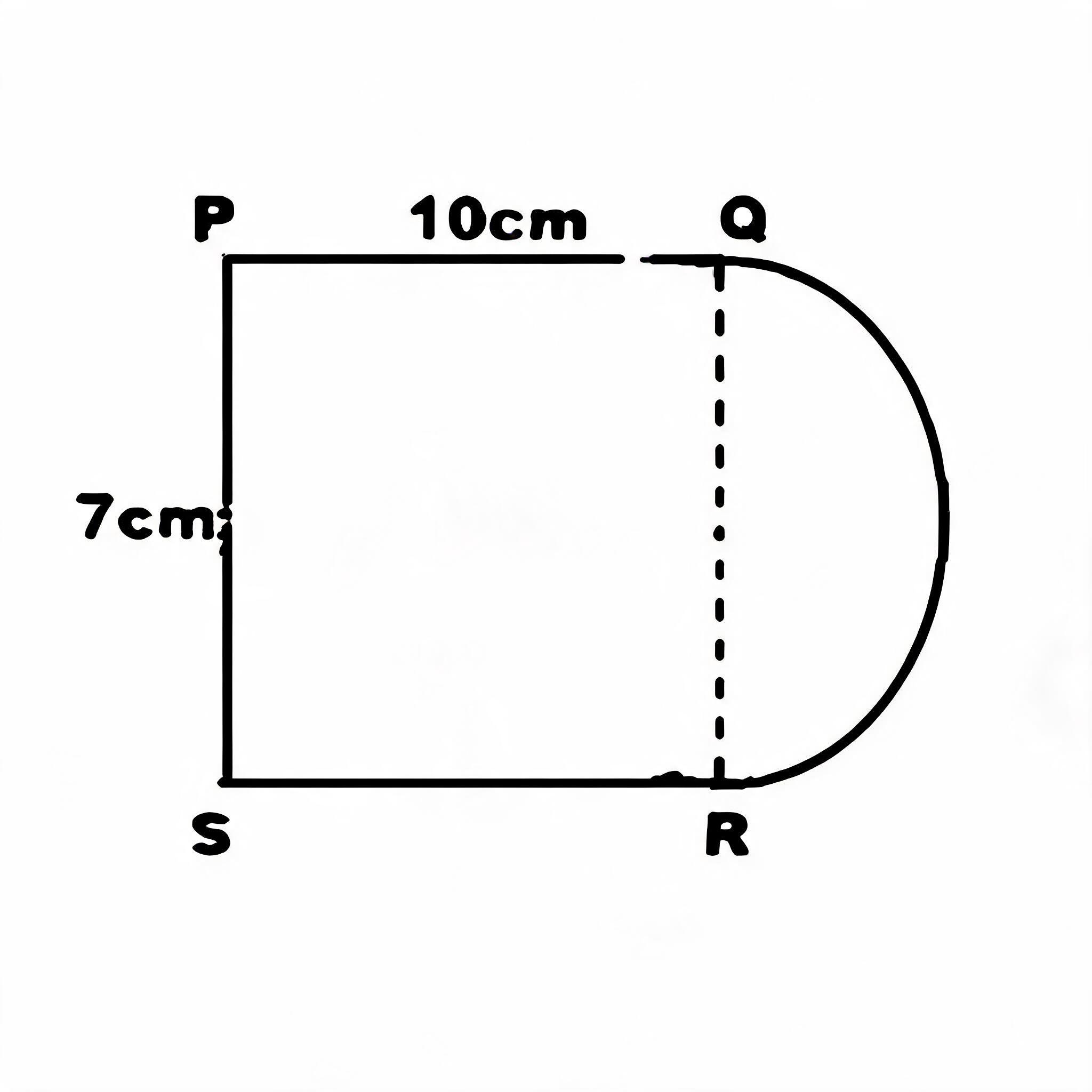
In the diagram above, QR is in the diameter of the semicircle QR. Find the areas of the figure to the nearest whole number.
- A.89
- B.70
- C.90
- D.80
The total area of the figure is the sum of the area of the rectangle and the area of the semicircle. The area of the rectangle is length × breadth = 10 cm × 7 cm = 70 cm². The semicircle has a diameter of 7 cm, so its radius is 3.5 cm, and its area is = × × (3.5)² = 19.25 cm². The total area is 70 cm² + 19.25 cm² = 89.25 cm². The provided correct answer is 90 cm², which is likely the result of rounding up 89.25 or a slight miscalculation in the question's original solution.
Common mistake: A common mistake is to calculate only the area of the rectangle (70 cm²) and select that as the answer, forgetting to add the area of the attached semicircle.
See all 50 JAMB Mathematics 2006 questions
Sign up free to unlock every question in this paper — with the verified answer and Beta's worked explanation on each one. No card needed to begin.
Start free