JAMB Mathematics 2005 Past Questions & Answers
48 JAMB Mathematics 2005 questions with verified answers and worked explanations. Here are the first 10 — sign up free to practise the full paper.
Find the value of m if + =
- A.8
- B.6
- C.5
- D.2
To find the value of m, you first need to convert all the numbers from base m to base 10. So, 13m becomes (1 × m) + 3, 24m becomes (2 × m) + 4, and 41m becomes (4 × m) + 1. Now, set up the equation in base 10: (m + 3) + (2m + 4) = 4m + 1. Simplifying this gives 3m + 7 = 4m + 1, and solving for m gives m = 6.
Common mistake: A common mistake is to add the numbers as if they are in base 10 , which does not help solve the problem and shows a misunderstanding of number bases.
If is divided by and leaves a remainder r, what is the value of r?
- A.zero
- B.1
- C.2
- D.3
To find the remainder, it is easiest to first convert both numbers from base 4 to our normal base 10. The number 321 in base 4 is (3 x 4²) + (2 x 4¹) + (1 x 4⁰), which equals 48 + 8 + 1 = 57 in base 10. Similarly, 23 in base 4 is (2 x 4¹) + (3 x 4⁰), which equals 8 + 3 = 11 in base 10. Now, we divide 57 by 11, which gives 5 with a remainder of 2. Therefore, the value of r is 2.
Common mistake: The most common mistake is performing the division as 321 ÷ 23 in base 10, forgetting that the numbers must first be converted from base 4.
Simplify - * +
- A.
- B.
- C.
- D.
To solve this, first convert all mixed numbers to improper fractions: is , is , and is . Following the order of operations (BODMAS), perform the multiplication first: * = . The expression becomes - + . Find the lowest common denominator for 2, 12, and 5, which is 60, and then calculate . This simplifies to , which is equal to as a mixed number.
Common mistake: Students may make a calculation error when combining the fractions, such as incorrectly adding or subtracting the numerators to get 61 instead of 71, leading to the wrong choice D.
If the interest on N150.00 for years is N4.50, find the interest on N250.00 for 6 months at the same rate
- A.N1.50
- B.N7.50
- C.N15.00
- D.N18.00
First, find the rate of interest using the formula I = PRT/100. From the first statement, N4.50 = (N150 x R x 2.5 years)/100, which gives the rate (R) as 1.2%. Now, use this rate to find the new interest for the second statement, remembering to convert 6 months to 0.5 years. The new interest is I = (N250 x 1.2 x 0.5)/100, which calculates to N1.50.
Common mistake: Students often forget to convert the time from 6 months to 0.5 years, leading them to incorrectly calculate the interest as N18.00.
Three boys shared some oranges. The first received of the oranges and the second received of the remaining. If the third boy received the remaining 12 oranges, how many oranges did they share
- A.60
- B.54
- C.48
- D.42
Let the total number of oranges be 'x'. The first boy received of x, leaving a remainder of of x. The second boy then received of this remainder, which is * = of x. The total fraction shared by the first two boys is + = , so the fraction left for the third boy is 1 - = . If of the total oranges is 12, then the total number of oranges (x) is / 2, which equals 54.
Common mistake: Students often make the mistake of calculating the second boy's share as of the total oranges, instead of of the remainder after the first boy took his share.
( 81 3 4 −<!-- − --> 27 1 3 ) 3 ×<!-- × --> 2 3
Evaluate
- A.3
- B.1
- C.
- D.
To solve this, we first simplify the terms inside the bracket following the order of operations (BODMAS). 81 to the power of is the 4th root of 81 (which is 3) raised to the power of 3, giving 27. Next, 27 to the power of is the cube root of 27, which is 3, so the numerator becomes 27 - 3 = 24. For the denominator, 2 cubed is 8, and 3 times 8 is 24. Finally, dividing the numerator (24) by the denominator (24) gives us 1.
Common mistake: A common mistake is to miscalculate the numerator to be 3 instead of 24, which when divided by the denominator (24) leads to the incorrect option D, .
If 2 = 0.3010 and = 0.4771, evaluate
- A.0.9542
- B.0.6532
- C.0.4771
- D.0.3010
To solve this, first express 4.5 as a fraction, which is . Using the laws of logarithms, can be written as Log₁₀9 - Log₁₀2. Since 9 is 3 squared (3²), Log₁₀9 becomes 2 * Log₁₀3. Substituting the given values, we get - 0.3010, which equals 0.9542 - 0.3010 = 0.6532.
Common mistake: Students may mistakenly calculate Log₁₀9 as 2 * Log₁₀3 to get 0.9542 (Option A) and forget to complete the calculation by subtracting Log₁₀2.
( √ 12 −<!-- − --> √ 3 ) ( √ 12 + √ 3 )
Simplify
- A.zero
- B.
- C.
- D.1
To solve this, first simplify to , which is . Substitute this into the expression to get / . The numerator simplifies to and the denominator simplifies to . The expression becomes / , and after cancelling out from the top and bottom, you are left with .
Common mistake: A common mistake is to rationalize the denominator by multiplying by its conjugate, but then incorrectly calculating the numerator as - = 9 and the denominator as + = 15, leading to or .
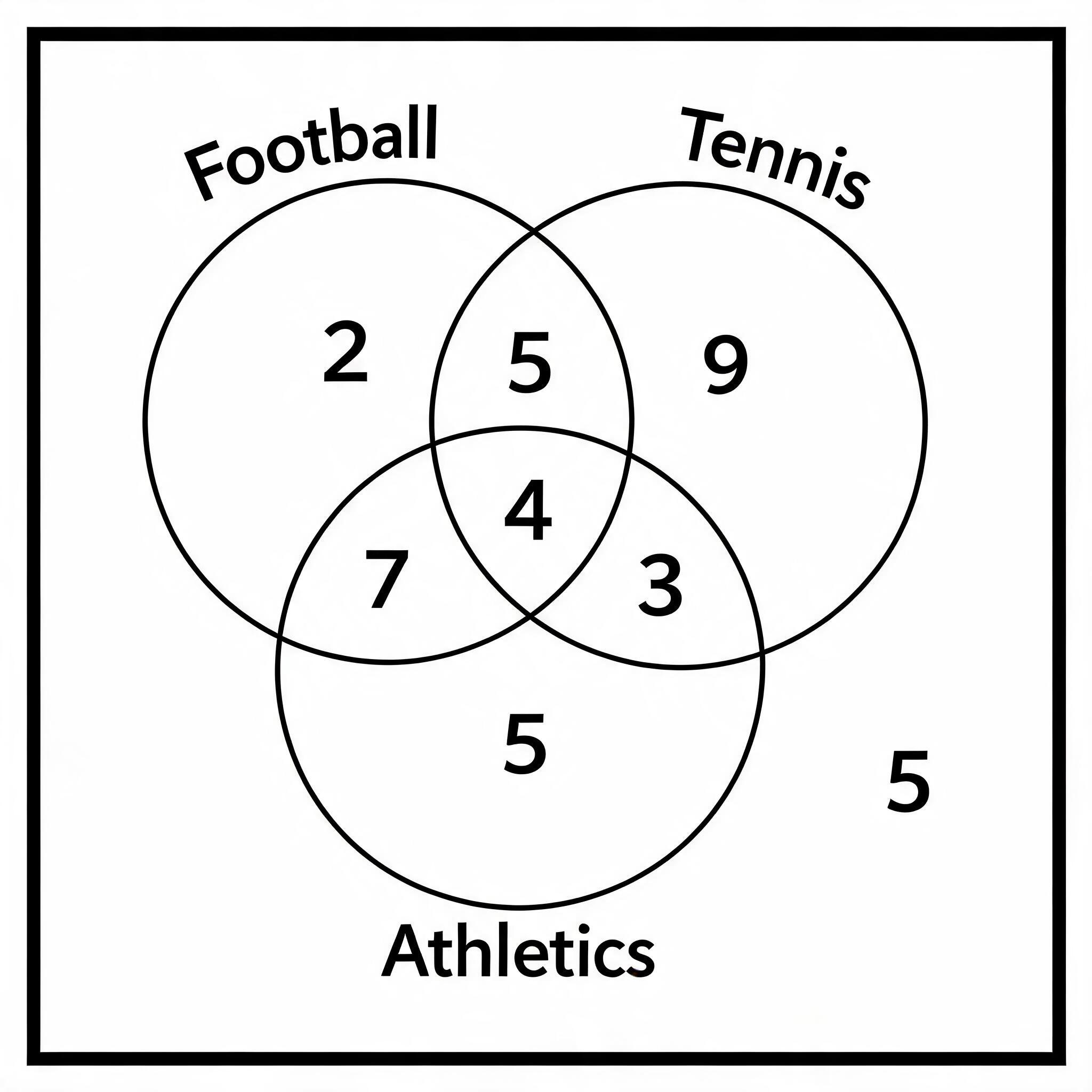
The venn diagram above shows a class of 40 students with the games they play. How many of the students play two games only?
- A.19
- B.16
- C.15
- D.4
To find the number of students who play two games only, we must add the numbers in the regions where exactly two circles overlap. From the Venn diagram, these numbers are 5 (for Football and Tennis only), 7 (for Football and Athletics only), and 3 (for Tennis and Athletics only). Summing these values gives the total: 5 + 7 + 3 = 15.
Common mistake: A common mistake is to also include the 4 students who play all three games, leading to the incorrect answer of 19 (Option A).
If m = 3, p = -3, q = 7 and r = , evaluate m(p+q+r)
- A.19.50
- B.19.15
- C.18.95
- D.18.05
To solve this, first substitute the given values of m, p, q, and r into the expression m(p+q+r). This gives you . Next, simplify the expression inside the bracket by first converting the fraction to its decimal form, which is 2.5. Adding the numbers inside the bracket gives -3 + 7 + 2.5 = 6.5. Finally, multiply this result by m, which is 3, so you have 3 x 6.5 = 19.50.
Common mistake: A common mistake is to ignore the brackets and multiply m by p first (3 x -3), which violates the BODMAS rule requiring you to solve the expression in the bracket first.
See all 48 JAMB Mathematics 2005 questions
Sign up free to unlock every question in this paper — with the verified answer and Beta's worked explanation on each one. No card needed to begin.
Start free