JAMB Mathematics 2004 Past Questions & Answers
49 JAMB Mathematics 2004 questions with verified answers and worked explanations. Here are the first 25 — sign up free to practise the full paper.
An arc of a circle of length 22 cm subtends an angle of 3x° at the center of the circle. Find the value of x if the diameter of the circle is 14 cm
- A.60°
- B.120°
- C.180°
- D.30°
The formula for the length of an arc is (θ/360) × 2πr. From the question, the length of the arc is 22 cm, the angle θ is 3x°, and the radius r is half of the diameter, which is = 7 cm. Substituting these values and using π = , we get 22 = (3x/360) × 2 × × 7. Simplifying the equation gives 22 = (3x/360) × 44, which leads to = 3x/360. Solving for x, we find 3x = 180, so x = 60.
Common mistake: A common mistake is to solve for 3x and find 180, then forget to divide by 3 to find the final value of x, leading to the incorrect choice of 180°.
Solution: P Q = ( β −<!-- − --> 1 ) 2 + ( 1 −<!-- − --> α ) 2 3 = ( β 2 −<!-- − --> 2 β 2 + 1 + 1 −<!-- − --> 2 α + α 2 ) 3 = ( α 2 + β 2 −<!-- − --> 2 α + 2 β + 2 ) 3 = ( α 2 + β 2 −<!-- − --> 2 ( α + β ) + 2 ) 3 = ( α 2 + β 2 −<!-- − --> 2 ∗<!-- ∗ --> 2 + 2 ) 3 = ( α 2 + β 2 −<!-- − --> 2 ) 9 = ( α 2 + β 2 −<!-- − --> 2 ) α 2 + β 2 = 9 + 2 α 2 + β 2 = 11
Find the value of + if α + β = 2 and the distance between points (1, α) and (β, 1)is 3 units
- A.14
- B.3
- C.5
- D.11
The distance formula between two points (x₁, y₁) and (x₂, y₂) is d² = (x₂ - x₁)² + (y₂ - y₁)². Given the points (1, α) and (β, 1) and distance d = 3, we substitute these values: 3² = (β - 1)² + (1 - α)². Expanding this gives 9 = β² - 2β + 1 + 1 - 2α + α², which simplifies to 9 = α² + β² - 2(α + β) + 2. Since we are given α + β = 2, we have 9 = α² + β² - 2(2) + 2, which means 9 = α² + β² - 2. Therefore, α² + β² = 9 + 2 = 11.
Common mistake: Students might forget to square the distance (3² = 9) and instead use 3 in the equation, which leads to an incorrect answer of 5.
The sum of the interior angles of a pentagon is 6x + 6y. Find y in the terms of x
- A.y = 90 - x
- B.y = 150 - x
- C.y = 60 - x
- D.y = 120 -x
The formula for the sum of interior angles in a polygon with 'n' sides is (n - 2) × 180°. For a pentagon, n=5, so the sum is × 180° = 3 × 180° = 540°. The question gives the sum as 6x + 6y, so we set 6x + 6y = 540. Dividing the entire equation by 6 gives x + y = 90, and making y the subject gives y = 90 - x.
Common mistake: Students might mistakenly use the sum of exterior angles (360°) instead of the sum of interior angles (540°), leading them to incorrectly choose y = 60 - x.
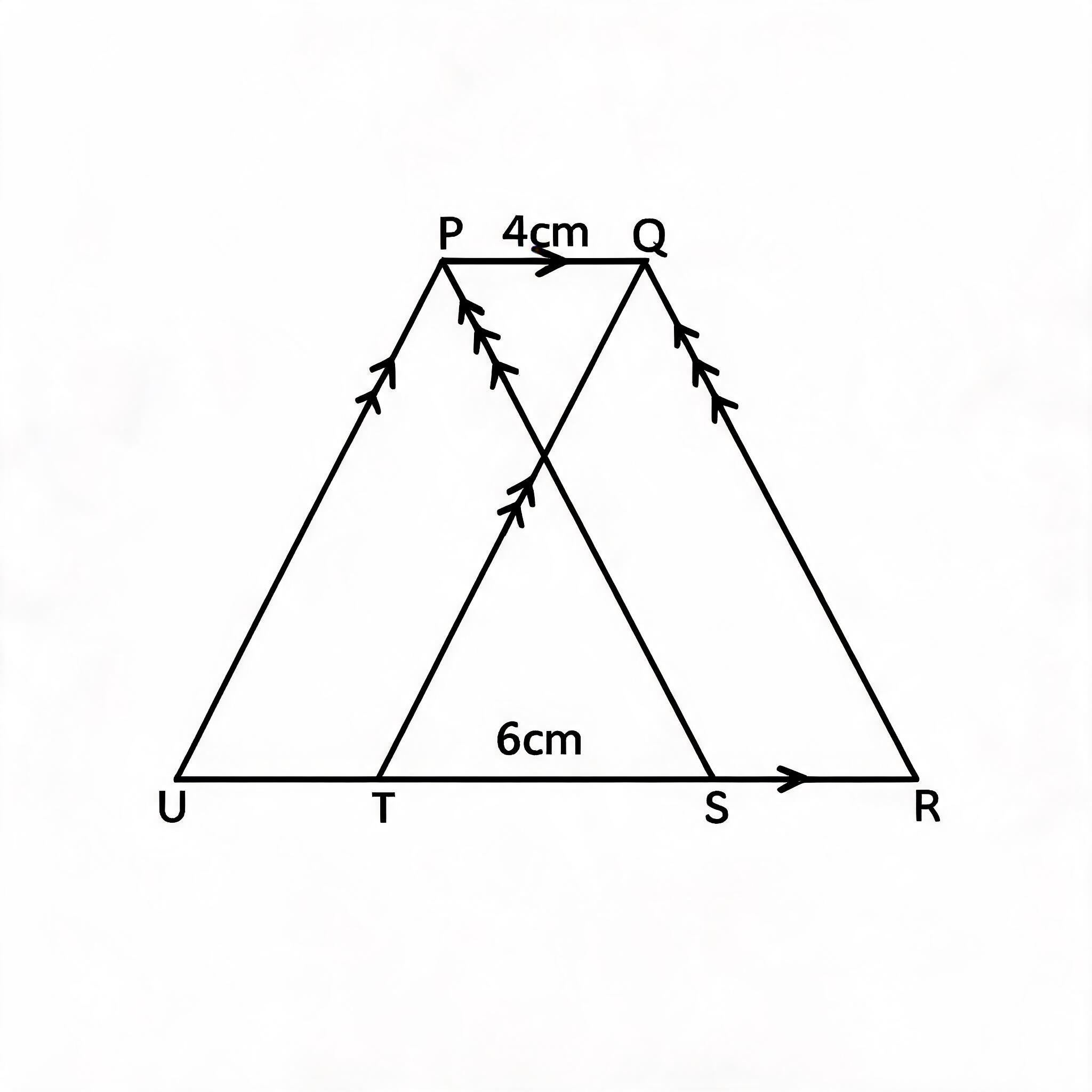
In the diagram above, PQ = 4 cm and TS = 6 cm. If the area of parallelogram PQTU is 32 cm 2, find the area of the trapezium PQRU
- A.60 cm2
- B.72 cm2
- C.48 cm2
- D.24 cm2
First, find the height using the area of the parallelogram PQTU. Since Area = base × height, we have 32 = 4 × h, which gives the height h = 8 cm. Next, find the length of the longer parallel side UR, which is UT + TS + SR. As PQTU is a parallelogram, UT = PQ = 4 cm, and by symmetry in the diagram, we can infer SR = UT = 4 cm. Therefore, the full length of UR is 4 + 6 + 4 = 14 cm. Finally, calculate the area of the trapezium PQRU using the formula ½ × (sum of parallel sides) × height, which is ½ × × 8 = 72 cm².
Common mistake: A common mistake is to calculate the area of a parallelogram with base TS (6 cm) and the derived height (8 cm) to get 48 cm², forgetting this is not the area of the entire trapezium PQRU.
M i d p o i n t = ( x 1 + x 2 ) 2 ; ( y 1 + y 2 ) 2 = ( −<!-- − --> 3 + 5 ) 2 ; ( 5 −<!-- − --> 3 ) 2 = 2 2 ; 2 2 = ( 1 , 1 )
Find the midpoint of the line joining P(-3, 5) and Q(5, -3).
- A.(1, 1)
- B.(2, 2)
- C.(4, 4)
- D.(4, -4)
To find the midpoint of a line joining two points, you calculate the average of their x-coordinates and the average of their y-coordinates. For points P(-3, 5) and Q(5, -3), the x-coordinate of the midpoint is / 2 = 2 / 2 = 1. The y-coordinate is (5 + (-3)) / 2 = 2 / 2 = 1. Therefore, the midpoint is (1, 1).
Common mistake: A common mistake is to subtract the coordinates instead of adding them before dividing by two, which would incorrectly lead to the answer (4, -4).
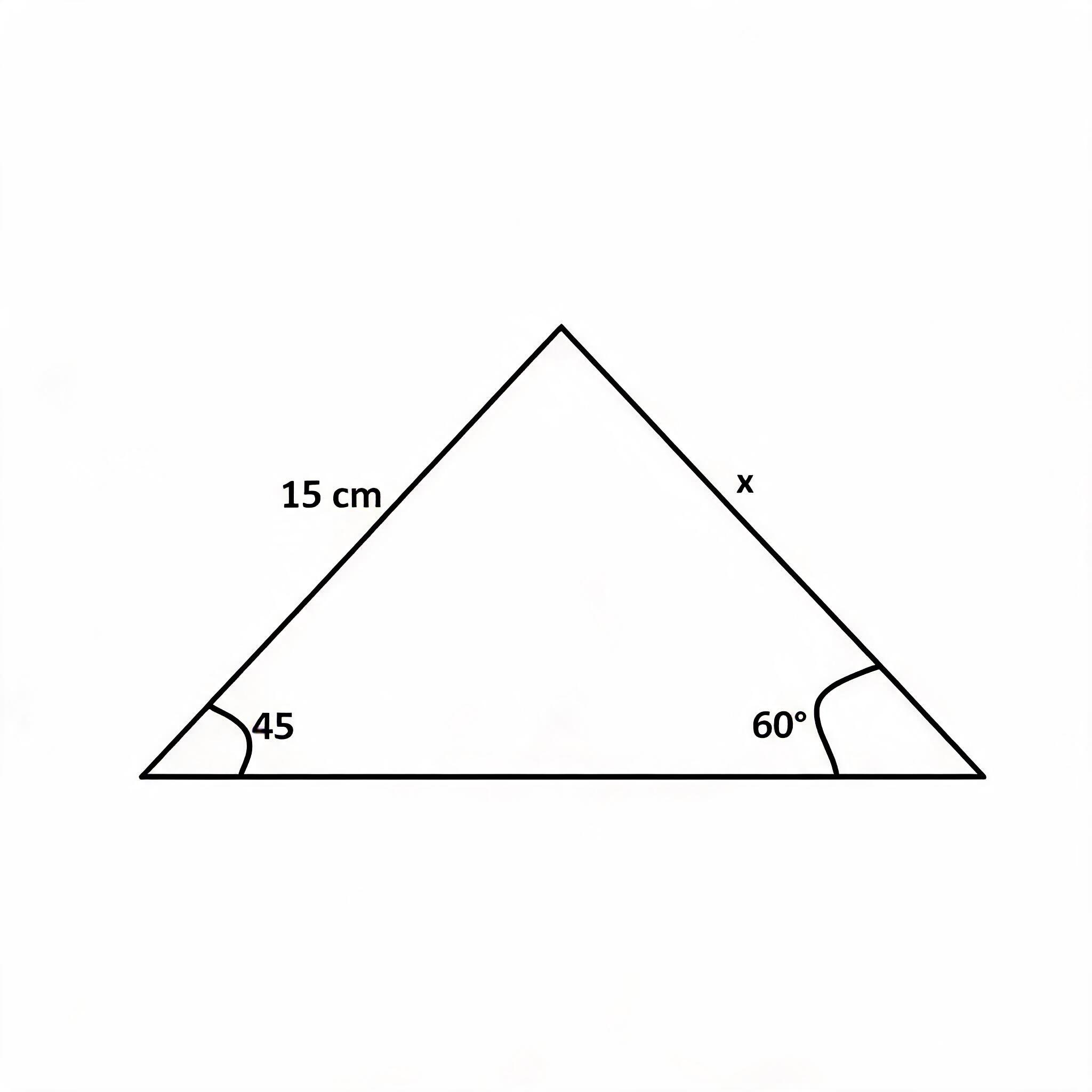
X s i n 45 = 15 s i n 60 X = 15 s i n 45 s i n 60 X = 15 ×<!-- × --> ( 1 2 ) 3 2 X = 15 2 ×<!-- × --> 2 3 X = 30 6 X = 30 6 ×<!-- × --> 6 6 = 30 6 6 = 5 6
Find the value of x in the figure above
- A.
- B.
- C.
- D.
To find the value of x in the given triangle, you apply the Sine Rule, which is used for non-right-angled triangles. The rule states that the ratio of a side to the sine of its opposite angle is constant, so we set up the equation x/sin(45°) = 15/sin(60°). By solving for x, we get x = (15 × sin(45°)) / sin(60°), which simplifies to x = / , resulting in the final answer .
Common mistake: A common mistake is incorrectly applying the Sine Rule by matching a side with the wrong opposite angle, which leads to an incorrect proportion and a wrong answer.
Determine the locus of a point inside a square PQRS which is eqidistant from PQ and QR
- A.The diagonal QS
- B.the perpendicular bisector of PQ
- C.The diagonal PR
- D.side SR
The locus of a point that is equidistant from two intersecting lines is the line that bisects the angle between them. In the square PQRS, the sides PQ and QR are two lines that intersect at point Q, forming a 90° angle. The diagonal of a square bisects the corner angles, so the diagonal QS cuts the angle at Q into two equal halves, making it the correct locus.
Common mistake: Students might mistakenly choose the other diagonal, PR, without realizing that the locus must bisect the angle formed by the specific sides mentioned (PQ and QR), which meet at point Q.
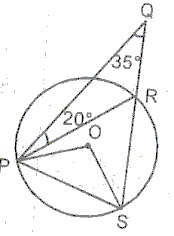
P, R and S lie on a circle center as shown above while Q lies outside the circle. Find ∠PSO
- A.45°
- B.55°
- C.35°
- D.40°
First, find the third angle in triangle PQR: ∠PRQ = 180° - (20° + 35°) = 125°. Since the points Q, R, and S lie on a straight line, the angle on the straight line ∠PRS = 180° - 125° = 55°. According to circle theorems, the angle an arc subtends at the center (∠POS) is twice the angle it subtends at the circumference (∠PRS), so ∠POS = 2 × 55° = 110°. Triangle POS is an isosceles triangle because OP and OS are both radii, so its base angles are equal (∠OPS = ∠PSO), which means ∠PSO = (180° - 110°) / 2 = 35°.
Common mistake: Students often mistakenly use ∠PQR (35°) as the angle subtended by arc PS at the circumference, which leads to the incorrect answer of 55°.
The locus of a point which is 5 cm from the line LM is a
- A.line distance 10 cm from LM and parallel to LM
- B.pair of line on opposite sides of LM and parallel to it, each distance 5 cm from LM
- C.line parallel to LM and 5 cm from LM
- D.pair of parallel lines on one side of LM and parallel to LM
Locus describes the path of a point that moves according to a specific rule. The rule here is that the point must always be 5 cm away from the line LM. A point can be 5 cm away from a line on either of its two sides, so the complete path is a pair of lines. These two lines are on opposite sides of LM, parallel to it, and each is 5 cm away from it.
Common mistake: Students often mistakenly choose option C, forgetting that the point can be 5 cm away from the line on both opposite sides, not just one.
If y = 3 cos(x/3), find dy/dx when x = (3π/2)
- A.1
- B.-3
- C.2
- D.-1
To find dy/dx, we must differentiate the function y = 3 cos(x/3) using the chain rule. The derivative of 3cos(u) is -3sin(u), and the derivative of the inner function (x/3) is , so dy/dx = -3sin(x/3) * , which simplifies to -sin(x/3). We then substitute x = 3π/2 into the derivative, giving us -sin((3π/2)/3) which is -sin(π/2). Since sin(π/2) equals 1, the final answer is -1.
Common mistake: Students often forget to apply the chain rule correctly, neglecting to multiply by the derivative of the inner function , which leads to the incorrect answer -3.
Find the derivatives of with respect to x
- A.6
- B.-3
- C.
- D.6x-1
To find the derivative, first expand the expression: becomes 2 - 2x + 3x - 3x², which simplifies to 2 + x - 3x². Next, differentiate this simplified expression term by term using the power rule. The derivative of the constant 2 is 0, the derivative of x is 1, and the derivative of -3x² is -6x. Adding these results together gives 0 + 1 - 6x, which equals 1 - 6x.
Common mistake: Students may mistakenly differentiate each bracket separately (getting 3 and -1) and then multiply the results, which incorrectly gives -3 (Option B).
What is the rate of change of the volume v of a hemisphere with respect to its radius r when r = 2?
- A.8π
- B.16π
- C.2π
- D.4π
The volume of a hemisphere is given by the formula v = . The 'rate of change' of the volume with respect to the radius is found by differentiating v with respect to r, which gives dv/dr = 2πr². To find the rate of change when r = 2, we substitute 2 for r in the derivative. This gives 2π(2)² = 2π(4) = 8π.
Common mistake: Students might mistakenly differentiate the volume of a full sphere instead of a hemisphere, which leads to the incorrect answer of 16π.
Find the derivatives of the function y = 2x2(2x - 1) at the point x = -1
- A.18
- B.16
- C.-4
- D.-6
First, expand the function y = 2x²(2x - 1) to get y = 4x³ - 2x². Next, find the derivative (dy/dx) using the power rule, which gives dy/dx = 12x² - 4x. Finally, substitute the given point x = -1 into the derivative: 12(-1)² - 4(-1) = 12(1) + 4, which simplifies to 16.
Common mistake: Students may mistakenly differentiate each part of the product separately and subtract (i.e., find the derivative of 2x² and subtract the derivative of 2x-1), which gives 4x - 2, and evaluates to -6 at x=-1, leading to option D.
∫ 1 3 ( X 2 − 1 ) d x
Evaluate ∫_13(X2-1)dx
- A.
- B.
- C.
- D.
To evaluate the definite integral, first integrate the expression (X² - 1) with respect to X. The integral of X² is X³/3 and the integral of -1 is -X, so we get [X³/3 - X]. Next, substitute the upper limit (3) and the lower limit (1) into the result and subtract: - . This simplifies to - , which is 6 - , giving the final answer .
Common mistake: A common mistake is to incorrectly subtract the value at the upper limit from the value at the lower limit, which results in the negative of the correct answer, leading to option C.
Some white balls put in a basket containing twelve red balls and sixteen black balls. If the probability of picking a white balls from the baskets is , how many white balls were introduced?
- A.12
- B.21
- C.28
- D.32
Let the number of white balls be 'w'. The total number of balls in the basket is the sum of red, black, and white balls, which is 12 + 16 + w = 28 + w. The probability of picking a white ball is the number of white balls divided by the total number of balls, so P(white) = w / (28 + w). Since we are given that this probability is , we can set up the equation w / (28 + w) = . Cross-multiplying gives 7w = 3(28 + w), which simplifies to 7w = 84 + 3w, and solving for w gives w = 21.
Common mistake: Students might mistakenly calculate the total number of balls as just the red and black balls (28), leading to the incorrect equation w/28 = , which wrongly solves to w = 12 (Option A).
find the mean deviation of 1, 2, 3 and 4
- A.2.5
- B.2.0
- C.1.0
- D.1.5
First, find the mean (average) of the numbers, which is / 4 = 2.5. Next, find the absolute difference (deviation) of each number from this mean: |1 - 2.5| = 1.5, |2 - 2.5| = 0.5, |3 - 2.5| = 0.5, and |4 - 2.5| = 1.5. Finally, calculate the mean of these deviations, which is / 4 = 4 / 4 = 1.0.
Common mistake: Students often mistakenly choose the mean of the data (2.5) instead of calculating the mean of the deviations from that mean.
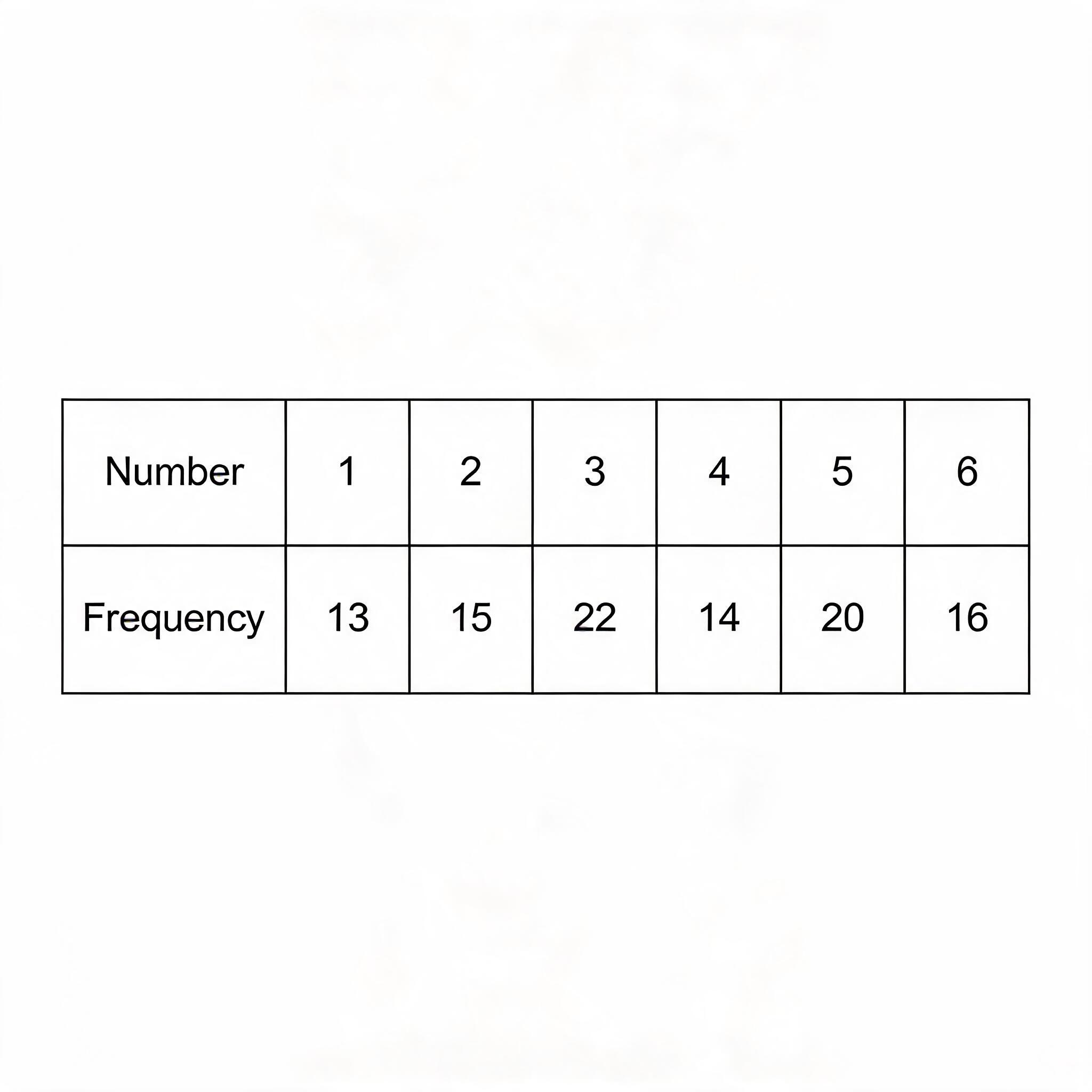
An unbiased die is rolled 100 times and the outcome is tabulated above. What is the probability of obtaining a 5?
- A.
- B.
- C.
- D.
This question asks for the experimental probability, which is found by dividing the number of times an event happened by the total number of trials. According to the frequency table in the image, the number 5 was obtained 20 times. Since the die was rolled a total of 100 times, the probability of obtaining a 5 is 20 divided by 100, which simplifies to .
Common mistake: Students often confuse experimental probability with theoretical probability and may incorrectly choose , which is the theoretical chance of rolling a 5 on a single fair die.
The pie chart above shows the distribution of the crops harvested from a farmland in a year. If 3000 tonnes of millet is harvested, what amount of beans is harvested
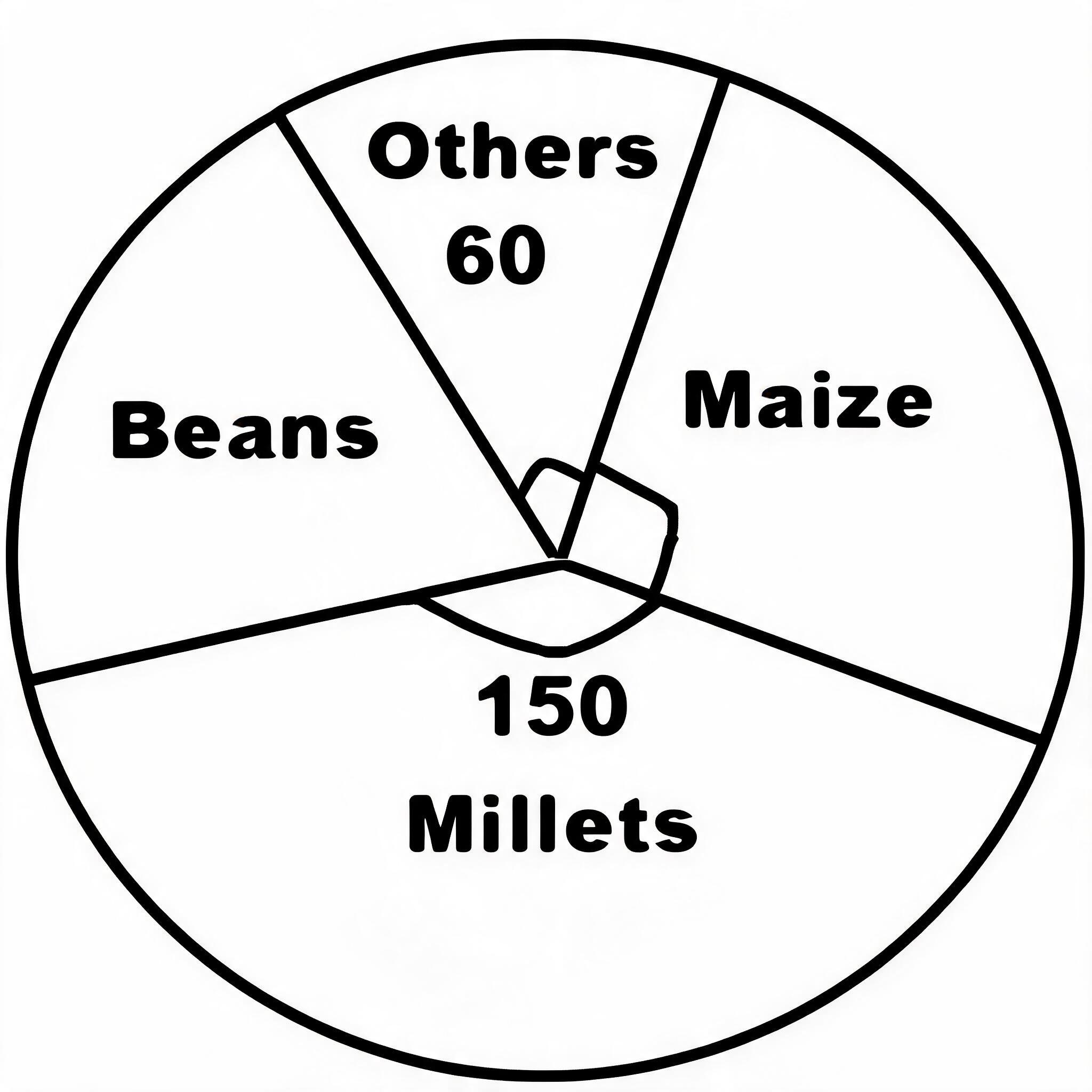
- A.6000 tonnes
- B.1500 tonnes
- C.1200 tonnes
- D.9000 tonnes
First, find the angle representing Beans on the pie chart. The total angle in a circle is 360°, and the image shows angles for Millet (150°), Maize (90°), and Others (60°). The angle for Beans is 360° - (150° + 90° + 60°) = 60°. Since 150° corresponds to 3000 tonnes of millet, we can set up a proportion to find the amount of beans (B): B/60° = 3000 tonnes/150°. Solving for B gives B = * 60 = 20 * 60 = 1200 tonnes.
Common mistake: A common mistake is failing to identify the right angle (90°) for Maize, which leads to an incorrect calculation for the remaining angle for Beans, often resulting in choosing 1500 tonnes.
In how many ways can 2 students be selected from a group of 5 students in a debating competition?
- A.25 ways
- B.10 ways
- C.15 ways
- D.20 ways
This question is about selection where the order does not matter, which is a combination problem. We need to find the number of ways to choose 2 students from 5, represented as ⁵C₂. The formula is nCr = n! / (r!(n-r)!), so we have 5! / = 5! / (2!3!) = (5 x 4) / (2 x 1) = 10.
Common mistake: A common mistake is to calculate the permutation (⁵P₂ = 20) instead of the combination, which leads to option D, by wrongly assuming the order of selection is important.
The mean age of a group of students is 15 years. When the age of a teacher, 45 years old, is added to the age of the students, the mean of their ages becomes 18 years. Find the number of the students in the group
- A.0
- B.7
- C.42
- D.15
Let 'n' be the number of students. The sum of their ages is 15n. When the teacher's age is added, the new sum is 15n + 45 and the total number of people is n + 1. The new mean is 18, so we set up the equation (15n + 45) / (n + 1) = 18. Solving this gives 15n + 45 = 18n + 18, which simplifies to 3n = 27, so n = 9. The correct answer is 9, which is not among the options, indicating an error in the question.
Common mistake: A common mistake is forgetting to add 1 to the total number of people in the denominator when calculating the new mean.
A container has 30 gold medals, 22 silver medals and 18 bronze medals. If one medals is selected at the random from the container, what is the probability that it is not a gold medal?
- A.
- B.
- C.
- D.
First, calculate the total number of medals in the container, which is 30 + 22 + 18 = 70. The question asks for the probability of selecting a medal that is not gold, so we find the number of silver and bronze medals, which is 22 + 18 = 40. The probability is the number of non-gold medals divided by the total number of medals, which is and simplifies to .
Common mistake: A common mistake is to calculate the probability of picking a gold medal , which is option D, instead of the probability of *not* picking a gold medal.
3 C 1 × 9 C 5 = 3 ! ( 3 − 1 ) ! 1 ! × 9 ! ( 9 − 5 ) ! 5 ! \= 3 ! 2 ! 1 ! × 9 ! 4 ! 5 ! \= 3 × 2 ! 2 ! × 1 × 9 × 8 × 7 × 6 × SOLUTION : 5 ! 4 × 3 × 2 × 1 × 5 ! \= 3 × 9 × 2 × 7 \= 378 w a y s
A committee of six is to be formed by a state governor from nine state commissioners and three members of the state house of assembly. In how many ways can the members of the committee be chosen so as to include one member of the house of assembly
- A.378 ways
- B.462 ways
- C.840 ways
- D.924 ways
To solve this, you find the total number of people available, which is 9 commissioners + 3 assembly members = 12 people. The question requires forming a committee of 6 from these 12 people, which is a combination problem calculated as ¹²C₆. The formula for this is divided by , which equals 924. This represents the total number of ways to choose the committee from the entire group.
Common mistake: A common mistake is to strictly follow the condition of including exactly 'one member of the house of assembly', leading to the calculation ³C₁ × ⁹C₅ = 378, which is a different option.
The weight of 10 pupils in a class are 15 kg, 16 kg, 17 kg, 18 kg, 16 kg, 17 kg, 17 kg, 17 kg, 18 kg, and 16 kg. What is the range of this distribution?
- A.4
- B.3
- C.1
- D.2
The range of a set of data is the difference between the highest value and the lowest value. In this distribution of weights, the highest value (maximum) is 18 kg and the lowest value (minimum) is 15 kg. Therefore, the range is calculated by subtracting the minimum from the maximum: 18 kg - 15 kg = 3 kg.
Common mistake: A common mistake is to count the number of unique weights (15, 16, 17, 18), which is 4, instead of calculating the difference between the highest and lowest values.
I. Rectangular bars of equal width II. The height of each rectangular bar is proportional to the frequency of the corresponding class interval. III. Rectangular bars have common sides with no gaps in between A histogram is described completely by
- A.I, II and III
- B.I and II
- C.II and III
- D.I and III
A histogram is a specific type of chart for representing the frequency distribution of continuous data. Statement I is correct because the bars represent class intervals, which are typically of equal width. Statement II is the core principle, as the bar's height shows the frequency for that interval. Statement III is what distinguishes a histogram from a bar chart; the bars touch to show that the data is continuous with no gaps.
Common mistake: Students often confuse a histogram with a bar chart, forgetting that the bars in a histogram must have no gaps between them (statement III) to represent continuous data.
y = is inversely proportional to x and y = 4 when x = . Find x when y = 10.
- A.2
- B.10
- C.
- D.
Since y is inversely proportional to x, the relationship can be written as y = k/x, where k is the constant of variation. We first find k by substituting the given values: 4 = k / , which simplifies to 4 = 2k, so k = 2. Now the equation is y = 2/x. To find x when y = 10, we solve the equation 10 = 2/x, which gives 10x = 2, and therefore x = = .
Common mistake: A common mistake is to confuse inverse with direct variation, or to forget to calculate the constant 'k' and incorrectly assume the relationship is y = 1/x, which would lead to the wrong answer of .
See all 49 JAMB Mathematics 2004 questions
Sign up free to unlock every question in this paper — with the verified answer and Beta's worked explanation on each one. No card needed to begin.
Start free