JAMB Physics 2007 Past Questions & Answers
50 JAMB Physics 2007 questions with verified answers and worked explanations. Here are the first 25 — sign up free to practise the full paper.
The unit of moment of a couple can be expressed in?
- A.N m⁻¹
- B.N m⁻²
- C.N m
- D.N m²
The moment of a couple is a measure of its turning effect. It is calculated by multiplying the magnitude of one of the forces (F) by the perpendicular distance (d) between the two forces. Since the S.I. unit of force is the Newton (N) and the S.I. unit of distance is the meter (m), the unit of the moment is the product of these two, which is Newton-meter (Nm).
Common mistake: Students might mistakenly choose N m⁻² because they confuse the formula for moment (Force × distance) with the formula for pressure (Force / Area).
A gramophone record takes 5s to reach its constant angular velocity of 4π rads⁻¹ from rest. Find its constant angular acceleration.
- A.0.4π rads⁻²
- B.0.8π rads⁻²
- C.1.3π rads⁻²
- D.20.0π rads⁻²
Angular acceleration is the rate of change of angular velocity. To find it, we use the formula: angular acceleration (α) = (final angular velocity - initial angular velocity) / time. From the question, the final angular velocity is 4π rads⁻¹, the initial angular velocity is 0 (since it started from rest), and the time taken is 5s. Substituting these values, we get α = (4π - 0) / 5, which simplifies to 0.8π rads⁻².
Common mistake: A common mistake is to incorrectly multiply the final angular velocity by the time , instead of dividing the change in velocity by the time.
A car of mass 1500 kg goes round a circular curve of radius 50m at a speed of 40 ms⁻¹. The magnitude of the centripetal force on the car is?
- A.4.8 × 10⁴ N
- B.4.8 × 10³ N
- C.1.2 × 10³ N
- D.1.2 × 10² N
The centripetal force required for an object to move in a circle is calculated using the formula F = mv²/r. For this car, the mass (m) is 1500 kg, the speed (v) is 40 m/s, and the radius (r) is 50 m. By substituting these values, we get F = / 50, which equals / 50, resulting in a force of 48,000 N or 4.8 × 10⁴ N.
Common mistake: A common mistake is forgetting to square the velocity (v), leading students to incorrectly calculate F = mv/r, which results in option C .
Two spheres of masses 5.0 kg and 10.0 kg are 0.3 m apart. Calculate the force of attraction between them?
- A.3.50 × 10⁻¹⁰ N
- B.3.71 × 10⁻⁸ N
- C.3.57 × 10⁻² N
- D.4.00 × 10² N
To find the force of attraction, we use Newton's Law of Universal Gravitation, which states F = Gm₁m₂/r². Given G = 6.67 × 10⁻¹¹, m₁ = 5.0 kg, m₂ = 10.0 kg, and the distance r = 0.3 m. Substituting these values gives F = / (0.3)², which simplifies to F = / 0.09, resulting in a force of approximately 3.71 × 10⁻⁸ N.
Common mistake: A common mistake is forgetting to square the distance 'r' in the denominator, which is a key part of the inverse square law for gravity.
A machine has a velocity ratio of 4. if it requires 800 N to overcome a load of 1600 N,what is the efficiency of the machine?
- A.60%
- B.50%
- C.40%
- D.20%
Efficiency is calculated using the formula: Efficiency = (Mechanical Advantage / Velocity Ratio) x 100%. First, find the Mechanical Advantage (MA), which is Load divided by Effort: MA = 1600 N / 800 N = 2. Then, use the given Velocity Ratio (VR) of 4 in the efficiency formula: Efficiency = x 100%. This gives an efficiency of 0.5 x 100%, which is 50%.
Common mistake: A common mistake is to incorrectly calculate the Mechanical Advantage by dividing the Effort by the Load instead of Load by Effort, leading to a wrong efficiency calculation.
A reservoir 500 m deep is filled with a fluid of density 850 kgm⁻³. If the atmospheric pressure is 1.05 × 10⁵ Nm⁻², the pressure at the bottom of the reservoir is. [g = 10ms⁻²]
- A.4.72 × 10⁶ Nm⁻²
- B.4.36 × 10⁶ Nm⁻²
- C.4.28 × 10⁶ Nm⁻²
- D.4.25 × 10⁶ Nm⁻²
The total pressure at the bottom of the reservoir is the sum of the atmospheric pressure and the pressure from the fluid column. First, calculate the fluid pressure using the formula P = hρg, which is 500 × 850 × 10 = 4,250,000 Nm⁻² or 4.25 × 10⁶ Nm⁻². Then, add the atmospheric pressure to this value: + = 4,250,000 + 105,000 = 4,355,000 Nm⁻², which is approximately 4.36 × 10⁶ Nm⁻².
Common mistake: Students often choose option D because they calculate only the pressure of the fluid (hρg) and forget to add the atmospheric pressure to find the total pressure.
A piece of iron weighs 250 N in air and 200 N in a liquid of density 1000 kgm⁻³. The volume of the iron is?
- A.5.0 × 10⁻³ m³
- B.4.5 × 10⁻³ m³
- C.2.5 × 10⁻³ m³
- D.2.0 × 10⁻³ m³
According to Archimedes' principle, the upthrust on the iron is the difference between its weight in air and its apparent weight in the liquid, which is 250 N - 200 N = 50 N. This upthrust is also equal to the weight of the liquid displaced (density × volume × g). To find the volume, we rearrange the formula: Volume = Upthrust / (density × g). Using g = 10 m/s², the volume is 50 / = 0.005 m³, which is 5.0 × 10⁻³ m³.
Common mistake: A common mistake is to incorrectly use the weight of the iron (250 N) instead of the upthrust (50 N) in the calculation, which would lead to the wrong answer C.
A clinical thermometer is different from other mercury in glass thermometers owing to
- A.the constriction on its stem
- B.the grade of mercury used in it
- C.its long stem
- D.its wide range of temperatures
A clinical thermometer is specially designed to measure body temperature. It has a narrow bend or kink called a constriction just above the mercury bulb. This constriction prevents the mercury from falling back down the tube immediately after the thermometer is removed from the body, which allows enough time for the temperature to be read accurately.
Common mistake: Students might mistakenly choose option D, thinking a clinical thermometer has a wide range, but it actually has a very narrow range specifically for measuring human body temperature.
I. Use a liquid with a high melting point. II. use a liquid of high volume expansivity. III. use a capillary tube of large diameter. which of the above best describes how the sensitivity of a liquid-in-glass thermometer can be enhanced?
- A.I only
- B.II. Only
- C.I and II only
- D.II and III only
The sensitivity of a thermometer is its ability to show a large, noticeable change in reading for a small change in temperature. To achieve this, the liquid inside must expand a lot when it gets slightly hotter, which means it must have a high volume expansivity. This large expansion causes a significant rise in the liquid column, making small temperature changes easy to detect.
Common mistake: Students often mistakenly think a large diameter tube (statement III) increases sensitivity, but it actually reduces it; a narrow tube is required to make the liquid rise higher for the same amount of expansion.
2 kg of water is heated with a heating coil which draws 3.5 A from a 200 V mains for 2 minutes. What is the increase in temperature of the water? [specific heat capacity of water = 4200 Jkg⁻¹K⁻¹]
- A.30°
- B.25°
- C.15°
- D.10°
First, calculate the electrical energy supplied by the coil using the formula Energy = Current × Voltage × time (E = IVt). Remember to convert the time from minutes to seconds (2 minutes = 120 seconds), so the energy supplied is 3.5 A × 200 V × 120 s = 84,000 Joules. This electrical energy is then converted to heat energy absorbed by the water, given by Heat = mass × specific heat capacity × temperature change (Q = mcΔθ). By equating the energy supplied to the heat absorbed (IVt = mcΔθ), we get 84,000 = 2 × 4200 × Δθ, which simplifies to 84,000 = 8400 × Δθ. Solving for the temperature change (Δθ) gives 10°C.
Common mistake: The most common mistake is forgetting to convert the time from 2 minutes to 120 seconds before calculating the electrical energy, which leads to a significantly underestimated answer.
I. Increase the melting point of the liquid. II. Increase the boiling point of the liquid. III. Decrease the melting point of the liquid. IV. Decrease the boiling point of the liquid. which of the statement above about the effect on increase in pressure in a liquid are correct?
- A.I and II only
- B.I and III only
- C.II and III only
- D.III and IV only
Increasing the pressure on a liquid makes it more difficult for its molecules to escape and turn into gas, so a higher temperature is needed to make it boil. This is why the boiling point increases (statement II). For water, which is an unusual substance that expands on freezing, increasing pressure helps to melt the ice because liquid water is denser than ice. This means the melting point decreases under pressure (statement III), a process called regelation.
Common mistake: Students often mistakenly believe that increasing pressure always makes it harder for a substance to change state, leading them to incorrectly choose option A where both melting and boiling points increase.
I. Mass II. Density III. Temperature IV. Nature of substance which of the above affect diffusion?
- A.I and II only
- B.I,II and IV only
- C.II, III and IV only
- D.I, II, III and IV
Diffusion is the movement of particles, and its rate is influenced by several factors. According to Graham's law, the rate of diffusion is inversely proportional to the square root of the mass or density of the particles, meaning lighter particles diffuse faster. Increasing the temperature gives particles more kinetic energy, causing them to move and mix more quickly. The nature of the substance, such as its state (gas, liquid) and the medium it is diffusing through, also significantly affects how easily particles can move.
Common mistake: Students might incorrectly choose option C, forgetting that while density is a factor, the mass of the diffusing particles is also a fundamental property in Graham's law of diffusion.
The blade of a hoe feel colder to touch in the morning than the wooden handle because the
- A.handle is a better conductor of heat than blade
- B.handle contains stored energy in form of heat
- C.blade is a better conductor of heat than the handle
- D.blade is placed at a lower temperature than the heat
The feeling of 'cold' is not just about temperature, but about how fast heat is transferred away from your body. Both the metal blade and the wooden handle are at the same low morning temperature. However, the metal blade is a very good conductor of heat, so it quickly draws heat away from your hand, making it feel cold. The wooden handle is a poor conductor (an insulator), so it transfers heat away from your hand much more slowly and does not feel as cold.
Common mistake: Students often mistakenly believe that the metal blade is actually at a lower temperature than the wooden handle, not realizing that the sensation of cold is due to the rate of heat transfer.
I. They should be identical II. They should originate from the same source. III. They should be coherent. IV. They should be monochromatic. from the statements above, the conditions for two waves to interfere are?
- A.I ,II and III only
- B.I, III and IV only
- C.II, III and IV only
- D.I, II, III and IV
For two waves to produce a clear and stable interference pattern, they must be coherent, meaning they have a constant phase difference. They also need to be monochromatic, which means they have the same frequency and wavelength. A practical way to achieve coherence is for the waves to originate from the same source. Therefore, conditions II, III, and IV are the necessary requirements for interference.
Common mistake: Students often mistakenly choose option D because they think the waves must be 'identical' in every way, but this term is too general and not a strict requirement like coherence.
In a large telecommunications auditorium, perforated absorbent materials are used to line the ceiling so as to
- A.Increase the reverberation of sound in the hall
- B.increase the amount of echo in the hall
- C.reduce the hight of the ceiling from the floor
- D.reduce the reverberation of sound in the hall
Reverberation is the persistence of sound in a large hall due to multiple reflections from the walls, floor, and ceiling. Too much reverberation makes sound unclear and jumbled. Absorbent materials are soft and porous, so they trap sound energy instead of reflecting it. By lining the ceiling with these materials, the unwanted reflections are reduced, which in turn reduces the reverberation and improves sound clarity.
Common mistake: Students might mistakenly choose option A, thinking that materials are added to enhance or increase sound, confusing the purpose of absorbent materials with that of hard, reflective surfaces.
The phenomenon of light bending round an obstacle is?
- A.diffraction
- B.refraction
- C.reflection
- D.polarization
Diffraction is the scientific term for the bending of waves, like light, as they pass around an obstacle or through a small opening. This is exactly what the question describes when it asks about light bending round an obstacle. While reflection is the bouncing of light and refraction is the bending of light as it enters a new medium, diffraction is specifically about spreading out around edges.
Common mistake: Students often confuse diffraction with refraction because both involve the bending of light, but refraction is the bending that happens when light passes from one medium to another (like from air to water), not when it goes around an obstacle.
The instrument used by designers to obtain different color pattern is called?
- A.periscope
- B.sextant
- C.episcope
- D.kaleidoscope
A kaleidoscope is an optical instrument that uses two or more reflecting surfaces, usually mirrors, tilted at an angle to one another. When you look through one end, small coloured objects at the other end are reflected multiple times by these mirrors. This process of multiple reflections creates beautiful, symmetrical, and ever-changing colour patterns, which is why designers use it.
Common mistake: Students might mistakenly choose periscope because it is also a common optical instrument that uses mirrors, but a periscope is designed to see over obstacles, not to create colourful patterns.
A glass plate 0.9cm thick has a refractive index of 1.50. How long does it take for a pulse of light to pass through the plate?
- A.4.5 × 10⁻¹¹ s
- B.4.5 × 10⁻¹⁰ s
- C.4.5 × 10⁻¹² s
- D.3.0 × 10⁻¹⁰ s
First, find the speed of light in the glass using the refractive index formula, n = c/v, where c is the speed of light in vacuum and v is the speed in the glass. Rearranging gives v = c/n = / 1.50 = 2.0 × 10⁸ m/s. Next, convert the plate's thickness from centimeters to meters: 0.9 cm = 0.009 m. Finally, calculate the time taken using the formula time = distance / speed, so t = 0.009 m / = 4.5 × 10⁻¹¹ s.
Common mistake: A common mistake is to forget to convert the thickness from centimeters to meters, or to use the speed of light in a vacuum instead of calculating the speed in the glass.
When an object is placed between the principal focus and the optical center of a convex lens, it could be used as a?
- A.Simple microscope
- B.refecting lens
- C.compound microscope
- D.projector
A convex lens produces a magnified, virtual, and erect image when the object is placed between its principal focus and the optical center. This specific arrangement is the working principle of a simple microscope, which is also known as a magnifying glass. The image appears on the same side as the object and allows us to see small details more clearly.
Common mistake: Students often confuse this setup with a projector, but a projector must form a real image on a screen, which requires placing the object beyond the principal focus, not between it and the lens.
The production of pure spectrum could easily be achieved using a?
- A.glass prism with a pin
- B.triangular prism with two convex lens
- C.traingular prism only
- D.triangular prism with two concave lenses
To produce a pure spectrum, where the colours do not overlap, a spectrometer setup is needed. This setup uses a convex lens to create a parallel beam of light that enters the prism. After the prism separates the light into its different colours (a process called dispersion), a second convex lens is used to focus each colour to a sharp, distinct point, forming a 'pure' spectrum.
Common mistake: Students often mistakenly choose 'triangular prism only' because they know a prism separates light, but they forget that two convex lenses are essential to prevent the colours from overlapping and to create a sharp, pure image.
A charge 50 µC has electric field strength of 360 NC⁻¹ at a certain point. The electric field strength due to another charge 120 µC kept at the same distance apart and in the same medium is?
- A.864 NC⁻¹
- B.150 NC⁻¹
- C.144 NC⁻¹
- D.18 NC⁻¹
Electric field strength (E) is directly proportional to the charge (Q) creating the field, provided the distance and medium are constant. This relationship can be written as a ratio: E₁/Q₁ = E₂/Q₂. Plugging in the given values, we get 360 / 50 = E₂ / 120. Solving for the new electric field strength (E₂) gives E₂ = / 50, which equals 864 NC⁻¹.
Common mistake: A common mistake is assuming an inverse relationship, leading students to incorrectly calculate / 120, which gives 150 NC⁻¹.
The energy E of a photon and its wavelength are related by Eλ = X. The numerical value of X is?
- A.6.6 × 10⁻²⁸
- B.1.99 × 10⁻²⁷
- C.6.60 × 10⁻²⁶
- D.1.99 × 10⁻²⁵
The energy of a photon (E) is given by the formula E = hc/λ, where h is Planck's constant, c is the speed of light, and λ is the wavelength. The question gives the relation Eλ = X, so by rearranging the energy formula, we see that X is equal to the product of h and c. Calculating this product, X = × , which gives 19.89 × 10⁻²⁶ or approximately 1.99 × 10⁻²⁵ Jm.
Common mistake: Students may incorrectly handle the scientific notation, calculating 19.89 × 10⁻²⁶ and then wrongly converting it to 1.99 × 10⁻²⁷ by adjusting the decimal point and the exponent in the wrong direction.
The bond that forms a semiconductor is?
- A.covalent
- B.electrovalent
- C.ionic
- D.metallic
Semiconductors, like silicon and germanium, are elements with four electrons in their outermost shell. To achieve stability, each atom shares these four electrons with four of its neighbours, forming a crystal lattice. This sharing of electrons between atoms is the definition of a covalent bond, which is responsible for the unique electrical properties of semiconductors.
Common mistake: Students may confuse semiconductors with metals and incorrectly choose 'metallic' bonding, but metallic bonds involve a 'sea' of free electrons, which is why metals are excellent conductors, unlike semiconductors.
Silicon doped with aluminum and germanium doped with arsenic become?
- A.p- and n- types respectively
- B.n- en p- type respectively
- C.p- type semiconductor
- D.n- type semiconductors
Doping is adding impurities to a semiconductor to change its properties. When silicon (a group 4 element) is doped with aluminum (a group 3 element), it creates a 'hole' which acts as a positive charge carrier, forming a p-type semiconductor. When germanium (also group 4) is doped with arsenic (a group 5 element), it provides an extra electron, which is a negative charge carrier, forming an n-type semiconductor.
Common mistake: Students often get confused and mix up the dopants, incorrectly thinking that a group 3 element like aluminum creates an n-type semiconductor and a group 5 element like arsenic creates a p-type.
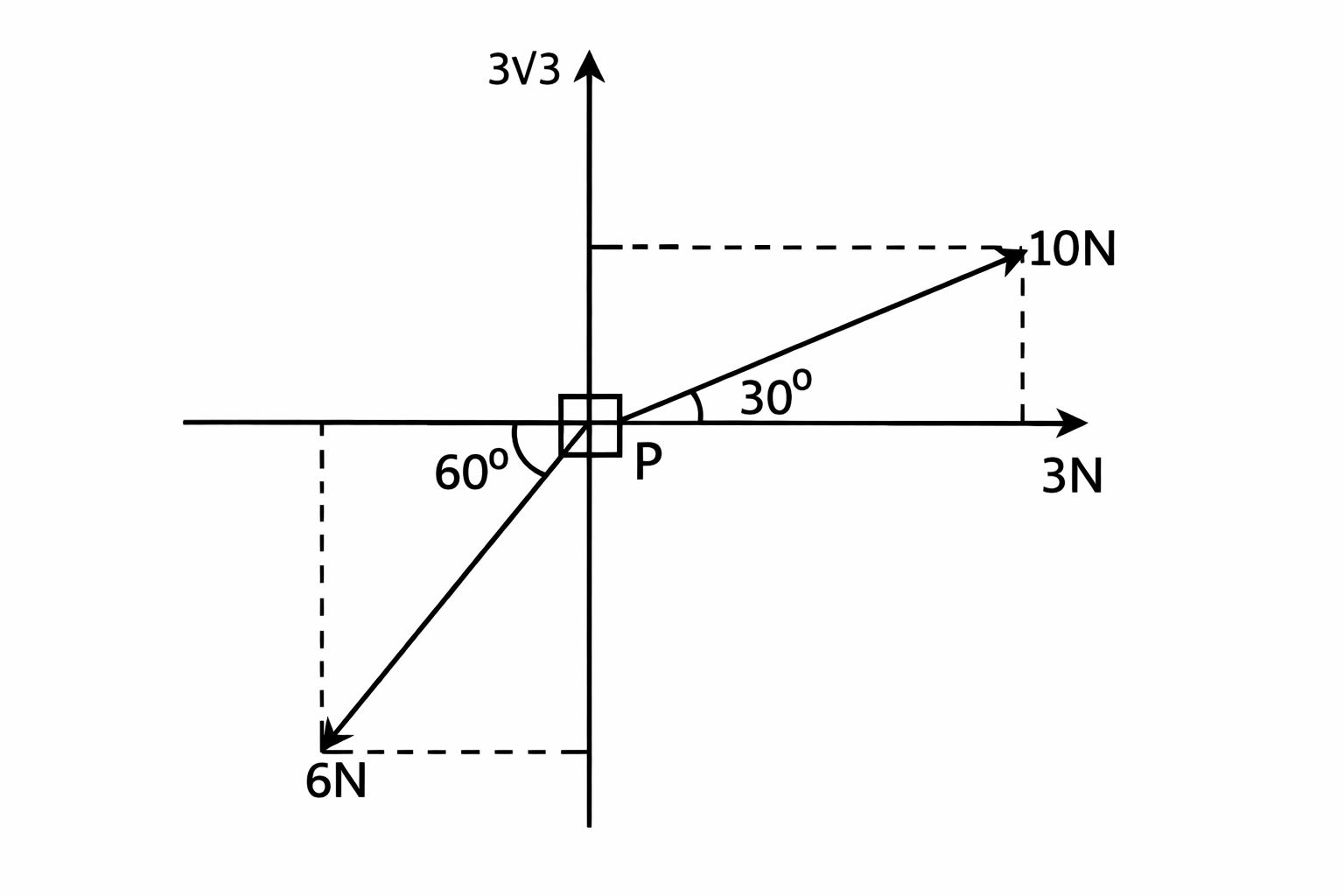
The figure above shows 4 forces 3N, 10N, and 6N acting on a particle P. The resultant of the four forces is
- A.5N
- B.
- C.10N
- D.
To find the resultant force, we first resolve all forces into their horizontal (x) and vertical (y) components and sum them up. The total horizontal component is Rx = 3 + 10cos(30°) - 6cos(60°) = N, and the total vertical component is Ry = + 10sin(30°) - 6sin(60°) = 5 N. The magnitude of the resultant force is then found using Pythagoras' theorem, R = , which gives R = . This simplifies to R = = , resulting in a final answer of 10N.
Common mistake: A common mistake is to stop after calculating the total horizontal component or total vertical component (5N) and select one of them as the answer, instead of finding their final resultant magnitude.
See all 50 JAMB Physics 2007 questions
Sign up free to unlock every question in this paper — with the verified answer and Beta's worked explanation on each one. No card needed to begin.
Start free