JAMB Physics 2024 Past Questions & Answers
50 JAMB Physics 2024 questions with verified answers and worked explanations. Here are the first 10 — sign up free to practise the full paper.
The stress experienced by a wire of diameter yπm loaded by a weight y²N is
- A.πNm⁻²
- B.2πNm⁻²
- C.4πNm⁻²
- D.8πNm⁻²
Stress is defined as the force applied per unit cross-sectional area (Stress = Force / Area). The force is the weight, F = y²N, and assuming a typo in the question, the diameter is d = y/π m, making the radius r = d/2 = y/(2π) m. The cross-sectional area A = πr² = π(y/2π)² = π(y²/4π²) = y²/4π m². Therefore, Stress = F/A = y² / (y²/4π), which simplifies to 4π Nm⁻².
Common mistake: A common mistake is to incorrectly calculate the area, for example by forgetting to square the '2' in the denominator when using the radius (r=d/2), which would lead to an incorrect answer of 2π Nm⁻².
Under which conditions is work done
- A.A man supports a heavy load on his head with hands.
- B.A woman holds a pot of water
- C.A boy climbs onto a table
- D.A man pushes against a stationary petrol tanker
In Physics, work is done only when a force causes an object to move a distance in the direction of the force (Work = Force x Distance). When the boy climbs onto the table, he applies an upward force to lift his body and moves a vertical distance, so work is done. In all the other options, a force is applied, but there is no movement (displacement), so no work is done.
Common mistake: Students often confuse the everyday meaning of 'work' (like feeling tired) with the physics definition, leading them to incorrectly choose option D because pushing a tanker feels like hard work, even if it doesn't move.
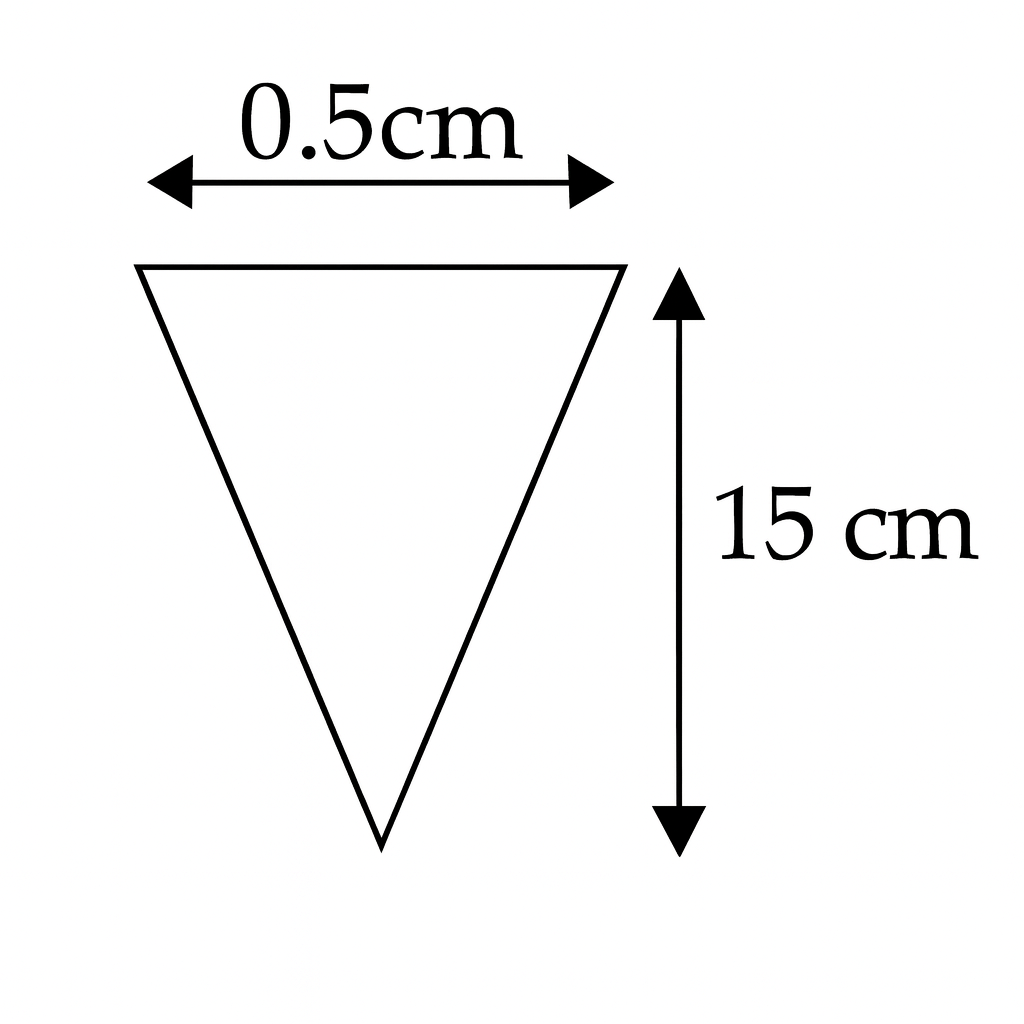
The mechanical advantage of the machine shown above
- A.7.5
- B.15.5
- C.30
- D.60
The image shows a wedge, which is a type of simple machine. The mechanical advantage (M.A.) of a wedge is calculated by dividing its length by its thickness. From the diagram, the length is 15 cm and the thickness is 0.5 cm, so M.A. = Length / Thickness = 15 cm / 0.5 cm = 30.
Common mistake: A common mistake is to multiply the length and thickness , leading to the incorrect option A, instead of dividing.
Rainbow is formed when sunlight undergoes
- A.reflection
- B.refraction
- C.dispersion
- D.diffraction
A rainbow is formed when sunlight passes through water droplets in the atmosphere, which act like tiny prisms. The water droplets split the white sunlight into its seven different colours, a phenomenon known as dispersion. Although both refraction and reflection are involved in the process, dispersion is the specific name for the colour-splitting effect that creates the visible rainbow.
Common mistake: Students often choose refraction because it is the underlying cause of dispersion, but dispersion is the more specific and complete term for the separation of light into its spectrum of colours.
Find the value of a capacitor with voltage 5V and 30C.
- A.7f
- B.6f
- C.15f
- D.0.17f
The relationship between charge (Q), capacitance (C), and voltage (V) is given by the formula Q = CV. To find the capacitance, we rearrange the formula to C = Q / V. Substituting the given values, Q = 30C and V = 5V, we get C = 30 / 5 = 6F.
Common mistake: A common mistake is to wrongly divide the voltage by the charge (V/Q) instead of the charge by the voltage (Q/V), which would lead to the incorrect answer of 0.17F.
When a bus is accelerating, it must be
- A.changing its speed
- B.changing its velocity
- C.changing its position
- D.changing its direction
Acceleration is defined as the rate of change of velocity. Velocity is a vector quantity, which means it has both speed (how fast you are going) and direction. Therefore, for an object to accelerate, its velocity must change. This change can be in its speed, its direction, or both, so it is certain that its velocity is changing.
Common mistake: Students often mistakenly choose 'changing its speed' because they forget that acceleration can also happen when an object changes direction, even if its speed remains constant.
The friction due to air mass can be reduced by
- A.streaming
- B.lubricating
- C.propeller
- D.polishing
The question asks how to reduce friction from air, which is also known as air resistance or drag. Streamlining (written as 'streaming' in the option) is the process of designing an object with a special shape that allows air to flow smoothly around it. This smooth flow minimizes the opposing force of friction, making it easier for the object to move through the air.
Common mistake: Students might mistakenly choose 'lubricating' because it is a common method for reducing friction, but lubrication is used to reduce friction between solid surfaces, not for reducing air resistance.
Which of the following operates based on magnetic effect of electric current?
- A.electric heater
- B.photocell
- C.Dynamo
- D.Cold cathode
A dynamo is a type of generator that produces electric current. It operates based on the principle of electromagnetic induction, where rotating a coil of wire inside a magnetic field causes a current to flow. This is a direct application of the relationship between magnetism and electricity.
Common mistake: Students might mistakenly choose the electric heater because it uses electric current, but its operation is based on the heating effect of current (Joule's law), not the magnetic effect.
When a charged ebonite rod is brought near a charged glass rod, there will be
- A.attraction
- B.repulsion
- C.spark
- D.no force experienced
By convention, when an ebonite rod is charged by rubbing, it acquires a negative charge. A glass rod, when charged, acquires a positive charge. The fundamental law of electrostatics states that opposite charges attract each other, while like charges repel. Since the ebonite rod is negative and the glass rod is positive, they will experience a force of attraction.
Common mistake: Students may mistakenly choose repulsion if they forget that ebonite and glass rods acquire opposite charges when rubbed, incorrectly assuming they both have the same type of charge.
Pilots uses aneroid barometer to know the height above sea level because
- A.Very accurate
- B.Small and convenient
- C.Heavy and huge
- D.Costly
An aneroid barometer is an instrument used to measure atmospheric pressure. Since atmospheric pressure decreases with an increase in altitude (height), pilots use it to determine how high they are flying. The main reason an aneroid barometer is used in airplanes, instead of other types like a mercury barometer, is that it is compact, portable, and does not contain any liquid, making it small and convenient for the cockpit.
Common mistake: Students might mistakenly choose option A because accuracy is a desirable quality in any measuring instrument, but the key reason for its use in aviation is its practical, compact, and liquid-free design.
See all 50 JAMB Physics 2024 questions
Sign up free to unlock every question in this paper — with the verified answer and Beta's worked explanation on each one. No card needed to begin.
Start free