JAMB Physics 2023 Past Questions & Answers
50 JAMB Physics 2023 questions with verified answers and worked explanations. Here are the first 25 — sign up free to practise the full paper.
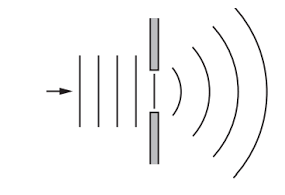
The property of wave shown in the diagram above is?
- A.Diffraction
- B.Refraction
- C.Polarisation
- D.Interference
The diagram shows plane waves (straight lines) passing through a narrow opening. After passing through the opening, the waves are seen to bend and spread out in a semi-circular pattern. This bending or spreading of waves as they pass through an aperture or around an obstacle is the definition of diffraction.
Common mistake: Students may confuse diffraction with refraction, but refraction is the bending of a wave as it passes from one medium to another, which is not what is depicted in the diagram.
Which of the following statements regarding the application of electrical conduction via gases is/are correct? Electrical conduction in gas is applied in: (i) The identification of gases (ii) Lighting/fluorescent tubes (iii) Neon signs/Advertising industry (iv) Cathode ray oscilloscope/T.V. tubes
- A.(i), (iii) and (iv) only
- B.(i), (ii), (iii) and (iv)
- C.(ii), (iii) and (iv) only
- D.(i), (ii) and (iii) only
Electrical conduction through gases is the principle behind many common devices. Fluorescent tubes and neon signs work by passing electricity through a gas, causing it to glow. Each gas glows with a unique colour and spectrum, which allows for the identification of gases. Finally, cathode ray tubes, used in old TVs and oscilloscopes, operate by controlling a beam of electrons through a vacuum, which is an extreme case of conduction in a gas.
Common mistake: Students often choose option C because they are familiar with the lighting applications but may forget that the unique light spectrum produced during gas discharge is also used to identify the specific gas.
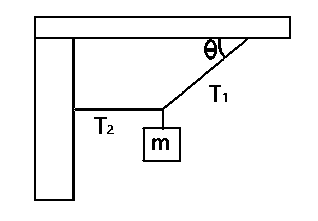
Find the tension in the two cords shown in the figure above. Neglect the mass of the cords, and assume that the angle is 38° and the mass m is 220 kg [Take g = 9.8 ms⁻²]
- A.T₁ = 2864 N, T₂= 3612 N
- B.T₁= 3612 N, T₂ = 2864 N
- C.T₁= 3502 N, T₂= 2760 N
- D.T₁ = 2760 N, T₂ = 3502 N
The system is in equilibrium, which means all the forces acting on the mass are balanced. First, calculate the weight of the mass, W = mg = 220 kg × 9.8 m/s² = 2156 N. For the forces to be balanced, the upward vertical force must equal the downward force (weight), so T₁ sin(38°) = 2156 N, which gives T₁ = 2156 / sin(38°) ≈ 3502 N. Also, the horizontal force to the left (T₂) must equal the horizontal force to the right, so T₂ = T₁ cos(38°), which gives T₂ = 3502 × cos(38°) ≈ 2760 N.
Common mistake: Students often correctly calculate the two tension values but mix them up, choosing option D where the values for T₁ and T₂ are swapped.
A missile is launched with a speed of 75 ms-1 at an angle of 22° above the surface of a warship. Find the horizontal range achieved by the missile. Ignore the effects of air resistance. [Take g = 10 ms⁻²]
- A.195
- B.271 m
- C.391 m
- D.136 m
To find the horizontal range of the missile, we use the formula for projectile motion, which is R = (u² * sin(2θ)) / g. Here, the initial speed 'u' is 75 m/s, the angle 'θ' is 22°, and 'g' is 10 m/s². First, calculate 2θ, which is 2 * 22° = 44°. Then, substitute the values into the formula: R = (75² * sin(44°)) / 10. This gives R = / 10, which calculates to approximately 390.77 m. Therefore, the closest answer is 391 m.
Common mistake: A common mistake is forgetting to double the angle inside the sine function, calculating with sin(22°) instead of sin(44°), which leads to a much smaller and incorrect answer.
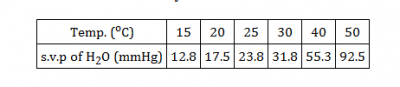
On a particular hot day, the temperature is 40°C and the partial pressure of water vapor in the air is 38.8 mmHg. What is the relative humidity?
- A.70
- B.62
- C.80
- D.42
Relative humidity is calculated by dividing the partial pressure of water vapour by the saturated vapour pressure (s.v.p) at that temperature, then multiplying by 100. From the question, the partial pressure is 38.8 mmHg. Using the table provided, we find the s.v.p of water at 40°C is 55.3 mmHg. Therefore, Relative Humidity = x 100% ≈ 70%.
Common mistake: Students might mistakenly read the saturated vapour pressure for a different temperature from the table, for instance, using 92.5 mmHg for 50°C, which would lead to an incorrect answer of about 42%.
Calculate the absolute pressure at the bottom of a lake at a depth of 32.8 m. Assume the density of the water is 1 × 10³ kgm⁻³ and the air above is at a pressure of 101.3 kPa. [Take g = 9.8 ms⁻²]
- A.422.7 kPa
- B.220.14 kPa
- C.464.53 kPa
- D.321.74 kPa
To find the absolute pressure at a depth, you must add the atmospheric pressure to the pressure from the water column (gauge pressure). First, calculate the gauge pressure using the formula P = hρg, which gives 32.8 m × × 9.8 ms⁻² = 321,440 Pa or 321.44 kPa. Finally, add this to the given atmospheric pressure: 321.44 kPa + 101.3 kPa = 422.74 kPa, which is approximately 422.7 kPa.
Common mistake: Students often calculate only the gauge pressure (321.74 kPa) and forget to add the atmospheric pressure to find the total absolute pressure.
The terminals of a battery of emf 24.0 V and internal resistance of 1.0 Ω is connected to an external resistor 5.0 Ω. Find the terminal p.d.
- A.18.0V
- B.12.0V
- C.16.0V
- D.20.0V
First, calculate the total resistance in the circuit, which is the sum of the external resistance and the internal resistance (5.0 Ω + 1.0 Ω = 6.0 Ω). Next, find the current flowing through the circuit using the formula I = E / (R+r), which gives 24.0 V / 6.0 Ω = 4.0 A. The terminal potential difference (p.d.) is the voltage across the external resistor, calculated as V = I × R, so V = 4.0 A × 5.0 Ω = 20.0 V.
Common mistake: A common mistake is to confuse the electromotive force (emf) with the terminal potential difference, forgetting to account for the 'lost volts' due to the internal resistance.
A lorry accelerates uniformly in a straight line with acceleration of 4ms⁻² and covers a distance of 250 m in a time interval of 10 s. How far will it travel in the next 10 s?
- A.650 m
- B.900 m
- C.800 m
- D.250 m
First, we find the lorry's initial velocity (u) using the equation s = ut + ½at². For the first interval, 250 = u(10) + ½(4)(10)², which gives u = 5 m/s. Next, we find the velocity at the end of this interval, v = u + at = 5 + (4)(10) = 45 m/s, which is the initial velocity for the next 10 seconds. Finally, we calculate the distance for the next 10 seconds using s = ut + ½at² with the new initial velocity: s = (45)(10) + ½(4)(10)² = 450 + 200 = 650 m.
Common mistake: Students may mistakenly calculate the total distance covered from the start over 20 seconds (which is 900 m) instead of the distance covered only in the second 10-second interval.
The half life of a radioactive material is 12 days. Calculate the decay constant.
- A.0.8663 day⁻¹
- B.0.04331 day⁻¹
- C.0.17325 day⁻¹
- D.0.05775 day⁻¹
The relationship between the half-life (T½) of a radioactive material and its decay constant (λ) is given by the formula T½ = 0.693 / λ. To find the decay constant, we rearrange the formula to λ = 0.693 / T½. Substituting the given half-life of 12 days, we get λ = 0.693 / 12, which calculates to 0.05775 day⁻¹.
Common mistake: A common mistake is to confuse the constant ln(2) ≈ 0.693 with just the number 2, leading to an incorrect calculation like 2 ÷ 12 ≈ 0.167, which is close to option C.
The number of holes in an intrinsic semiconductor
- A.s not equal to the number of free electrons
- B.is greater than the number of free electrons
- C.is equal to the number of free electrons
- D.is less than the number of free electrons
An intrinsic semiconductor is a pure semiconductor without any impurities added. When thermal energy excites the material, an electron can break free from its bond, becoming a free electron. The empty space left by this electron is called a hole. Since each free electron is created by leaving behind one hole, the number of free electrons is always equal to the number of holes in an intrinsic semiconductor.
Common mistake: Students often confuse intrinsic semiconductors with extrinsic (doped) semiconductors, where the number of electrons and holes are deliberately made unequal to improve conductivity.
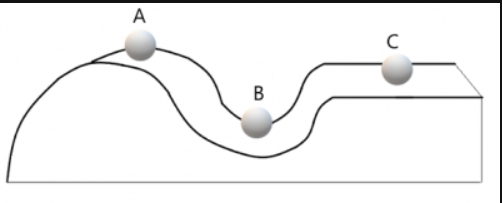
Name the type of equilibrium for each position of the ball
- A.A - unstable, B - neutral, C - stable
- B.A - stable, B - neutral, C - unstable
- C.A - stable, B - unstable, C - neutral
- D.A - unstable, B - stable, C - neutral
The ball at position A is in unstable equilibrium because if it is slightly pushed, its center of gravity is lowered and it will not return to its original position. The ball at position B is in stable equilibrium because if it is slightly pushed, its center of gravity is raised and it will return to its original lowest position. The ball at position C is in neutral equilibrium because if it is pushed, its center of gravity remains at the same level and it stays in the new position.
Common mistake: Students often confuse stable and unstable equilibrium, perhaps incorrectly thinking that the ball at the top of the hill (A) is stable because it is momentarily at rest.
Rainbow formation is as a result of the combination of which of the following phenomena? (i) Reflection (ii) Dispersion (iii) Total internal reflection (iv) Refraction
- A.(ii) and (iv) only
- B.(i), (iii) and (iv) only
- C.(ii), (iii) and (iv) only
- D.(i), (ii) and (iv) only
When sunlight enters a water droplet, it first bends (refracts) and splits into its different colours (dispersion). The light then bounces off the inner back surface of the droplet (reflection). Finally, the light refracts again as it leaves the droplet and travels to the observer's eye, appearing as a rainbow. Therefore, the formation of a rainbow is a combined effect of refraction, dispersion, and reflection.
Common mistake: Students often mistakenly choose option C, thinking that total internal reflection is involved, but for the primary rainbow, it is just a simple internal reflection, not total internal reflection.
The surface temperature of a swimming pool on a warm day is 25ºC and the temperature at the bottom is 15ºC. If the swimming pool has a surface area of 620 m² and a depth of 1.5m. Find the rate at which energy is transferred by conduction from the surface to the bottom of the swimming pool. [Thermal conductivity of water (k) = 0.6071 Wm⁻¹K⁻¹]
- A.2.5 kW
- B.250 kW
- C.300 kW
- D.3.0 kW
The rate of energy transfer by conduction is calculated using the formula: Rate = (k × A × ΔT) / L. Here, k is the thermal conductivity (0.6071), A is the area (620 m²), ΔT is the temperature difference (25°C - 15°C = 10°C), and L is the depth (1.5 m). Plugging in these values gives / 1.5, which equals approximately 2509 Watts. To convert this to kilowatts, we divide by 1000, resulting in 2.509 kW, which is rounded to 2.5 kW.
Common mistake: Students might correctly calculate the rate of heat transfer but make a decimal point error during the final conversion from Watts to Kilowatts, leading them to incorrectly choose 250 kW.
Which process is responsible for production of energy in stars?
- A.Nuclear reaction
- B.Nuclear fission
- C.Nuclear fusion
- D.Radioactive decay
Stars produce energy through a process called nuclear fusion. In the extremely hot and dense core of a star, light atomic nuclei, such as hydrogen, are forced to combine or 'fuse' together to form heavier nuclei, like helium. This fusion process releases a massive amount of energy in the form of light and heat, which is why stars shine.
Common mistake: Students often mistakenly choose nuclear fission, but fission is the splitting of heavy atoms (used in nuclear power plants), whereas fusion is the joining of light atoms that powers stars.
How much net work is required to accelerate a 1200 kg car from 10ms⁻¹ to 15ms⁻¹
- A. J
- B. J
- C. J
- D. J
According to the work-energy theorem, the net work done on an object is equal to the change in its kinetic energy. The formula is Work Done = Final Kinetic Energy - Initial Kinetic Energy, or W = ½m(v² - u²). Plugging in the values, we get W = ½ × 1200 × (15² - 10²), which simplifies to W = 600 × = 600 × 125, which equals 75,000 J or 7.5 × 10⁴ J.
Common mistake: Students might mistakenly calculate the sum of the initial and final kinetic energies , instead of finding the difference which represents the change in energy.
A wire of radius 0.2 mm is extended by 0.5% of its length when supported by a load of 1.5 kg. Determine the Young's modulus for the material of the wire. [Take g = 10 ms⁻²]
- A. (Nm⁻²)
- B. (Nm⁻²)
- C. (Nm⁻²)
- D. (Nm⁻²)
Young's modulus is calculated as Stress divided by Strain. First, find the stress, which is the force (1.5 kg × 10 ms⁻² = 15 N) divided by the wire's cross-sectional area . Then, find the strain, which is the percentage extension (0.5%) expressed as a decimal . Dividing the calculated stress by the strain gives the Young's modulus, which is approximately 2.4 × 10¹⁰ Nm⁻².
Common mistake: A common mistake is incorrectly converting the radius from millimeters to meters or making an error in calculating the area (πr²), which often results in an answer with the wrong power of ten, such as option C.
A man swung an object of mass 2 kg in a circular path with a rope 1.2 m long. If the object was swung at 120 rev/min, find the tension in the rope.
- A.400
- B.288
- C.240
- D.379
To find the tension in the rope, we must calculate the centripetal force. First, convert the rotational speed from revolutions per minute (rev/min) to radians per second (rad/s): ω = (120 rev/min × 2π rad/rev) / 60 s/min = 4π rad/s. Then, use the formula for centripetal force, which is equal to the tension (T): T = mω²r. Substituting the values, we get T = 2 kg × (4π rad/s)² × 1.2 m, which calculates to approximately 379 N.
Common mistake: Students might mistakenly multiply the rotational speed in rev/min (120) by the mass (2 kg) to get 240, ignoring the correct formula for centripetal force and the need for proper unit conversion.
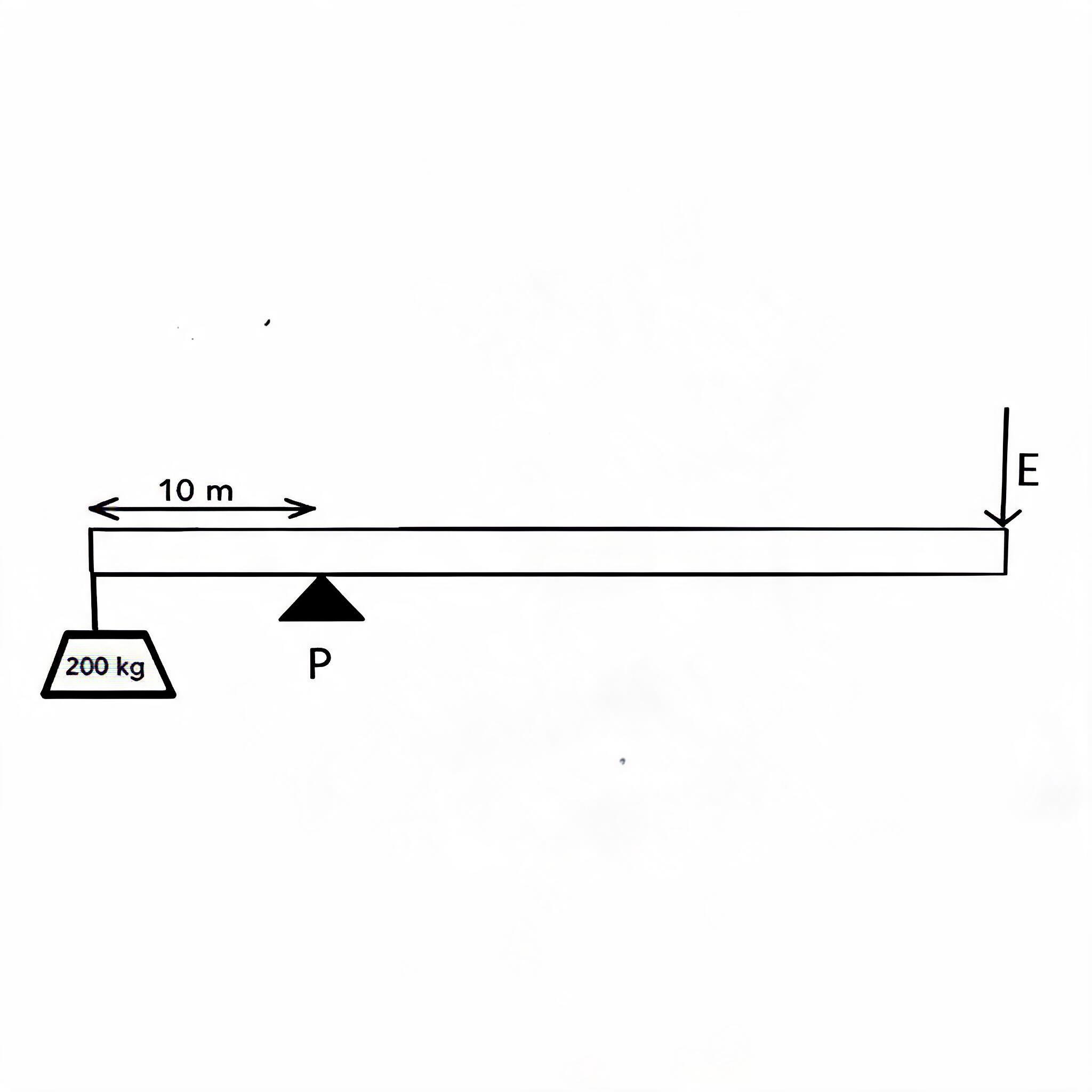
A 200 kg load is raised using a 110 m long lever as shown in the diagram above. The load is 10m from the pivot P. If the efficiency of the lever is 80%, find the effort E required to lift the load. [Take g = 10ms⁻²]
- A.250 N
- B.300 N
- C.450 N
- D.200 N
First, calculate the load force, which is mass × g = 200 kg × 10 m/s² = 2000 N. From the diagram, the load distance is 10 m and the effort distance is the total length minus the load distance (110 m - 10 m = 100 m), so the Velocity Ratio (VR) is effort distance / load distance = = 10. Since efficiency is 80% (or 0.8), we use the formula Efficiency = Mechanical Advantage (MA) / VR to find MA = 0.8 × 10 = 8. Finally, since MA = Load / Effort, the effort E = Load / MA = 2000 N / 8 = 250 N.
Common mistake: Students often forget to use the given efficiency, instead calculating the ideal effort (assuming 100% efficiency), which would give an incorrect answer of 200 N.
An air bubble of radius 4.5 cm initially at a depth of 12 m below the water surface rises to the surface. If the atmospheric pressure is equal to 10.34 m of water, the radius of the bubble just before it reaches the water surface is
- A.6.43 cm
- B.8.24 cm
- C.4.26 cm
- D.5.82 cm
This problem is an application of Boyle's Law, which states P₁V₁ = P₂V₂ for a gas at constant temperature. The initial pressure (P₁) at a depth of 12 m is the sum of the atmospheric pressure and the water pressure, so P₁ = 10.34 m + 12 m = 22.34 m of water. The final pressure (P₂) at the surface is just the atmospheric pressure, 10.34 m. Since the volume of the bubble is V = , the equation becomes (22.34) × (4.5)³ = (10.34) × r₂³. Solving this equation for the final radius r₂ gives approximately 5.82 cm.
Common mistake: A common mistake is to forget to add the atmospheric pressure when calculating the initial pressure at the depth, using only the 12 m of water instead of the total pressure.
A parallel plate capacitor separated by an air gap is made of 0.8m² tin plates and 20 mm apart. It is connected to 120 V battery. What is the charge on each plate? Take εo =
- A.3.54nC
- B.42.5nC
- C.35.4nC
- D.4.25nC
To find the charge on the capacitor, you first need to calculate its capacitance (C) using the formula C = εoA/d. Plugging in the values, C = / , which gives C = F. Next, use the formula Q = CV to find the charge (Q), so Q = × 120 = C, which is approximately 42.5 nanoCoulombs (nC).
Common mistake: A common mistake is to calculate the capacitance and then incorrectly select option A (3.54nC), forgetting to multiply by the voltage to find the final charge.
What is the amount of heat required to raise the temperature of a 0.02 kg of ice cube from −10°C to 10°C ? [specific latent heat of fusion of ice = 3.34 x 10⁵ Jkg⁻¹, Specific heat capacity of water = 4200 Jkg⁻¹ k⁻¹, Specific heat capacity of ice = 2100 Jkg⁻¹ k⁻¹]
- A.6680 J
- B.1680 J
- C.7520 J
- D.7940 J
To find the total heat required, you must calculate the heat for three separate stages. First, calculate the heat needed to raise the ice's temperature from -10°C to 0°C using Q₁ = mcΔT . Second, calculate the heat needed to melt the ice into water at 0°C using Q₂ = mL (0.02 x 3.34 x 10⁵ = 6680 J). Finally, calculate the heat needed to raise the water's temperature from 0°C to 10°C using Q₃ = mcΔT . The total heat is the sum of these three amounts: 420 J + 6680 J + 840 J = 7940 J.
Common mistake: Students often make the mistake of only calculating the latent heat of fusion (6680 J), forgetting to add the heat required to first warm the ice to 0°C and then warm the resulting water to 10°C.
Which of the following thermometers measures temperature from the thermal radiation emitted by objects?
- A.Pyrometer thermometer
- B.Platinum resistance thermometer
- C.Thermocouple thermometer
- D.Constant pressure gas thermometer
A pyrometer is a special thermometer designed to measure the temperature of an object from a distance by detecting the thermal radiation (heat energy) it emits. This is why it can be used to measure the temperature of very hot objects like the sun or molten metal without touching them. The other options are contact thermometers that work on different principles, like changes in electrical resistance or gas pressure.
Common mistake: Students might mistakenly choose the thermocouple or platinum resistance thermometer because they are common electrical thermometers, but these work based on voltage and resistance changes, not thermal radiation.
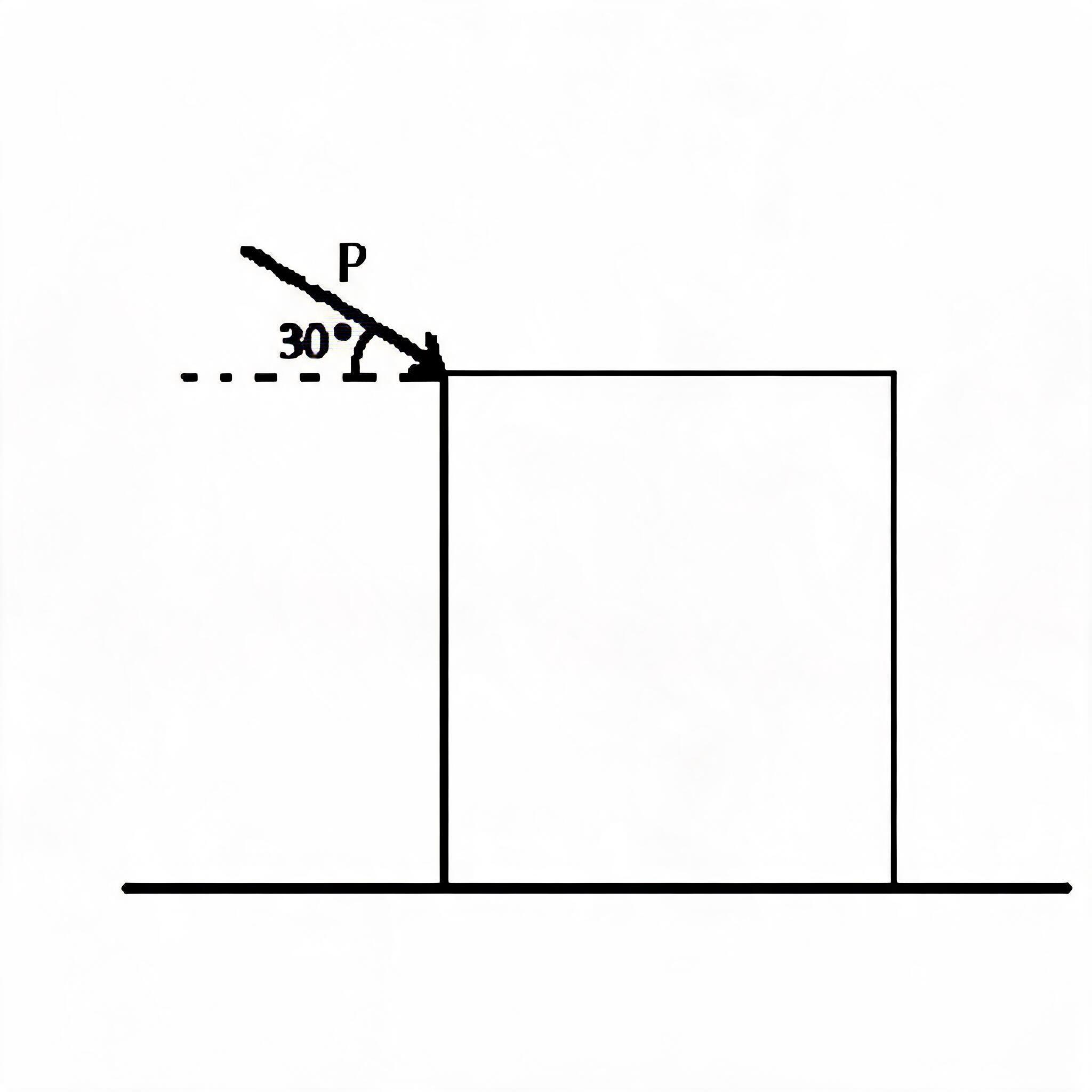
A 400 N box is being pushed across a level floor at a constant speed by a force P of 100 N at an angle of 30.0° to the horizontal, as shown in the the diagram below. What is the coefficient of kinetic friction between the box and the floor?
- A.0.19
- B.0.24
- C.0.4
- D.0.22
Since the box moves at a constant speed, the forces are balanced. First, find the total downward force to get the normal reaction, R = Weight + vertical component of P = 400 N + (100 N * sin 30°) = 450 N. The frictional force, F, must be equal to the horizontal component of the push, so F = 100 N * cos 30° ≈ 86.6 N. Finally, the coefficient of friction μ is calculated as F divided by R, which is 86.6 N / 450 N ≈ 0.19.
Common mistake: Students often mistakenly assume the normal reaction is equal to the weight (400 N), forgetting to add the downward vertical component of the applied force, which leads them to an incorrect answer.
Light of wavelength 589 nm in vacuum passes through a piece of fused quartz of index of refraction n = 1.458. What is the frequency of the light in fused quartz?
- A.
- B. Hz
- C. Hz
- D. Hz
A fundamental principle of waves is that when light or any wave passes from one medium to another, its frequency remains constant. Therefore, the frequency of the light in the fused quartz is the same as its frequency in a vacuum. We can calculate this frequency using the formula c = fλ, which gives f = c / λ = / , resulting in 5.09 × 10¹⁴ Hz. The refractive index is extra information not needed to find the frequency.
Common mistake: Students often mistakenly believe that frequency changes when light enters a new medium and incorrectly try to use the refractive index to calculate a new frequency.
A simple pendulum, has a period of 5.77 seconds. When the pendulum is shortened by 3 m, the period is 4.60 seconds. Calculate the new length of the pendulum
- A.5.23 m
- B.6.42 m
- C.4.87 m
- D.7.26 m
The period of a pendulum squared (T²) is directly proportional to its length (L), so we can write the relationship T₁²/T₂² = L₁/L₂. Let the original length be L, then the new length is L-3. Substituting the values gives (5.77)² / (4.60)² = L / (L-3), which simplifies to 33.29 / 21.16 = L / (L-3). Solving this equation for the original length gives L ≈ 8.23 m, so the new length is 8.23 m - 3 m = 5.23 m.
Common mistake: A common mistake is to calculate the original length of the pendulum (about 8.23 m) and then forget to subtract 3 m to find the final, new length as requested by the question.
See all 50 JAMB Physics 2023 questions
Sign up free to unlock every question in this paper — with the verified answer and Beta's worked explanation on each one. No card needed to begin.
Start free