JAMB Physics 2019 Past Questions & Answers
48 JAMB Physics 2019 questions with verified answers and worked explanations. Here are the first 10 — sign up free to practise the full paper.
The limiting frictional force between two surface depends on I. the gaseous reaction between the surfaces II. the nature of the surfaces in contact III. the relative velocity between the surfaces
- A.I only
- B.I & II only
- C.II only
- D.III only
Frictional force is the force that opposes motion between two surfaces. The limiting frictional force, which is the maximum friction before an object moves, depends mainly on the normal reaction and the nature of the surfaces. The 'nature of the surfaces' refers to how rough or smooth they are, which is represented by the coefficient of friction. Therefore, statement II is correct.
Common mistake: Students might mistakenly choose an option including statement III, confusing limiting static friction with kinetic friction; the limiting frictional force is independent of relative velocity.
If a body moves with a constant speed and at the same time undergoes an acceleration, its motion is said to be
- A.oscillation
- B.circular
- C.rotational
- D.rectilinear
Acceleration is defined as the rate of change of velocity. Velocity is a vector, meaning it has both magnitude (which we call speed) and direction. Therefore, even if the speed is constant, the body is accelerating if its direction of motion is changing, which is exactly what happens in uniform circular motion.
Common mistake: Students often mistakenly believe that acceleration only means a change in speed, leading them to think constant speed implies zero acceleration, which is only true for motion in a straight line (rectilinear).
When blue and green colours of light are mixed, the resultant colour is
- A.cyan
- B.magenta
- C.black
- D.yellow
The primary colours of light are Red, Green, and Blue (RGB). When you mix these primary colours of light in pairs, you get secondary colours in a process called additive colour mixing. Mixing blue light and green light specifically produces the secondary colour known as cyan.
Common mistake: Students often confuse the rules for mixing light (additive mixing) with the rules for mixing paints or pigments (subtractive mixing), which would produce a different result.
A metal rod has a length of 100cm at 200°C. At what temperature will its length be 99.4cm, if the linear expansivity of the material of the rod is 2 × 10⁻⁵ °C⁻¹?
- A.200°C
- B.300°C
- C.100°C
- D.-100°C
This question is about linear thermal expansion, which describes how an object's length changes with temperature. We use the formula: Change in length (L₂ - L₁) = linear expansivity (α) × original length (L₁) × change in temperature (T₂ - T₁). The change in length is 99.4cm - 100cm = -0.6cm, showing a contraction. Substituting the values gives -0.6 = × 100 × (T₂ - 200), which means the change in temperature is -300°C, so the final temperature T₂ is 200°C - 300°C = -100°C.
Common mistake: Students might correctly calculate the magnitude of the temperature change as 300°C but mistakenly choose it as the final answer (Option B) instead of using it to find the final temperature.
According to kinetic molecular model, in gases
- A.The molecule are very fast apart & occupy all the space made available
- B.The particles occur in clusters with molecules slightly farther apart
- C.The particles vibrate about fixed positions and are held together by the strong intermolecular bond between them
- D.The particles are closely packed together, they occupy minimum space & are usually arranged in a regular pattern
The kinetic molecular model describes the properties of the states of matter. For gases, this model states that the particles (molecules) are very far apart from each other and move randomly and at high speeds. Because the forces between the molecules are very weak, they are not held in a fixed position and will expand to fill any container they are put in.
Common mistake: Students often confuse the properties of the different states of matter and might choose option C or D, which correctly describe the particle arrangement in solids, not gases.
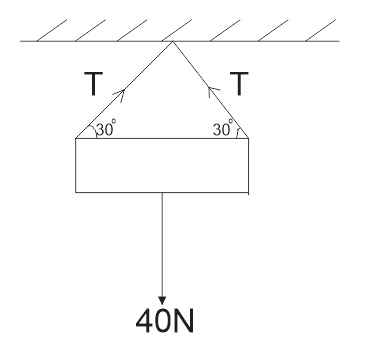
The value of T in the figure above is
- A.30N
- B.10.0N
- C.20N
- D.40N
Since the block is stationary, it is in equilibrium, meaning the total upward force must equal the total downward force. The downward force is the weight, 40N. The total upward force is the sum of the vertical components of the two tensions, which is 2 x Tsin(30°). Therefore, 2Tsin(30°) = 40, and since sin(30°) = 0.5, the equation becomes 2 x T x 0.5 = 40, which simplifies to T = 40N.
Common mistake: A common mistake is to assume the two tensions simply add up to the weight (2T = 40N), giving T = 20N, but this incorrectly ignores that only the vertical components of the tension support the weight.
A train has an initial velocity of 44 m/s and an acceleration of -4 m/s². Calculate its velocity after 10 seconds.
- A.10 m/s
- B.6 m/s
- C.8 m/s
- D.4 m/s
To find the final velocity, we use the first equation of motion, which is v = u + at. In this question, the initial velocity (u) is 44 m/s, the acceleration (a) is -4 m/s², and the time (t) is 10 seconds. Substituting these values into the formula gives v = 44 + , which simplifies to v = 44 - 40. Therefore, the final velocity (v) is 4 m/s.
Common mistake: A common mistake is to correctly identify the formula but make a simple calculation error under pressure, for example misreading the initial velocity as 48 m/s, which would lead to the incorrect answer of 8 m/s .
Lamps in domestic lightings are usually in
- A.series
- B.divergent
- C.convergent
- D.parallel
In domestic wiring, lamps are connected in parallel so that each lamp receives the full voltage from the mains supply and shines at its intended brightness. This arrangement also ensures that if one bulb gets spoilt or is switched off, the other bulbs will continue to work because the circuit for them is not broken. Each lamp has its own independent path to the power source.
Common mistake: Students often mistakenly choose 'series' because it is the other main type of connection they learn, but they forget that in a series circuit, if one bulb fails, the entire circuit breaks and all lights go out.
During the transformation of matter from the solid to the liquid state, the heat supplied does not produce temperature increase because
- A.all the heat is used to break the bonds holding the molecules of the solid together
- B.the heat capacity has become very large as the substance melts
- C.the heat energy is quickly conducted away
- D.the heat gained is equal to the heat lost by the substance
During a change of state, like melting from solid to liquid, the heat energy supplied is known as latent heat. This energy is not used to increase the kinetic energy of the molecules (which would raise the temperature). Instead, it is used entirely to break the intermolecular bonds that hold the molecules in a fixed, rigid structure in the solid state, allowing them to move freely as a liquid.
Common mistake: Students may mistakenly choose option B, confusing the concept of latent heat with specific heat capacity, which relates heat supplied to temperature change when no phase change is occurring.
In a slide wire bridge, the balance is obtained at a point 25cm from one end of wire 1m long. The resistance to be tested is connected to that end and a standard resistance of 3.6Ω is connected to the other end of the wire. Determine the value of the unknown resistance
- A.3.2Ω
- B.1.4Ω
- C.3.21Ω
- D.1.2Ω
A slide wire bridge is a form of Wheatstone bridge, and when it is balanced, the ratio of the resistances is equal to the ratio of the corresponding lengths of the wire. Let the unknown resistance be R. The balance length is L₁ = 25cm, so the other length is L₂ = 100cm - 25cm = 75cm. Setting up the ratio, we get R / 3.6Ω = 25cm / 75cm, which simplifies to R / 3.6 = . Therefore, R = 3.6 / 3 = 1.2Ω.
Common mistake: Students often invert the ratio of the lengths, incorrectly calculating R = 3.6 × instead of R = 3.6 × , which leads to a wrong answer.
See all 48 JAMB Physics 2019 questions
Sign up free to unlock every question in this paper — with the verified answer and Beta's worked explanation on each one. No card needed to begin.
Start free