JAMB Physics 2025 Past Questions & Answers
40 JAMB Physics 2025 questions with verified answers and worked explanations. Here are the first 25 — sign up free to practise the full paper.
Which of these colours in the visible spectrum has the longest wavelength?
- A.Red
- B.Blue
- C.Yellow
- D.Violet
The colours of the visible light spectrum are often remembered with the acronym ROYGBIV, which stands for Red, Orange, Yellow, Green, Blue, Indigo, and Violet. In this order, the wavelength of the light decreases, while its frequency and energy increase. Therefore, red light has the longest wavelength at one end of the spectrum.
Common mistake: Students often confuse wavelength with frequency or energy; they might incorrectly choose violet because it has the highest frequency and energy in the visible spectrum.
The power of a lens in diopters is
- A.3f
- B.1/f
- C.2f
- D.f
The power of a lens (P) is a measure of its ability to bend light, which is inversely related to its focal length (f). The mathematical definition for the power of a lens is the reciprocal of its focal length. For the power to be measured in diopters (D), the focal length must be in meters (m), giving the formula P = 1/f.
Common mistake: Students sometimes mistakenly choose option D, confusing the power of a lens directly with its focal length (f) rather than its reciprocal.
A man moves 6.0 m East and then 10.0 m N30°E. How far is he from his starting point?
- A.15.0 m
- B.17.0 m
- C.14.0 m
- D.12.0 m
This problem requires adding two displacement vectors to find the resultant distance. We can use the cosine rule for vector addition, R² = A² + B² + 2ABcosθ, where A and B are the magnitudes of the vectors and θ is the angle between them. The angle between the East direction and N30°E is 60°. Therefore, R² = 6² + 10² + 2(6)(10)cos(60°) = 36 + 100 + 120(0.5) = 196, which means the resultant distance R is = 14.0 m.
Common mistake: A common mistake is to use the 30° angle directly in the formula, instead of correctly identifying that the angle between the two paths is 60°.
The density of water is 1 g/cm³ while that of ice is 0.9 g/cm³. Calculate the change in volume when 90 g of ice is completely melted.
- A.9 cm³
- B.90 cm³
- C.0 cm³
- D.10 cm³
First, calculate the initial volume of the ice using the formula Volume = Mass / Density, which gives 90 g / 0.9 g/cm³ = 100 cm³. When the ice melts into water, the mass remains the same (90 g), so the new volume is 90 g / 1 g/cm³ = 90 cm³. The change in volume is the difference between the initial volume of the ice and the final volume of the water, which is 100 cm³ - 90 cm³ = 10 cm³.
Common mistake: Students often mistakenly choose 90 cm³ because they correctly calculate the final volume of the water but forget to find the *change* in volume by subtracting it from the initial volume.
The graphical representation of the pressure law is always a straight line passing through the origin, only if the temperature scale is
- A.Rankine
- B.Celsius
- C.Fahrenheit
- D.thermodynamic
The Pressure Law states that for a fixed mass of gas at constant volume, pressure is directly proportional to its absolute temperature (P ∝ T). A graph of two directly proportional quantities is a straight line passing through the origin. The thermodynamic scale, also known as the Kelvin scale, is the absolute temperature scale, so plotting pressure against thermodynamic temperature results in a straight line through the origin.
Common mistake: Students often mistakenly choose Celsius because they know the graph is a straight line, but they forget that it only passes through the origin when the absolute (thermodynamic) temperature scale is used.
According to the kinetic theory of gases, the pressure exerted by a gas on the walls equals.
- A.Momentum imparted to the walls per unit area.
- B.Change in momentum per unit volume.
- C.Change in momentum imparted to the walls per unit area.
- D.Rate of change of momentum imparted to the walls per second per unit area.
According to the kinetic theory, gas pressure is caused by the force of gas molecules colliding with the walls of their container. Force is defined as the rate of change of momentum (change in momentum per second). Since pressure is force divided by area, the pressure exerted by the gas is the rate of change of momentum imparted to the walls, per unit area. Option D correctly states this fundamental relationship.
Common mistake: Students often mistakenly choose option C because they remember the connection between force and momentum but forget that force is the *rate* of change of momentum, not just the change in momentum.
Which of the following is not true about a wave in a plucked string?
- A.It is mechanical
- B.It has a crest
- C.It is transverse
- D.It is longitudinal
When you pluck a string, the wave that travels along it is a transverse wave, meaning the particles of the string vibrate up and down, perpendicular to the direction the wave is moving. Because it is a transverse wave, it has crests and is mechanical (it needs the string as a medium). A longitudinal wave, where vibrations are parallel to the wave's direction, is a different type of wave, so the statement that the wave in the string is longitudinal is not true.
Common mistake: Students might get confused because a plucked string produces sound (which is a longitudinal wave), leading them to incorrectly think the wave in the string itself is also longitudinal.
The emf of a cell is the potential difference across its terminals when it is in
- A.series connection
- B.closed circuit
- C.open circuit
- D.parallel connection
The electromotive force (e.m.f.) of a cell is the total energy the cell can supply per unit of charge, representing its maximum possible potential difference. This maximum value can only be measured when no current is being drawn from the cell. A circuit where no current flows is called an open circuit, which is why the e.m.f. is defined as the potential difference across the terminals in this state.
Common mistake: Students often mistakenly choose 'closed circuit' because that is when a cell is actively working, but in a closed circuit, you measure the terminal potential difference, which is lower than the true e.m.f. due to internal resistance.
The thermometric property of mercury is best on the change in
- A.density with temperature
- B.volume with temperature
- C.pressure with temperature
- D.resistance with temperature
A thermometer works by using a substance with a property that changes consistently and uniformly with temperature. For a mercury-in-glass thermometer, this property is its thermal expansion. As temperature increases, the volume of the mercury expands in a predictable way, causing it to rise up the narrow tube, which is then read on a calibrated scale.
Common mistake: Students often confuse the working principles of different thermometers and might incorrectly choose 'resistance with temperature', which is the thermometric property used in a resistance thermometer, not a mercury thermometer.
Some of the features of the human eye that greatly help to refract light entering the eyes are
- A.cornea and lens
- B.cornea and aqueous humor
- C.lens and vitreous humor
- D.aqueous humor and lens
The human eye works like a camera, focusing light onto the retina by refracting (bending) it. The cornea, the transparent outer layer of the eye, does most of the initial, powerful refraction because of its curved shape. The crystalline lens then provides the fine-tuning to focus light from objects at different distances. Therefore, the cornea and the lens are the two main features responsible for refracting light in the eye.
Common mistake: Students may mistakenly choose options including the aqueous or vitreous humor, but these fluids have a much smaller refractive effect compared to the powerful, curved cornea and the adjustable lens.
When both the object and its image move together in the same direction relative to the observer, then there is
- A.no parallax error
- B.blurred image
- C.mechanical error
- D.parallax error
Parallax is the apparent shift in position between two objects when viewed from different angles. In optics experiments, this error occurs if the image and the object (or search pin) are not at the same location. When they are at the exact same position, they will appear 'stuck' together and move as one when the observer moves their head, which indicates there is no parallax error.
Common mistake: Students often confuse the condition for eliminating parallax with the error itself, leading them to incorrectly select 'parallax error' because the question describes movement.
The diagram above shows a magnetic field due to a
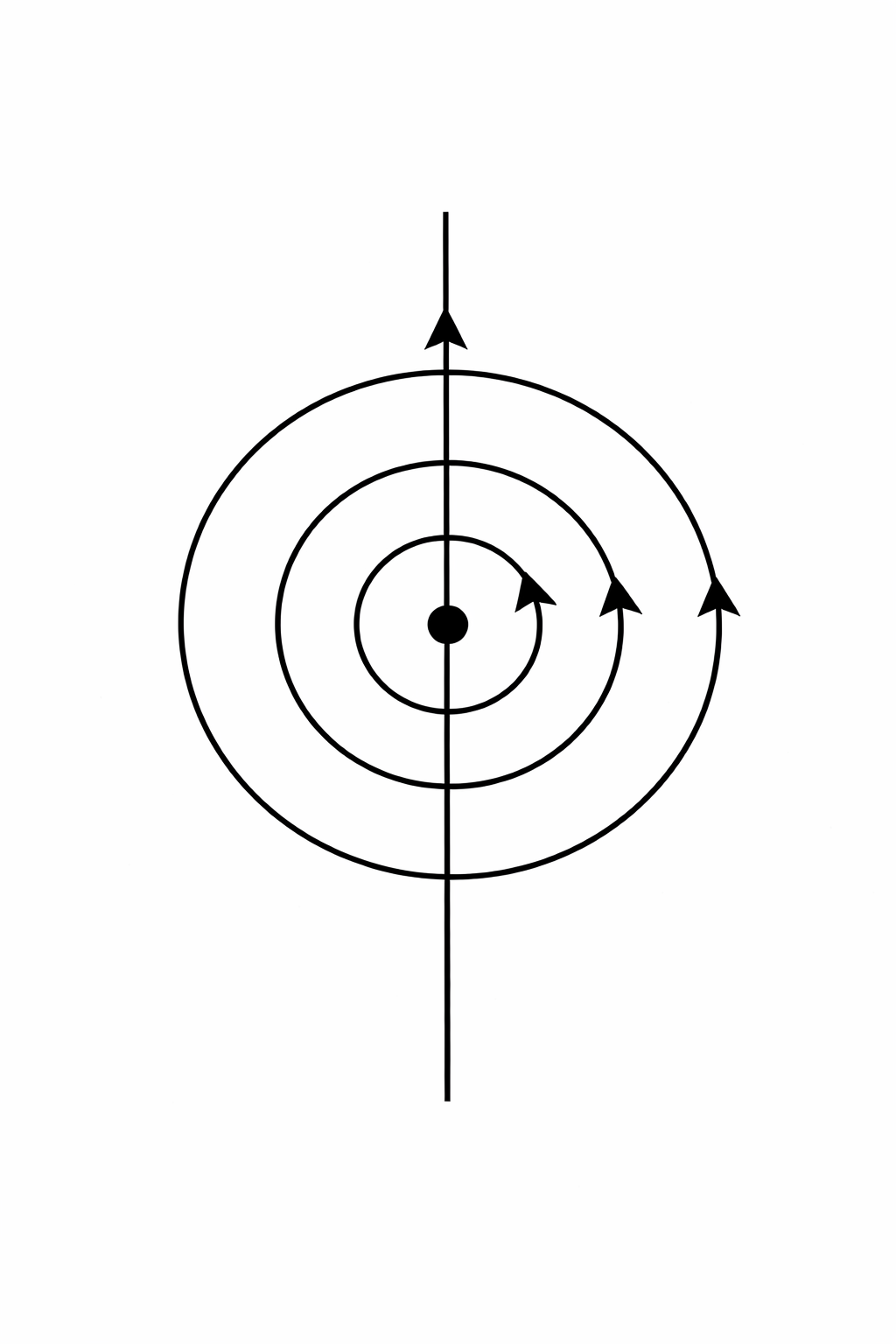
- A.solenoid
- B.circular coil
- C.current-carrying straight conductor
- D.the earth's meridian
The diagram shows concentric circular magnetic field lines around a straight conductor carrying an electric current. This pattern is characteristic of the magnetic field produced by a long, straight wire, as described by the right-hand grip rule. If you point your thumb in the direction of the current (upwards), your fingers curl in the direction of the magnetic field, which matches the circular lines shown.
Common mistake: Students might mistakenly choose 'circular coil' because the magnetic field lines are circular, confusing the shape of the field with the shape of the conductor that creates it.
I. The colour of light depends on its frequency II. When white light is dispersed by a triangular prism, yellow is deviated more than green III. Rainbows are formed when rains fall heavily Which of the above statements is/are correct about dispersion and colours?
- A.I and III only
- B.I only
- C.II and III only
- D.I and II only
The correct option is B because only the first statement is true. The colour of light is determined by its frequency, a property that remains constant as it travels through different materials. Statement II is false because in the spectrum (ROYGBIV), green light has a higher frequency than yellow light, so it bends or deviates more when passing through a prism. Statement III is also false, as rainbows are caused by the dispersion of sunlight through water droplets, which can be present even in a light shower or mist, not just heavy rain.
Common mistake: Students often mistakenly choose option D because they forget the correct order of deviation for colours in a prism and incorrectly think yellow deviates more than green.
A force of 18 N pulls a 40 kg mass on a horizontal floor at 0.3 m s⁻². Find the coefficient of friction.
- A.0.003
- B.0.015
- C.0.3
- D.0.6
First, find the net force using Newton's second law, = mass × acceleration, which is 40 kg × 0.3 m/s² = 12 N. This net force is the difference between the pulling force and the frictional force, so the frictional force = 18 N - 12 N = 6 N. The formula for friction is = μN, where N is the normal reaction equal to the weight (mg). Assuming g = 10 m/s², the normal reaction N = 40 kg × 10 m/s² = 400 N, so the coefficient of friction μ = 6 N / 400 N = 0.015.
Common mistake: Students may mistakenly choose option C by confusing the value for acceleration (0.3 m s⁻²) with the coefficient of friction, which is a dimensionless quantity.
A 500W electric oven plugged into a 220 V source will consume an electric current of
- A.4.88A
- B.2.27A
- C.6.43A
- D.3.23A
To solve this problem, you need the formula for electrical power, which is Power (P) = Current (I) × Voltage (V). We are given the power of the oven (500W) and the voltage of the source (220V). To find the current, we rearrange the formula to I = P / V, so we calculate I = 500 / 220, which gives us 2.27A.
Common mistake: Students might make a mistake by incorrectly rearranging the formula, for example, by dividing voltage by power (V/P) instead of power by voltage (P/V).
A hydraulic press consists of two cylinders of cross-sectional radius r₁ and r₂. If a force of 200 N applied to the smaller piston (r₁) causes a force of 3200 N to be transmitted onto the larger piston (r₂). The ratio r₁ : r₂ is?
- A.1 : 4
- B.1 : 2
- C.1 : 8
- D.1 : 16
According to Pascal's principle for a hydraulic press, the pressure on both pistons is the same, so F₁/A₁ = F₂/A₂. Since the pistons are circular, their area is A = πr², which gives F₁/(πr₁²) = F₂/(πr₂²). Substituting the values, we get 200/r₁² = 3200/r₂². Rearranging the equation gives r₂²/r₁² = = 16, and taking the square root of both sides gives r₂/r₁ = 4, which means the ratio r₁ : r₂ is 1 : 4.
Common mistake: A common mistake is forgetting that pressure depends on area (πr²), not just the radius, leading students to incorrectly calculate the ratio as 1:16.
The gravitational pull between two bodies is 20N. Find the gravitational pull when their distance of separation is doubled.
- A.10N
- B.5N
- C.13N
- D.20N
According to Newton's law of universal gravitation, the force of attraction between two bodies is inversely proportional to the square of the distance between them (F ∝ 1/r²). This means if you double the distance (r becomes 2r), the new force becomes 1/(2²) or of the original force. Therefore, the new gravitational pull will be 20N divided by 4, which equals 5N.
Common mistake: Students often forget the 'square' in the inverse square law and mistakenly think the force is simply halved when the distance is doubled, leading them to incorrectly choose 10N.
The volume of a 1 cm³ metal ball increases by 0.0018 cm³ when heated through temperature θ. If the linear expansivity of the ball is 2.0 × 10⁻⁵ K⁻¹, find θ.
- A.20 °C
- B.50 °C
- C.30 °C
- D.25 °C
First, we need to find the cubical expansivity (γ) from the given linear expansivity (α), using the relationship γ = 3α, which gives γ = 3 × 2.0 × 10⁻⁵ = 6.0 × 10⁻⁵ K⁻¹. The formula for volume expansion is Change in Volume (ΔV) = γ × Original Volume (V₁) × Change in Temperature (θ). To find θ, we rearrange the formula to θ = ΔV / (γ × V₁). Plugging in the values, we get θ = 0.0018 / , which calculates to 30 °C.
Common mistake: A common mistake is forgetting to convert the linear expansivity (α) to cubical expansivity (γ) by multiplying by 3, and instead using the value of α directly in the volume expansion formula.
For a gas, which pair of variables is inversely proportional to each other (provided other conditions are constant), where P = pressure, T = temperature, V = volume, and n = number of molecules?
- A.P, T
- B.P, V
- C.n, P
- D.V, T
This question is a direct application of Boyle's Law, which is one of the fundamental gas laws. Boyle's Law states that for a fixed mass of gas at a constant temperature, the pressure (P) is inversely proportional to its volume (V). This means that if you increase the pressure on a gas, its volume will decrease, and if you decrease the pressure, its volume will increase, making P and V the correct pair.
Common mistake: Students often confuse the inverse relationship of Boyle's Law with the direct relationships found in Charles' Law (V and T) or the Pressure Law (P and T), leading them to incorrectly select options D or A.
A boy uses a single string pulley system to lift a mass of 20 kg moving with a velocity of 5 m s⁻¹. What is the power developed by the boy if g = 10 m s⁻²?
- A.100 W
- B.1000 W
- C.250 W
- D.40 W
Power is calculated as the product of force and velocity (P = F × v). First, we need to find the force required to lift the mass, which is its weight. The weight is calculated as mass times acceleration due to gravity (F = mg), so F = 20 kg × 10 m/s² = 200 N. Finally, we calculate the power by multiplying this force by the velocity: Power = 200 N × 5 m/s = 1000 W.
Common mistake: Students might mistakenly use mass instead of force in the power equation, calculating 20 kg × 5 m/s to get 100 W, forgetting to first calculate the weight (force).
Without considering the containing vessel, what mass of boiled water can raise the temperature of 8 kg of water from 25 °C to 60 °C when mixed in a heat‑proof container?
- A.10 kg
- B.7 kg
- C.5 kg
- D.6 kg
This problem uses the principle of mixtures, where the heat lost by the hot body equals the heat gained by the cold body. Using the formula Heat = mass × specific heat capacity × temperature change (mcΔθ), we set up the equation: × c × (100°C - 60°C) = 8 kg × c × (60°C - 25°C). This simplifies to × 40 = 8 × 35, which gives × 40 = 280. Therefore, the mass of the boiled water is 280 divided by 40, which equals 7 kg.
Common mistake: Students might make a calculation error, for example, calculating 8 × 35 as 240 instead of 280, which would incorrectly lead them to choose 6 kg.
Which of the following has the least thermal conductivity?
- A.air
- B.ash
- C.glass
- D.water
Thermal conductivity is the measure of a material's ability to conduct heat. A material with low thermal conductivity is a poor conductor of heat, which means it is a good insulator. Among the options, air is a gas, and gases are very poor conductors of heat because their particles are far apart, making it difficult for heat energy to be transferred. Therefore, air has the least thermal conductivity.
Common mistake: Students might mistakenly choose water or glass, but they should remember that gases are generally the poorest thermal conductors when compared to most liquids and solids.
5400 kJ of heat energy was lost when some amount of steam condensed to water for drinking purposes at 15 °C. What is the quantity of water collected?
- A.0.95 kg
- B.8.24 kg
- C.1.84 kg
- D.2.06 kg
The total heat lost (5400 kJ or 5,400,000 J) is the sum of two parts: the heat lost when steam condenses to water at 100°C (Q₁ = mL) and the heat lost when that water cools from 100°C to 15°C (Q₂ = mcΔT). The total heat equation is Q = m(L + cΔT), where the temperature change ΔT is 100 - 15 = 85°C. By substituting the given values, we get 5,400,000 = . Solving for the mass (m) gives approximately 2.06 kg.
Common mistake: Students often calculate the mass using only the latent heat for the change of state (Q = mL) and forget to include the heat lost during the cooling process (Q = mcΔT).
Charge carriers in doped semiconductors are
- A.electrons and protons
- B.electrons and neutrons
- C.anions and cations
- D.electrons and holes
In semiconductors, electricity is conducted by the movement of charge carriers. These carriers are free electrons, which have a negative charge, and 'holes,' which are positions in the crystal lattice where an electron is missing and act like positive charges. Doping is the process of adding impurities to increase the number of either electrons or holes, making the semiconductor a better conductor. Therefore, both electrons and holes are the charge carriers in doped semiconductors.
Common mistake: Students might mistakenly choose 'electrons and protons' because holes behave like positive charges, and they confuse this with protons, which are the fundamental positive particles in an atom's nucleus.
If the critical angle for a glass–air boundary is 45°, what is the refractive index of the glass?
- A.
- B.
- C.
- D.
The relationship between the refractive index (n) of a medium and its critical angle (c) is given by the formula n = 1 / sin(c). In this question, the critical angle c is 45°. Substituting this value, we get n = 1 / sin(45°). Since sin(45°) is equal to , the equation becomes n = 1 / , which simplifies to n = .
Common mistake: Students might mistakenly use the formula n = sin(c) instead of n = 1/sin(c), leading them to an incorrect answer of .
See all 40 JAMB Physics 2025 questions
Sign up free to unlock every question in this paper — with the verified answer and Beta's worked explanation on each one. No card needed to begin.
Start free