JAMB Physics 2018 Past Questions & Answers
50 JAMB Physics 2018 questions with verified answers and worked explanations. Here are the first 25 — sign up free to practise the full paper.
A man walks 1km due east and then 1 km due north His displacement?
- A. km N 45°E
- B.1 km N 30°E
- C.1 km N 15°E
- D. km N 60°E
The man's movement creates a right-angled triangle, with the 1km east path and the 1km north path as the two perpendicular sides. The displacement is the hypotenuse of this triangle, and its magnitude is found using Pythagoras' theorem: magnitude = = km. The direction is the angle (θ) north of the east direction, found using tan(θ) = Opposite/Adjacent = = 1, which means θ = 45°. Therefore, the displacement is km N 45°E.
Common mistake: A common mistake is to correctly calculate the magnitude but guess the angle or misapply trigonometric rules, leading to incorrect direction choices like 30° or 60°.
The density of 400cm³ of palm oil was 0.9gcm⁻³ before frying. If the density of the oil was 0.6gcm⁻³ after frying, assuming no loss of oil due to spilling, its new volume was?
- A.1360cm³
- B.600cm³
- C.240cm³
- D.8000m³
The key principle is that the mass of the palm oil remains constant since no oil was lost. First, calculate the mass using the initial values: Mass = Density × Volume = 0.9 g/cm³ × 400 cm³ = 360 g. Since this mass stays the same after frying, we can find the new volume using the new density: New Volume = Mass / New Density = 360 g / 0.6 g/cm³ = 600 cm³.
Common mistake: Students might mistakenly multiply the new density by the old volume (0.6 g/cm³ × 400 cm³ = 240 cm³), leading them to incorrectly choose option C.
Natural radioactivity consists of the emission of
- A.α- particles and β-rays
- B.α- particles and X-rays
- C.α- particles, β - rays and y-rays
- D.γ- rays and X-rays
Natural radioactivity is the process where an unstable atomic nucleus spontaneously breaks down to become more stable. In doing so, it releases energy in the form of radiation. The three main types of radiation emitted are alpha (α) particles, beta (β) particles, and gamma (γ) rays.
Common mistake: Students sometimes confuse X-rays with gamma rays because both are high-energy electromagnetic waves, but X-rays are produced by electron transitions while gamma rays are emitted from the nucleus during radioactive decay.
Which of the following is true of an electrical charge?
- A.Positive charge means deficit electrons
- B.Negative charge means excess of electrons
- C.electric current means movement of electrons
- D.All of the above
Option D is correct because all the statements are true definitions related to electric charge. An object becomes positively charged when it loses electrons, creating a deficit. It becomes negatively charged when it gains extra electrons, creating an excess, and electric current is defined as the flow of these charges (usually electrons) through a conductor.
Common mistake: Students may choose only one of the options like A or B because they know it is a correct statement, but they fail to verify that all the other statements are also correct.
Which of the following does NOT describe the Image formed by a plane minor?
- A.Erect
- B.Laterally inverted
- C.Same distance from mirror as object
- D.Magnified
A plane mirror forms an image with specific characteristics known by the acronym 'VUSLI': Virtual, Upright, Same size, and Laterally Inverted. The question asks for the property that does NOT describe the image. Since the image formed by a plane mirror is always the same size as the object (magnification is 1), it is never magnified (made bigger). Therefore, 'Magnified' is the incorrect description.
Common mistake: Students sometimes get confused by the term 'laterally inverted' and may incorrectly choose it, but this is a correct property describing how a mirror image swaps left and right.
What is the resultant resistance of the circuit in the image shown?
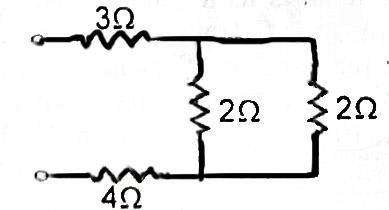
- A.8Ω
- B.11Ω
- C.4Ω
- D.3.6Ω
To find the resultant resistance, first calculate the equivalent resistance for the parallel section. The two 2Ω resistors are in parallel, so their combined resistance is / = 4 / 4 = 1Ω. This 1Ω resistance is now in series with the 3Ω and 4Ω resistors. To get the total resistance, add the series components: 3Ω + 1Ω + 4Ω = 8Ω.
Common mistake: A common mistake is to add all the resistances together as if they are all in series , which incorrectly leads to option B.
Which of the following best describes the energy changes which take place when a steam engine drives a generator which lights a lamp?
- A.heat ----> Light----> Sound ----> Kinetic
- B.Kinetic ----> Light ----> Heat ----> Electricity
- C.heat ----> Kinetic ----> Electricity ----> Heat and Light
- D.electricity ----> Kinetic ----> Heat ----> Light
The process starts with a steam engine, which uses heat from steam to create motion, converting heat energy into kinetic energy. This motion then drives a generator, which transforms the kinetic energy into electrical energy. Finally, the electricity powers the lamp, which converts the electrical energy into both heat and light energy, making the correct sequence Heat -> Kinetic -> Electricity -> Heat and Light.
Common mistake: Students may mistakenly choose option B, focusing on the engine's movement (kinetic energy) as the starting point, but forgetting that the heat from steam is what initially causes that movement.
Cathode rays are
- A.High-energy electromagnetic waves
- B.protons
- C.neutrons
- D.streams of electrons
Cathode rays are beams produced in a vacuum tube when a high voltage is applied across the electrodes. Experiments conducted by scientists like J.J. Thomson showed that these rays are deflected by electric and magnetic fields, proving they are made of negatively charged particles. These fundamental particles were later identified as electrons, so cathode rays are simply a stream of electrons moving at high speed.
Common mistake: Students often mistakenly choose 'High-energy electromagnetic waves' because the term 'rays' makes them think of light or X-rays, but cathode rays are streams of particles (electrons), not waves.
A narrow beam of white light can be split up into different Colours by a glass prism. The correct explanation is that
- A.white light Is an electromagnetic wave
- B.the prism has all the colours of the white light
- C.different colours of white light travel with different speeds in glass
- D.white light has undergone total Internal reflection in the prism
The splitting of white light into its different colours by a prism is a phenomenon called dispersion. This happens because when light enters the glass prism, it refracts or bends. The speed of light in glass is not the same for all colours; red light travels fastest, while violet light travels slowest. Because they have different speeds, each colour bends at a slightly different angle, causing them to separate and form a spectrum.
Common mistake: Students often confuse dispersion with total internal reflection (option D), which is a different phenomenon that can occur in a prism but does not explain the splitting of light into colours.
The diagram shown represents a block-and-tackle pulley system on which an effort of W Newtons supports a load of 120.0N. If the efficiency of the machine is 40, then the value of W is?
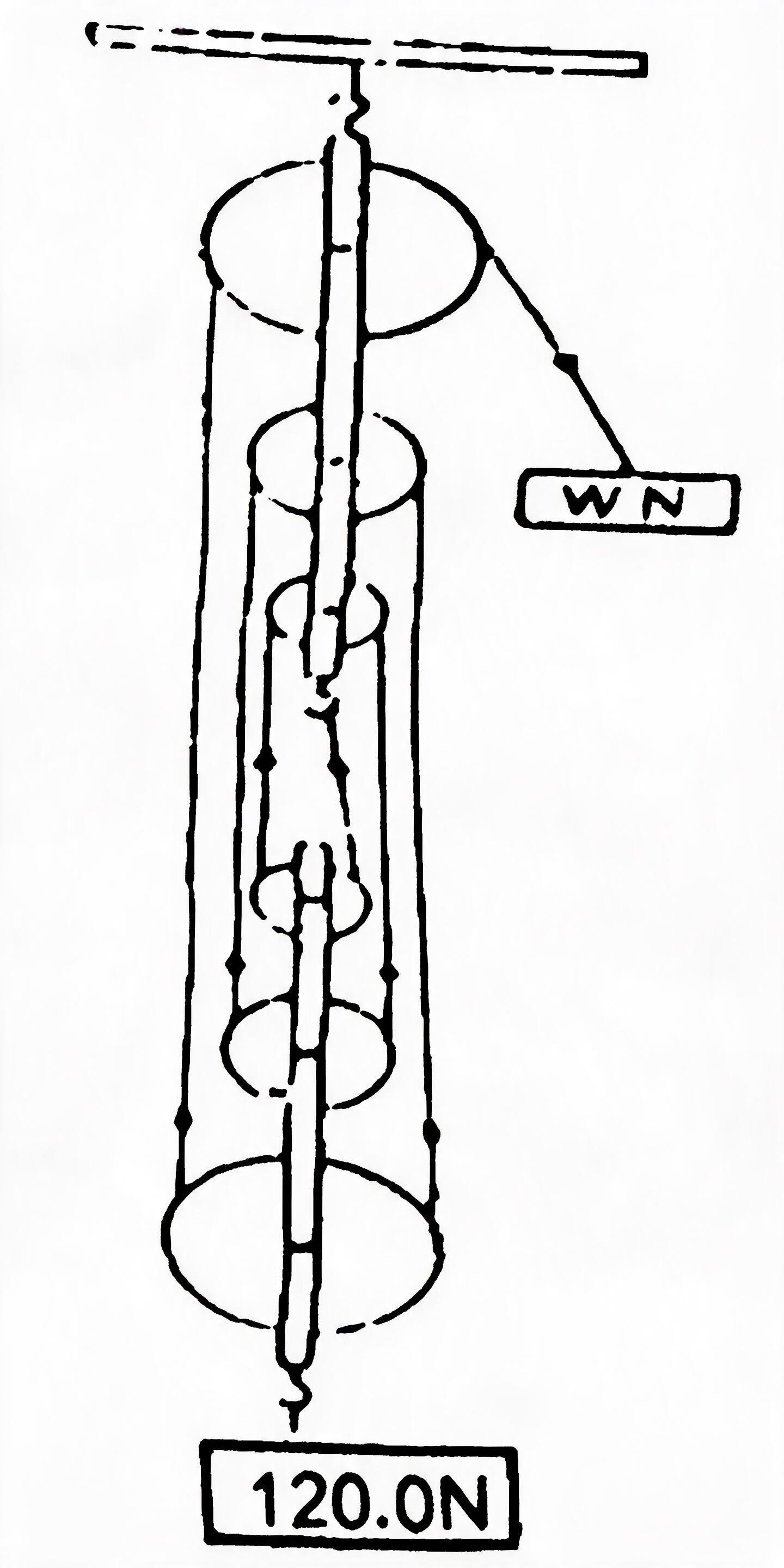
- A.28
- B.48.0N
- C.233.0N
- D.50.0N
The efficiency of a machine is given by the formula: Efficiency = (Mechanical Advantage / Velocity Ratio) × 100%. From the diagram, the number of ropes supporting the load is 6, so the Velocity Ratio (VR) is 6. The Mechanical Advantage (MA) is Load ÷ Effort, which is 120N ÷ W. Substituting these into the formula, we get 40 = ((120/W) / 6) × 100. Solving for W gives W = / = 12000 / 240 = 50.0N.
Common mistake: Students might mistakenly calculate the effort by simply multiplying the load by the efficiency as a decimal , which incorrectly leads to option B.
What type of reaction is represented by the following scheme? ²¹X + ²¹Y → ³²Z + ¹⁰n + energy
- A.Fusion reaction
- B.Fission reaction
- C.Chain reaction
- D.Radioactive decay
The reaction shows two light nuclei, X and Y, combining to form a single, heavier nucleus, Z, along with the release of a neutron and energy. This process of joining or 'fusing' smaller atomic nuclei to create a larger one is the definition of a nuclear fusion reaction. This is the same type of reaction that powers the sun.
Common mistake: Students often confuse fusion with fission, but fission is the opposite process where one large, heavy nucleus splits into smaller ones.
The amount of heat needed to raise the temperature of 10kg of Copper by 1K is its
- A.specific heat capacity
- B.latent heat
- C.heat capacity
- D.internal energy
Heat capacity is the amount of heat energy required to raise the temperature of a specific body or object by 1 Kelvin (1K). The question asks for the heat needed for a 10kg mass of copper, which is a specific body. This is the definition of heat capacity, which is the product of mass and specific heat capacity (C = mc).
Common mistake: Students often mistakenly choose 'specific heat capacity' because they confuse it with 'heat capacity', but specific heat capacity is for a unit mass (1kg), not a given mass like 10kg.
The electrochemical equivalent of silver is 0.0012g/C. If 36.0g of silver is to be deposited by electrolysis on a surface by passing a steady current for 5mins, the current must be?
- A.6000A
- B.100A
- C.10A
- D.1A
This question is based on Faraday's first law of electrolysis, which uses the formula m = ZIt, where 'm' is the mass deposited, 'Z' is the electrochemical equivalent, 'I' is the current, and 't' is the time. First, convert the time from minutes to seconds: t = 5 minutes × 60 = 300 seconds. To find the current (I), rearrange the formula to I = m / (Zt). Substituting the given values, we get I = 36.0 / , which calculates to I = 36.0 / 0.36 = 100A.
Common mistake: A common mistake is forgetting to convert the time from minutes to seconds, which leads to an incorrect calculation (36 / (0.0012 x 5) = 6000A) and choosing option A.
Shadows and eclipses result from the
- A.refraction of light
- B.reflection of light
- C.defraction of light
- D.rectilinear propagation of light
Shadows and eclipses are formed because light travels in a straight line, which is called rectilinear propagation. When an opaque object blocks the path of light, the light cannot bend around it, creating a dark area (a shadow) behind the object. An eclipse is simply a very large-scale shadow, like when the Moon blocks the Sun's light from reaching the Earth.
Common mistake: Students may mistakenly choose reflection or refraction because they are well-known properties of light, but these describe light bouncing off or bending through a surface, not being blocked to form a shadow.
Which of the following obeys Ohm's law?
- A.all metals
- B.diode only
- C.all electrolytes
- D.glass
Ohm's law states that the voltage across a conductor is directly proportional to the current flowing through it, as long as physical conditions like temperature are constant. Materials that follow this rule are called ohmic conductors. Metals are the best examples of ohmic conductors, which is why option A is correct. Other materials like diodes, electrolytes, and glass are non-ohmic because their resistance changes with the applied voltage.
Common mistake: Students may mistakenly choose 'all electrolytes' because they know electrolytes conduct electricity, but they fail to remember that their resistance is not constant, making them non-ohmic conductors.
Which of the following statements are TRUE of isotopes? I. Isotopes of an element have the same chemical properties because they have the same number of electrons II. Isotopes of elements are normally separated using physical properties III. Isotopes of an element have the same number of protons in their nuclei
- A.I and II only
- B.I and III only
- C.II and III only
- D.I, II and III
Isotopes are atoms of the same element, so by definition, they must have the same number of protons (making statement III true). Because they have the same number of protons, a neutral atom will also have the same number of electrons, which determines their identical chemical properties (making statement I true). However, isotopes have different numbers of neutrons, which gives them different mass numbers; this physical difference in mass is the basis for separating them (making statement II true).
Common mistake: Students often choose option B, correctly identifying that isotopes share proton numbers and chemical properties, but they mistakenly believe that statement II is false, not realizing that the mass difference is a physical property used for separation.
In the diagram given the hanging mass m2 is adjusted until m1 is on the verge of sliding. The coefficient of static
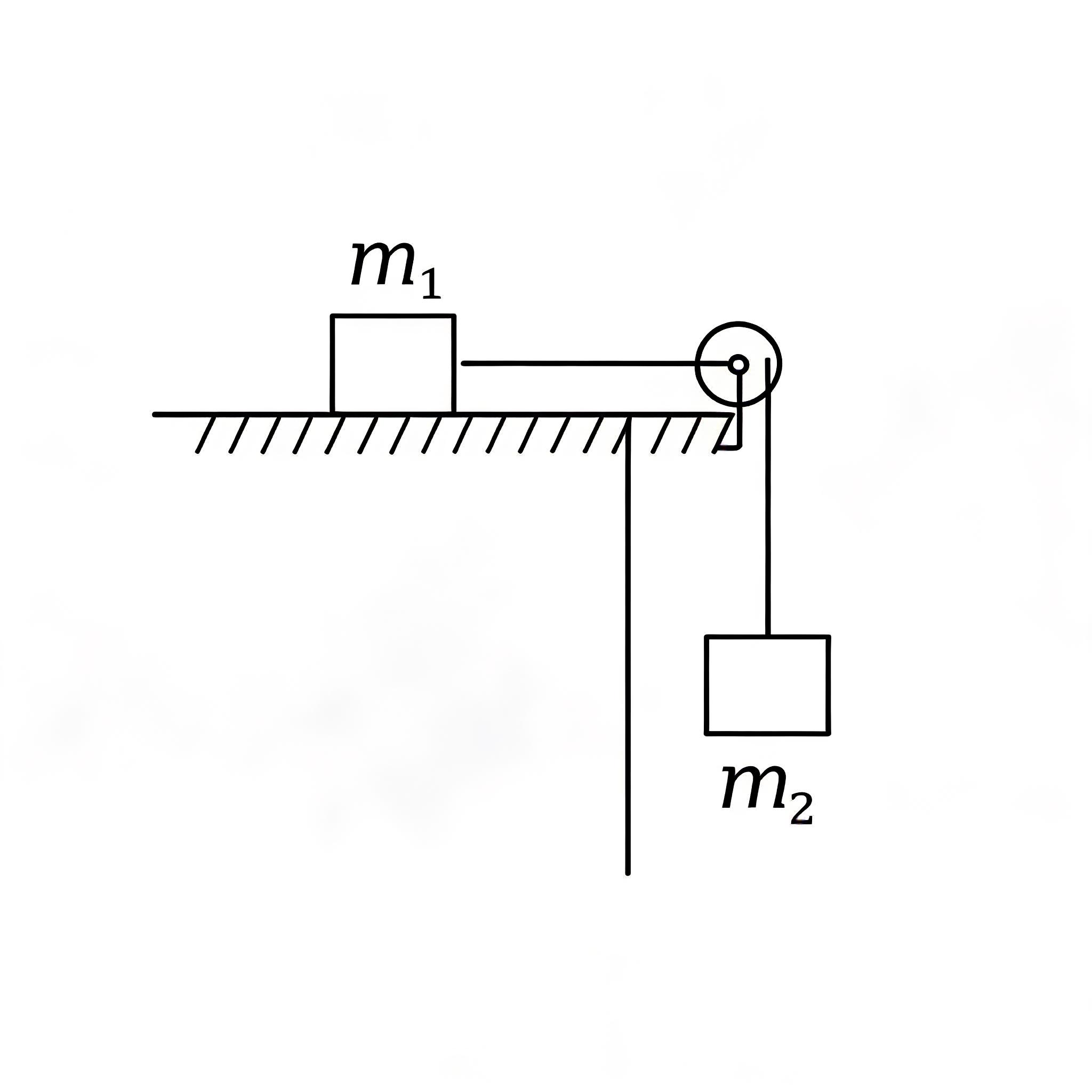
- A.m₁/m₂
- B.m₁g/m₂
- C.m₂/m₁
- D.m₂g/m₁
When mass m1 is on the verge of sliding, the pulling force is equal to the limiting static friction. The pulling force is the tension in the string, which is equal to the weight of the hanging mass, T = m₂g. The limiting static friction (f) is given by f = μR, where μ is the coefficient of static friction and R is the normal reaction, which equals the weight of m1 (R = m₁g). Equating the pulling force and friction (T = f), we get m₂g = μ * m₁g, and solving for μ gives μ = m₂/m₁.
Common mistake: Students often confuse the roles of the two masses, leading them to incorrectly calculate the ratio as m₁/m₂.
Which of the following may be used to explain a mirage? I. Layers of air near the road surface have varying refractive indices in hot weather II. Road surfaces sometimes becomes invisible in hot weather III. Light from the sky can be refracted upwards after coming close to the road surface.
- A.I and III only
- B.II and III only
- C.II only
- D.I, II and III
A mirage is an optical illusion caused by the bending (refraction) of light. On a hot day, the air near the road is hotter and less dense than the air above, creating layers with varying refractive indices (Statement I). Light from the sky travelling towards the ground is bent upwards as it enters the less dense, hotter air, a process called total internal refraction (Statement III). An observer sees this bent light and interprets it as a reflection from a pool of water.
Common mistake: Students often mistakenly choose option D, including statement II, because it describes an observation of a mirage, but it is an effect, not a scientific explanation of how it is formed.
In the diagram given if the atmospheric pressure is 760mm, the pressure in the chamber G Is
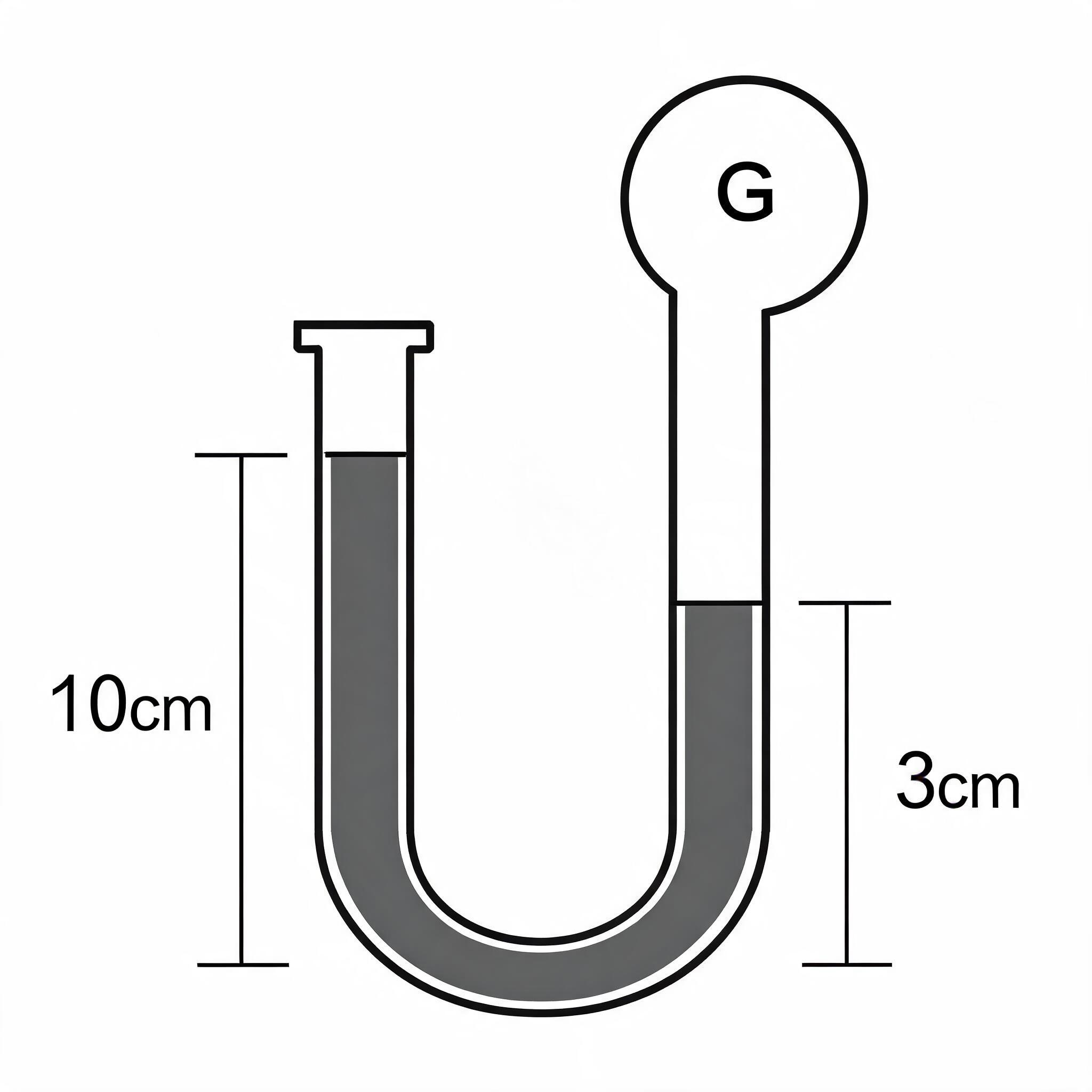
- A.660mm
- B.830mm
- C.690mm
- D.860mm
The diagram shows a manometer where the pressure in chamber G is greater than the atmospheric pressure, as it pushes the liquid up on the open side. The pressure of the gas is the sum of the atmospheric pressure and the pressure due to the height difference of the liquid. The height difference is 10 cm - 3 cm = 7 cm, which is 70 mm. Therefore, the pressure in chamber G is 760 mm + 70 mm = 830 mm.
Common mistake: A common mistake is to subtract the height difference from the atmospheric pressure , which would be the case if the atmospheric pressure was greater than the gas pressure.
Which of the following has the lowest internal resistance when new?
- A.Leclanche cell
- B.Daniell cell
- C.Torch battery
- D.Accumulator
An accumulator, also known as a secondary or rechargeable cell, is designed to deliver a very large current quickly, like when starting a car engine. To achieve this, it is constructed with large plates and a strong electrolyte, which results in a very low internal resistance. Primary cells like the Leclanche, Daniell, and torch batteries have higher internal resistance and are not designed to supply such large currents.
Common mistake: Students might choose 'Torch battery' because it is a common household item, but they often don't realize that these disposable cells have a significantly higher internal resistance than a rechargeable accumulator.
The pitch of an acoustic device can be increased by
- A.decreasing the loudness
- B.increasing the intensity
- C.increasing the frequency
- D.decreasing the intensity
Pitch is the quality of a sound that describes how high or low it is. In physics, the pitch of a sound is determined by its frequency, which is the number of vibrations per second. A high frequency produces a high pitch (a sharp sound), while a low frequency produces a low pitch (a deep sound).
Common mistake: Students often confuse pitch with loudness, mistakenly thinking that increasing the intensity or loudness of a sound will make its pitch higher, but loudness is actually related to the amplitude of the wave, not its frequency.
One of the features of the fission process is that
- A.it leads to chain reaction
- B.its products are not radioactive
- C.neutrons are not released
- D.The sum of the masses of the reactants equals the sum of the masses of the products
Nuclear fission is the process where a heavy atomic nucleus splits into smaller nuclei, releasing a large amount of energy. A key feature of this process is the release of several neutrons. These released neutrons can then strike other heavy nuclei, causing them to also split and release more neutrons, creating a self-sustaining process called a chain reaction.
Common mistake: Students might mistakenly choose option D, applying the law of conservation of mass from chemistry, but in nuclear reactions like fission, a small amount of mass (mass defect) is converted into a large amount of energy.
The linear expansivity of brass is 2 × 10⁻⁵ °C⁻¹. If the volume of a piece of brass is 15.00cm³ at 0°C, what is the volume at 100°C?
- A.16.03cm³
- B.15.09cm³
- C.16.00cm³
- D.15.03cm³
To solve this, we first find the cubical (volume) expansivity, which is three times the linear expansivity: γ = 3α = 3 × = 6 × 10⁻⁵ °C⁻¹. Next, we use the formula for the change in volume, ΔV = γV₁Δθ, where V₁ is the initial volume (15.00cm³) and Δθ is the temperature change (100°C - 0°C = 100°C). This gives a volume increase of ΔV = × 15 × 100 = 0.09cm³. Finally, add this increase to the original volume to get the new volume: 15.00cm³ + 0.09cm³ = 15.09cm³.
Common mistake: Students often make the mistake of using the given linear expansivity instead of the cubical expansivity (which is 3 times the linear value), leading to the incorrect answer 15.03cm³.
A lead bullet of mass 0.05 kg is fired with a velocity of 200 m/s into a lead block of mass 0.95 kg. Given that the lead block can move freely, the final kinetic energy after impact is
- A.100J
- B.150J
- C.50J
- D.200J
First, we use the principle of conservation of momentum to find the final velocity of the combined bullet and block, as this is an inelastic collision. The initial momentum (mass of bullet × its velocity) equals the final momentum (combined mass × final velocity), so (0.05kg × 200m/s) = (0.05kg + 0.95kg) × v, which gives a final velocity v = 10 m/s. Then, we calculate the final kinetic energy using the formula KE = ½mv², where 'm' is the total mass (1.0kg) and 'v' is the final velocity (10 m/s). This results in ½ × 1.0 × 10² = 50J.
Common mistake: A common mistake is to calculate the initial kinetic energy of the bullet (1000J) and assume energy is conserved, or to incorrectly calculate the final kinetic energy by mixing up values, for example by squaring the final momentum (10² = 100J).
In a series R-L-C circuit at resonance, the voltages across the resistor and the inductor are 30V and 40V respectively. What is the voltage across the capacitor?
- A.30V
- B.70V
- C.50V
- D.40V
In a series R-L-C circuit, the special condition called 'resonance' occurs when the inductive reactance equals the capacitive reactance . Since the voltage across the inductor is = I × and the voltage across the capacitor is = I × , and the current (I) is the same for all components in series, it means that at resonance, must equal . Therefore, if the voltage across the inductor is 40V, the voltage across the capacitor must also be 40V.
Common mistake: Students often mistakenly add the given voltages (30V + 40V = 70V), forgetting that voltages in a series AC circuit do not add up arithmetically because they are out of phase.
See all 50 JAMB Physics 2018 questions
Sign up free to unlock every question in this paper — with the verified answer and Beta's worked explanation on each one. No card needed to begin.
Start free