JAMB Geography 2021 Past Questions & Answers
74 JAMB Geography 2021 questions with verified answers and worked explanations. Here are the first 10 — sign up free to practise the full paper.
The following are volcanic mountains except
- A.Cotopaxi of Ecuador
- B.Midcrop of Sumatra
- C.Fuji of Japan
- D.Monadnock of USA
The question requires you to identify the mountain that is not formed by volcanic activity. Volcanic mountains, such as Cotopaxi and Fuji, are created by the eruption and accumulation of lava and ash. A monadnock, on the other hand, is a residual mountain, which is a hill of hard rock left standing after the softer rock around it has been eroded away. Therefore, Monadnock of USA is the correct option because it is a landform of denudation, not vulcanicity.
Common mistake: Students may not be familiar with the term 'monadnock' and might incorrectly assume it is a type of volcano, leading them to choose another option whose name is also unfamiliar.
The human activity that can improve composition of the atmosphere is
- A.Use of chemicals
- B.Land reclamation
- C.Mining and Construction works
- D.Cutting down of trees
The question asks for a human activity that can improve the atmosphere. While many chemicals are pollutants, specific chemicals can be used positively, for example, in industrial 'scrubbers' to clean harmful gases from factory smoke before they are released. The other options, like cutting down trees (deforestation) and mining, are known to worsen air quality and contribute to climate change.
Common mistake: Students may wrongly assume that all chemicals are harmful to the atmosphere, overlooking their specific uses in pollution control and weather modification like cloud seeding.
Which of the following is a sedimentary rock.
- A.Graphite
- B.shale
- C.marble
- D.schist
Rocks are classified into three main types: igneous, sedimentary, and metamorphic. Sedimentary rocks are formed from the accumulation and compaction of sediments (like sand, mud, and shells) over a long time. Shale is a perfect example of a sedimentary rock because it is formed from compacted layers of mud and clay.
Common mistake: Students often confuse marble with sedimentary rocks, but it is actually a metamorphic rock, formed when limestone is subjected to intense heat and pressure.
These are landforms producing agent except
- A.waves
- B.rivers
- C.storms
- D.glaciers
Waves, rivers, and glaciers are all primary agents of denudation, actively shaping the Earth's surface through processes of erosion and deposition, thereby producing various landforms. Storms, while powerful weather events, are not direct landform-producing agents themselves; rather, the strong winds and heavy rainfall associated with storms are the agents that contribute to erosion. Therefore, storms are the exception.
Common mistake: Students might incorrectly choose A, B, or D if they don't fully understand that storms are weather phenomena, not direct geological agents like water or ice.
The function performed by urban to the rural settlement in supply of
- A.Industrial raw materials
- B.medicinal herbs
- C.food
- D.maufactured goods
Urban settlements are typically centers of manufacturing and commerce, producing a wide range of finished products. These manufactured goods, such as tools, clothing, and processed items, are then supplied to rural areas. This exchange highlights the economic interdependence between urban and rural settlements, where urban areas provide industrial output to rural consumers.
Common mistake: Students might incorrectly choose options like 'industrial raw materials' or 'food' because these are often associated with rural areas, but the question specifically asks about what urban areas supply to rural areas.
Use the map below to answer this question above The feature marked Y on the map is?
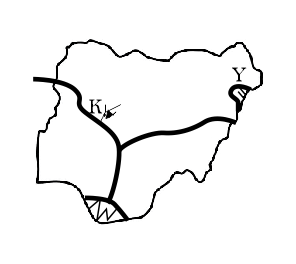
- A.obon hill
- B.obudu plateau
- C.alantika mountain
- D.mandara mountain
The question requires identifying a major physical feature on a map of Nigeria. The feature marked 'Y' is located in the North-East, along the border between Nigeria and Cameroon. This specific geographical location is home to the Mandara Mountains, a significant highland range in that region.
Common mistake: Students often confuse the Mandara Mountains with the Alantika Mountains, as both are major highlands in North-Eastern Nigeria near the Cameroon border, but they are distinct ranges in different locations.
Use the map below to answer this question above What is the feature labelled K on the map is
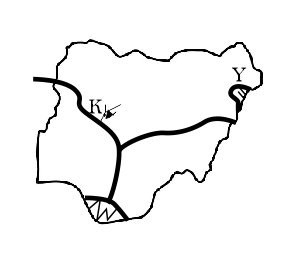
- A.river sokoto
- B.lake chad
- C.lake kainji
- D.river zamfara
The question requires the identification of a specific feature on a map of Nigeria. The feature labelled K is located on the River Niger in the western part of the country. This large, man-made body of water is Lake Kainji, which was formed by the Kainji Dam.
Common mistake: Students might mistakenly choose Lake Chad because it is another major lake in Nigeria, but they fail to check the map for its correct location in the far north-east.
The benefits of international trade to developing nations include the following except
- A.Encourages specialisation in production
- B.Encourages healthy competition
- C.Strains international trade relation
- D.Enables nations to move from subsistence to mechanized economy
The question asks for what is NOT a benefit of international trade. Options A, B, and D describe positive outcomes: specialisation, healthy competition, and economic development, respectively. Option C, 'Strains international trade relation,' describes a negative consequence or a challenge, not a benefit. Therefore, it is the correct answer as it is the exception to the benefits.
Common mistake: Students might incorrectly choose options A, B, or D if they fail to notice the word 'except' in the question, leading them to select an actual benefit of international trade instead of the non-benefit.
Which of the following is not caused by the earth's rotation?
- A.Day and night
- B.Seasonal changes
- C.Deflection of winds
- D.Deflection of ocean currents
The Earth's rotation on its axis is responsible for the occurrence of day and night, and also the Coriolis effect which causes the deflection of winds and ocean currents. However, seasonal changes are primarily caused by the Earth's revolution around the sun and the tilt of its axis, not its daily rotation. Therefore, seasonal changes are not a direct result of the Earth's rotation.
Common mistake: Students often confuse the effects of Earth's rotation with those of its revolution, leading them to incorrectly associate seasonal changes with rotation.
The following are responsible for the concentration of industries in eastern United States of America except
- A.Large market
- B.Natural resources
- C.Inadequate capital
- D.High technology
The question asks you to identify the factor that is NOT responsible for the concentration of industries in the eastern USA. A large market (many customers), available natural resources (like coal and iron), and high technology are all key reasons why industries thrive in a region. 'Inadequate capital' means not having enough money for investment, which would prevent industries from developing, not cause them to concentrate.
Common mistake: Students may misread the question and select a factor that does contribute to industrial concentration, like 'Large market' or 'Natural resources', because they forget the question asks for the exception.
See all 74 JAMB Geography 2021 questions
Sign up free to unlock every question in this paper — with the verified answer and Beta's worked explanation on each one. No card needed to begin.
Start free