JAMB Chemistry 2025 Past Questions & Answers
40 JAMB Chemistry 2025 questions with verified answers and worked explanations. Here are the first 10 — sign up free to practise the full paper.
The molecule with the highest number of lone pair of electrons is
- A.H₂O
- B.NH₃
- C.CH₄
- D.CO₂
To find the number of lone pairs, we must consider all atoms in the molecule. In carbon dioxide (CO₂), the central carbon atom has no lone pairs, but each of the two oxygen atoms has two lone pairs, giving a total of four lone pairs for the molecule. Water (H₂O) has two lone pairs, ammonia (NH₃) has one, and methane (CH₄) has zero, making CO₂ the molecule with the highest number.
Common mistake: Students might mistakenly choose H₂O because they only count the lone pairs on the central atom and forget to count the lone pairs on all atoms in the molecule.
The composition of petroleum varies because it is a
- A.hydrocarbon
- B.liquid
- C.mixture
- D.natural resource
Petroleum, also known as crude oil, is a complex mixture containing hundreds of different hydrocarbons of various sizes. A fundamental property of a mixture is that its components are not chemically bonded and can be present in variable proportions. This is why the composition of petroleum is not fixed and differs depending on where it is sourced from.
Common mistake: Students often incorrectly choose 'hydrocarbon' because while petroleum is composed of hydrocarbons, the term 'mixture' is the specific reason its composition is variable.
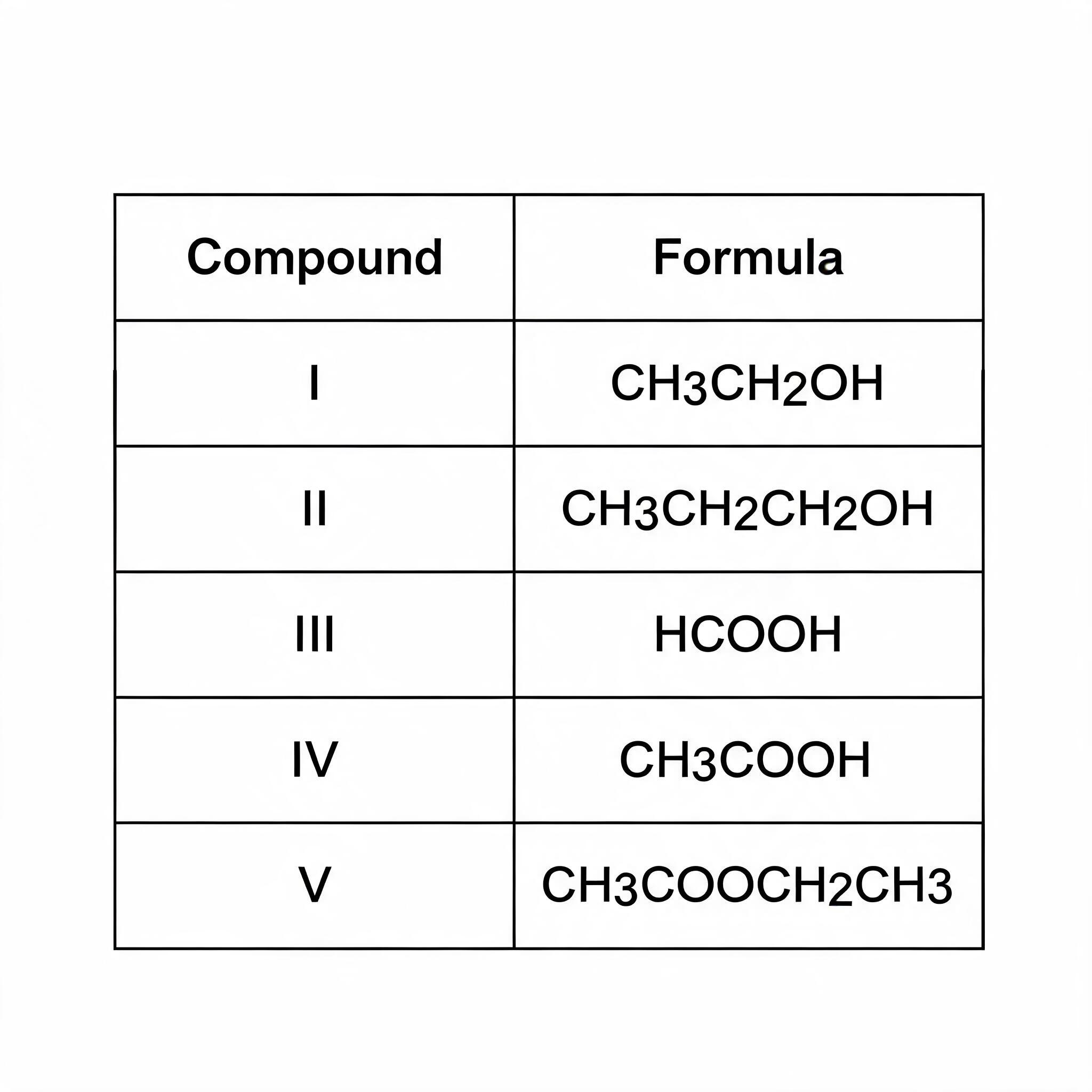
In the table above, the two compounds that will combine in the presence of an acid catalyst to form compound V are
- A.I and IV
- B.III and IV
- C.I and II
- D.II and III
The question describes the formation of an ester, a reaction known as esterification. This process involves the reaction of an alkanoic acid with an alkanol in the presence of an acid catalyst to produce an ester and water. Therefore, to form compound V (the ester), one must combine compound I (an alkanoic acid) and compound IV (an alkanol).
Common mistake: Students often forget the specific reactants for esterification and may incorrectly choose a pair of compounds that are not an alkanoic acid and an alkanol.
An example of an alkaline gas is
- A.HCl
- B.N₂
- C.NH₃
- D.NO₂
An alkaline gas is a gas that shows basic properties. When ammonia (NH₃) gas dissolves in water, it forms a solution of ammonium hydroxide (NH₄OH), which is a weak base. This solution can turn moist red litmus paper blue, confirming that ammonia is an alkaline gas. The other options are either acidic (HCl, NO₂) or neutral (N₂).
Common mistake: Students may mistakenly choose HCl because it is a very common gas studied in chemistry, but they forget that it is a classic example of an acidic gas, not an alkaline one.
The dusty and sand particles present in the air is an example of
- A.a suspension
- B.a dispersion
- C.an emulsion
- D.a saturated solution
A suspension is a type of mixture where solid particles are scattered in a fluid (like a liquid or gas) but are large enough to be seen and will eventually settle down due to gravity. Dust and sand are solid particles that are temporarily held up in the air, which is a gas. Because these particles will eventually fall and settle, this mixture is correctly classified as a suspension.
Common mistake: Students might confuse a suspension with an emulsion, but an emulsion is a mixture of two liquids that do not normally mix, like oil and water, not a solid in a gas.
The property of metal that makes it suitable as a catalyst is
- A.filled f-orbital
- B.partially filled d-orbitals
- C.partially filled f-orbital
- D.filled d-orbital
Many metals that are good catalysts are transition metals, like iron or vanadium. Their catalytic ability comes from their unique electronic structure, specifically having partially filled d-orbitals. These available orbitals allow them to form temporary bonds with reactant molecules, providing an alternative reaction pathway with a lower activation energy, thus speeding up the reaction.
Common mistake: Students may mistakenly choose 'filled d-orbital', confusing the stability of a full orbital with the reactivity needed for catalysis; it is the availability of space in the orbitals that is key.
When ΔH is positive and small, and ΔS is positive and large, the reaction will be
- A.Non-spontaneous
- B.favour forward reaction only
- C.favour backward reaction only
- D.spontaneous
The spontaneity of a reaction is determined by the Gibbs free energy change, using the formula ΔG = ΔH - TΔS. For a reaction to be spontaneous, ΔG must be negative. Since ΔS is positive and large, the term TΔS will be a large positive number, and because ΔH is positive but small, subtracting the large TΔS value will result in a negative ΔG, making the reaction spontaneous.
Common mistake: Students may mistakenly choose 'Non-spontaneous' because they see a positive ΔH (endothermic) and forget that a large positive entropy change (ΔS) can overcome the positive enthalpy to make the reaction spontaneous.
Calculate the pH of 0.001 M KOH solution.
- A.11
- B.14
- C.12
- D.3
Potassium hydroxide (KOH) is a strong base, so it completely breaks down in water to give hydroxide ions (OH-). The concentration of OH- is the same as the concentration of the KOH solution, which is 0.001 M or 10⁻³ M. First, we calculate the pOH using the formula pOH = -log[OH-], which gives pOH = -log(10⁻³) = 3. Finally, we find the pH using the relationship pH + pOH = 14, so pH = 14 - 3 = 11.
Common mistake: Students often mistakenly choose option D because they calculate the pOH to be 3 and forget to subtract it from 14 to find the actual pH of the basic solution.
The acid used in making baking soda and soft drink is
- A.tartaric acid
- B.fatty acid
- C.boric acid
- D.citric acid
Citric acid is a weak organic acid naturally found in citrus fruits like lemons and oranges. It is widely used in the food and beverage industry as a flavouring agent and preservative. In soft drinks, it provides a tart, sour taste, and it can be used with baking soda (sodium bicarbonate) as a leavening agent to produce carbon dioxide gas.
Common mistake: Students may mistakenly choose tartaric acid as it is also an organic acid used in food, particularly baking powder, but citric acid is the primary acidulant used in soft drinks.
NH₃(g) + HCl(g) → NH₄Cl(g). In the reaction above, increase in pressure will
- A.lower the equilibrium constant
- B.favour the product
- C.favour the reactant
- D.increase the equilibrium constant
According to Le Chatelier's principle, if you increase the pressure on a system at equilibrium, the system will shift to the side with fewer moles of gas to counteract the change. In this reaction, the reactant side has 2 moles of gas (1 mole of NH₃ and 1 mole of HCl). The product side has only 1 mole of gas (NH₄Cl). Therefore, increasing the pressure will favour the forward reaction, shifting the equilibrium to the right to produce more product.
Common mistake: Students may wrongly choose A or D, confusing the effect of pressure, which only shifts the equilibrium position, with the effect of temperature, which is the only factor that changes the value of the equilibrium constant.
See all 40 JAMB Chemistry 2025 questions
Sign up free to unlock every question in this paper — with the verified answer and Beta's worked explanation on each one. No card needed to begin.
Start free