JAMB Chemistry 2020 Past Questions & Answers
40 JAMB Chemistry 2020 questions with verified answers and worked explanations. Here are the first 25 — sign up free to practise the full paper.
The electronic configuration of an element is 1S² 2S² 2P⁶ 3S² 3P³. How many unpaired electrons are there in the element?
- A.5
- B.4
- C.3
- D.2
To find the number of unpaired electrons, you must look at the electron configuration of the outermost subshell, which is 3P³. The 'P' subshell contains three orbitals. According to Hund's rule of maximum multiplicity, electrons will occupy each orbital singly before any pairing occurs. Since there are three electrons in the 3P subshell, one electron will go into each of the three available orbitals, leaving all three of them unpaired.
Common mistake: Students might mistakenly choose option A by adding all the valence electrons in the third shell (3S² and 3P³), which is 5, confusing the total number of valence electrons with the number of unpaired electrons.
Which of the following can be obtained by fractional distillation?
- A.Nitrogen from liquid air
- B.Sodium Chloride from sea water
- C.Iodine from solution of Iodine in carbon tetrachloride
- D.Sulphur from the solution of sulphur in carbon disulphide
Fractional distillation is a method used to separate a mixture of liquids that have different but close boiling points. Liquid air is a mixture of mainly liquid nitrogen and liquid oxygen. Since liquid nitrogen boils at -196°C and liquid oxygen boils at -183°C, their boiling points are close enough to require fractional distillation for their separation.
Common mistake: Students often mistakenly choose option B because they remember that distillation can be used to get pure water from sea water, but they forget that fractional distillation is specifically for separating liquids with close boiling points.
Duralumin consists of aluminum, copper and?
- A.Zinc and Gold
- B.Lead and Manganese
- C.Nickel and Silver
- D.Manganese and Magnesium
Duralumin is an important alloy, which is a mixture of metals, known for being light and strong. Its main composition is aluminum (over 90%), followed by copper (about 4%), and then small amounts of both manganese and magnesium. These other metals are added to make the aluminum stronger and harder, which is why it is used in aircraft construction.
Common mistake: Students may be tempted by option B because it correctly includes manganese, but they often forget that lead is not a component of the lightweight duralumin alloy.
An example of a polysaccharide is?
- A.Dextrose
- B.Mannose
- C.Glucose
- D.Starch
Polysaccharides are large, complex carbohydrate molecules formed by joining many smaller sugar units, called monosaccharides, together. Starch is a perfect example of a polysaccharide because it is made up of long chains of glucose units. In contrast, glucose, dextrose (another name for glucose), and mannose are all monosaccharides, which are the simple, single sugar units.
Common mistake: Students often mistakenly choose glucose because they know it is the building block of starch, but they forget that a polysaccharide is the large polymer, not the small monomer unit.
8g of CH₄ occupies 11.2 dm³ at S.T.P. What volume would 22g of CH₃CH₂CH₃ occupy under the same condition?
- A.3.7dm³
- B.11.2dm³
- C.22.4dm³
- D.33dm³
First, calculate the number of moles for each gas. The molar mass of methane (CH₄) is 16 g/mol, so 8g is 0.5 moles. The molar mass of propane (C₃H₈) is 44 g/mol, so 22g is also 0.5 moles. According to Avogadro's Law, equal moles of any gas occupy the same volume at the same temperature and pressure. Since both gases are 0.5 moles, they must occupy the same volume, which is 11.2 dm³.
Common mistake: Students may mistakenly choose 22.4 dm³ because it is the standard molar volume for one mole of a gas at S.T.P., forgetting that the question involves 0.5 moles.
The best treatment for a student who accidentally poured conc tetraoxosulphate(vi) on his skin in the laboratory is to wash his skin with?
- A.cool running water
- B.sodium hydroxide solution
- C.iodine solution
- D.sodium trioxonitrate(v) solution
When a corrosive chemical like concentrated tetraoxosulphate(VI) acid spills on the skin, the most important first aid is to immediately wash the affected area with a large amount of cool, running water. This action rapidly dilutes the acid and washes it away, minimizing the chemical burn. The continuous flow of water also helps to dissipate the heat generated as the acid reacts with water.
Common mistake: Students often mistakenly choose sodium hydroxide solution because they know it neutralizes acids, but they forget that this neutralization reaction is highly exothermic and would cause a severe heat burn in addition to the chemical burn.
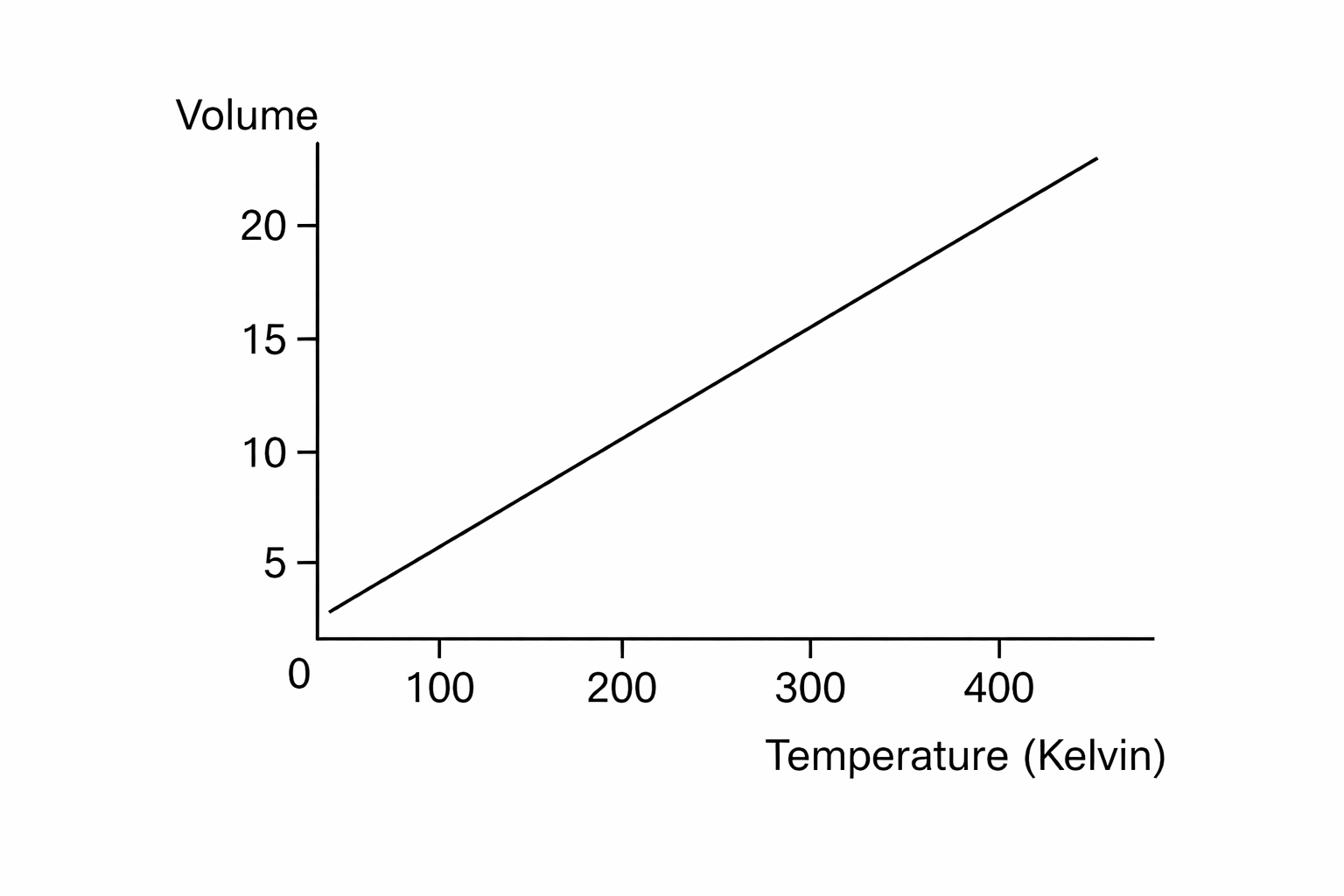
Which of the gas laws does this graph illustrate?
- A.Boyle
- B.Charles
- C.Gay-Lussac
- D.Graham
Charles' Law states that for a fixed mass of gas at constant pressure, the volume is directly proportional to its absolute temperature in Kelvin. The graph in the image shows a straight line plot of Volume on the y-axis against Temperature (in Kelvin) on the x-axis. This straight line passing through the origin demonstrates a direct proportionality (V ∝ T), which is the graphical representation of Charles' Law.
Common mistake: Students may mistakenly choose Gay-Lussac's Law because it also describes a direct relationship with temperature, but it relates pressure and temperature (P ∝ T), not volume and temperature as shown on the graph's axes.
What are the possible oxidation numbers of an element if its atomic number is 17?
- A.-1 and 7
- B.-1 and 6
- C.-3 and 5
- D.-2 and 6
An element with atomic number 17 has the electronic configuration 2, 8, 7. This means it has 7 electrons in its outermost shell and belongs to Group 17 of the periodic table. To achieve a stable octet, it can gain one electron, resulting in an oxidation number of -1. In compounds with more electronegative elements like oxygen, it can also exhibit positive oxidation states by using all its 7 valence electrons, giving it a maximum oxidation number of +7.
Common mistake: Students often mistakenly think the maximum positive oxidation number is different from the number of valence electrons, leading them to choose incorrect options like +6 or +5.
What process would coal undergo to give coal gas, coal tar, ammoniacal liquor and coke?
- A.Steam distillation
- B.Destructive distillation
- C.Liquefication
- D.Hydrolysis
Destructive distillation is the process of heating a complex organic substance, like coal, to a very high temperature in the absence of air. This process breaks down the coal into simpler, useful products. The main products from the destructive distillation of coal are coke (a solid fuel), coal tar, coal gas, and ammoniacal liquor.
Common mistake: Students might mistakenly choose 'Steam distillation' because it is another type of distillation, but it is used to separate temperature-sensitive materials and is not the correct process for breaking down coal.
Liquid black soap is made by boiling palm oil with liquid extract of ash. The function of the ash is to provide the?
- A.Acid
- B.Ester of alkanoic acid
- C.Alkali
- D.Alkanol
The process of making soap from oil is called saponification. This chemical reaction requires a strong base, known as an alkali, to react with the fat or oil. The liquid extract from ash contains compounds like potassium carbonate, which form an alkaline solution in water. This alkali is what breaks down the palm oil to form the soap.
Common mistake: Students may mistakenly choose 'Ester of alkanoic acid' because the palm oil itself is an ester, but they forget that the ash provides the alkali needed to react with the ester.
When water drops are added to calcium carbide in a container and the gas produced is passed through a jet and lighted, the resultant flame is called an?
- A.Oxyethene
- B.Oxyhydrocarbon flame
- C.Oxyacetylene flame
- D.Oxymethane flame
The chemical reaction between calcium carbide (CaC₂) and water (H₂O) produces ethyne gas (C₂H₂). The common name for ethyne is acetylene. When this gas is burned with a supply of oxygen, it creates a very hot flame which is specifically called an oxyacetylene flame, commonly used for welding and cutting metals.
Common mistake: Students might choose 'Oxyhydrocarbon flame' because while acetylene is a hydrocarbon, this is a general term and the question requires the specific name for the flame produced.
Which of the following substances is a mixture?
- A.Granulated sugar
- B.Seawater
- C.Sodium chloride
- D.Iron filling
A mixture is a substance made by combining two or more different materials in such a way that no chemical reaction occurs. Seawater is a mixture because it contains pure water (H₂O) with various salts and other substances dissolved in it, which can be separated by physical methods like evaporation. Granulated sugar (sucrose), sodium chloride, and iron fillings are all pure substances (two are compounds and one is an element), not mixtures.
Common mistake: Students might mistakenly choose sodium chloride because it is a key component of seawater, but pure sodium chloride by itself is a single chemical compound, not a mixture.
If the quantity of oxygen occupying 2.76L container at a pressure of 0.825 atm and 300K is reduced by one-half, what is the pressure exerted by the remaining gas?
- A.1.650atm
- B.0.825atm
- C.0.413atm
- D.0.275atm
According to the gas laws, when the volume and temperature of a gas are kept constant, the pressure is directly proportional to the amount (quantity) of the gas. This means if you reduce the amount of gas, the pressure will also reduce by the same factor. Since the quantity of oxygen was reduced by one-half, the initial pressure must also be reduced by one-half. Therefore, the new pressure is 0.825 atm divided by 2, which gives 0.413 atm.
Common mistake: Students might mistakenly choose 0.825atm, thinking that pressure remains constant because the volume and temperature did not change, forgetting that the amount of gas also affects pressure.
Four elements P, Q, R and S have atomic numbers of 4, 10, 12 and 14 respectively. Which of these elements is a noble gas?
- A.P
- B.Q
- C.R
- D.S
To identify the noble gas, we must check the electronic configuration of each element. Noble gases are elements with a completely filled outermost electron shell, making them very stable. Element Q has an atomic number of 10, so its electrons are arranged in shells as 2, 8. Since its outer shell is full with 8 electrons, it is a noble gas (Neon).
Common mistake: A common mistake is to incorrectly choose R (atomic number 12), which has a configuration of 2, 8, 2; students might see the filled '8' shell and get confused, forgetting that the outermost shell has 2 electrons and is therefore not full.
The products of the thermal decomposition of ammonium trioxonitrate(v) are?
- A.Nitrogen (I) Oxide and Water
- B.Ammonia and Oxide
- C.Nitrogen and Water
- D.Nitrogen (IV) Oxide and Water
Ammonium trioxonitrate(v) has the chemical formula NH₄NO₃. When this salt is gently heated, it undergoes thermal decomposition, which means it breaks down into simpler substances. The reaction produces Nitrogen (I) Oxide (N₂O), also known as dinitrogen monoxide, and water (H₂O). The balanced chemical equation for this specific decomposition is NH₄NO₃ → N₂O + 2H₂O.
Common mistake: Students often mistakenly choose option D, confusing the decomposition of ammonium nitrate with that of heavy metal nitrates which produce Nitrogen (IV) Oxide (NO₂).
How many valence electrons are contained in the element ³¹₁₅P?
- A.5
- B.4
- C.15
- D.31
The symbol ³¹₁₅P shows that the element Phosphorus (P) has an atomic number of 15. For a neutral atom, the atomic number is equal to the total number of electrons, so Phosphorus has 15 electrons. These electrons are arranged in shells with the electronic configuration 2, 8, 5, and valence electrons are the electrons in the outermost shell, which is 5.
Common mistake: Students may mistakenly choose 15, which is the total number of electrons (the atomic number), instead of just the electrons in the outermost shell.
The number of molecules of Carbon(iv)Oxide produced when 10.0g of CaCO₃ is treated with 0.2dm³ of 1 Mole of HCl in the equation CaCO₃ + 2HCl ⇒ CaCl₂ + H₂O + CO₂ is?
- A.1.00 × 10²³
- B.6.02 × 10²³
- C.6.02 × 10²²
- D.6.02 × 10²⁴
First, calculate the moles of each reactant: moles of CaCO₃ is 10g / 100g/mol = 0.1 mol, and moles of HCl is 1 mol/dm³ × 0.2 dm³ = 0.2 mol. From the balanced equation, the 1:2 mole ratio of CaCO₃ to HCl shows that 0.1 mol of CaCO₃ will react completely with 0.2 mol of HCl to produce 0.1 mol of CO₂. To find the number of molecules, multiply the moles of CO₂ by Avogadro's constant, which gives 0.1 × = 6.02 × 10²² molecules.
Common mistake: A common mistake is to correctly find that 0.1 moles of CO₂ are produced but then forget to multiply Avogadro's constant by 0.1, leading to the incorrect answer for one full mole.
The volume occupied by 1.58g of a gas at S.T.P is 500cm³. What is the relative molecular mass of the gas? [G.M.V at S.T.P = 22.4dm³]
- A.28
- B.32
- C.44
- D.71
First, convert the given volume from cm³ to dm³ by dividing by 1000, so 500cm³ becomes 0.5dm³. At S.T.P., one mole of any gas occupies 22.4dm³, which is its molar volume. We can set up a proportion: if 0.5dm³ of the gas has a mass of 1.58g, then 22.4dm³ (one mole) will have a mass equal to its molar mass. Therefore, the molar mass is (1.58g / 0.5dm³) * 22.4dm³, which equals 70.784g/mol, or approximately 71.
Common mistake: Students often forget to convert the volume from 500cm³ to 0.5dm³ before calculating, leading to an incorrect answer like 35.3, which might cause them to wrongly select option B or C.
Which of the following gases will rekindle a brightly glowing splint?
- A.NO₂
- B.NO
- C.N₂O
- D.Cl₂
The test of rekindling a brightly glowing splint is used to identify gases that support combustion, like oxygen. Dinitrogen monoxide (N₂O), also known as nitrous oxide, behaves similarly to oxygen in this test. When the hot glowing splint is introduced, the heat causes N₂O to decompose and release oxygen gas. It is this released oxygen that rekindles the splint.
Common mistake: Students often mistakenly choose NO₂ because they remember that an oxide of nitrogen supports combustion but cannot recall the specific one, and NO₂ is a more commonly discussed pollutant.
The shape of ammonia molecule is?
- A.Trigonal planar
- B.Octahedral
- C.Square planar
- D.Tetrahedral
The shape of a molecule is determined by the arrangement of electron pairs around the central atom, according to VSEPR theory. In ammonia (NH₃), the central nitrogen atom has 5 valence electrons. It forms three single bonds with three hydrogen atoms and has one lone pair of electrons left. These four electron pairs (3 bonding pairs and 1 lone pair) repel each other and arrange themselves in a tetrahedral geometry to be as far apart as possible. Although the molecular shape is trigonal pyramidal, it is derived from this tetrahedral arrangement of electrons.
Common mistake: Students often mistakenly choose 'Trigonal planar' because they see three hydrogen atoms and forget to account for the lone pair of electrons on the central nitrogen atom, which also influences the shape.
A few drops of conc HCl are added to about 10cm³ of a solution of pH 3.4. The pH of the resulting mixture is?
- A.less than 3.4
- B.greater than 3.4
- C.unaltered
- D.the same as that of the pure water
The pH scale measures how acidic or basic a solution is, where a lower pH value means higher acidity. The starting solution is already acidic with a pH of 3.4. When you add concentrated hydrochloric acid (HCl), which is a strong acid, you increase the concentration of hydrogen ions (H+) in the solution. An increase in hydrogen ion concentration makes the solution more acidic, which causes the pH value to decrease to a value less than 3.4.
Common mistake: Students might mistakenly choose 'unaltered' if they are thinking of a buffer solution, which resists pH change, but this question does not describe a buffer.
Chromatography is used to separate components of a mixture which differ in their rates of?
- A.diffusion
- B.migration
- C.reaction
- D.sedimentation
Chromatography is a technique used to separate the different parts of a mixture, like the colours in an ink. The separation works because as a solvent (mobile phase) moves over a surface (stationary phase), it carries the components of the mixture along with it. Each component travels or migrates at a different speed, causing them to separate out, so the technique relies on the different rates of migration.
Common mistake: Students might mistakenly choose 'diffusion' because it also involves the movement of particles, but 'migration' is the specific term for the differential movement of components through the stationary phase in chromatography.
Deliquescent substances are also?
- A.efflorescent
- B.anhydrous
- C.hygroscopic
- D.insoluble
A hygroscopic substance is one that can absorb moisture from the atmosphere. Deliquescence is an extreme form of hygroscopy, where a substance absorbs so much moisture that it dissolves in the absorbed water to form a solution. Therefore, all deliquescent substances are by definition also hygroscopic, as they must first absorb moisture before they can dissolve in it.
Common mistake: Students often confuse deliquescence (absorbing moisture to form a solution) with its opposite, efflorescence (losing water of crystallization to the air).
Helium is used in observation balloons because it is?
- A.Light and combustible
- B.light and non-combustible
- C.heavy and combustible
- D.heavy and non-combustible
Helium is used in observation balloons because it has two important properties. First, it is very light because it has a very low density, which allows the balloon to float in the air. Second, Helium is a noble gas, meaning it is chemically unreactive and will not catch fire or explode, which makes it much safer to use than a gas like hydrogen.
Common mistake: Students may mistakenly choose option A, confusing Helium with Hydrogen, which is also very light but is dangerously combustible.
32g of anhydrous copper(ii)tetraoxosulphate(vi) dissolved in 1dm³ of water generated 13.0kJ of heat. The heat of solution is?
- A.26.0kJ/mol
- B.65.0kJ/mol
- C.130.0kJ/mol
- D.260.0kJ/mol
The heat of solution is the amount of heat released or absorbed per mole of solute. First, calculate the molar mass of anhydrous copper(II) tetraoxosulphate(VI) (CuSO₄), which is 64 + 32 + 4(16) = 160 g/mol. Then, find the number of moles in the 32g sample: moles = mass / molar mass = 32g / 160g/mol = 0.2 moles. Since 0.2 moles generated 13.0 kJ of heat, the heat of solution per mole is 13.0 kJ / 0.2 mol, which equals 65.0 kJ/mol.
Common mistake: Students often make a calculation error, for example, incorrectly calculating the number of moles as 0.1 instead of 0.2, which would lead them to the wrong answer of 130.0 kJ/mol.
See all 40 JAMB Chemistry 2020 questions
Sign up free to unlock every question in this paper — with the verified answer and Beta's worked explanation on each one. No card needed to begin.
Start free