JAMB Chemistry 2015 Past Questions & Answers
50 JAMB Chemistry 2015 questions with verified answers and worked explanations. Here are the first 25 — sign up free to practise the full paper.
The filter in the cigarette reduce the nicotine construct by
- A.burning
- B.adsorption
- C.evaporation
- D.Absorption
Cigarette filters contain materials like activated carbon which have a large surface area. Adsorption is the process where particles, like the harmful nicotine in smoke, stick to the surface of another material. As the smoke passes through the filter, the nicotine molecules are trapped on the surface of the filter material, reducing the amount the smoker inhales.
Common mistake: Students often confuse adsorption, which happens on the surface, with absorption, where a substance soaks into the entire volume of another material like a sponge soaking up water.
Which of these require crystallization most?
- A.Drug making
- B.Cement making
- C.Paint making
- D.Perfume making
Crystallization is a chemical process used to purify solid substances by separating them from a solution. In the pharmaceutical industry, it is very important for drugs to be extremely pure to ensure they are safe and effective for patients. Therefore, crystallization is a critical and widely used step in drug making to obtain the pure active ingredient. Processes like making cement, paint, or perfume involve mixing different substances together, and do not require the high purity of a single crystalline component.
Common mistake: Students might mistakenly choose perfume making because it involves dissolving solids to create a solution, but this process is about mixing, not purifying a single component through crystallization.
Iron is often galvanized in order to
- A.Make it more malleable
- B.Remove the impurities unit
- C.Protect it against corrosion
- D.Render it passive
Galvanization is the process of coating iron or steel with a layer of zinc. This zinc layer acts as a barrier, preventing oxygen and water from reaching the iron surface. More importantly, zinc is more reactive than iron, so it corrodes or rusts first, sacrificially protecting the iron underneath. This entire process is done to protect the iron against corrosion, which is commonly known as rusting.
Common mistake: Students might mistakenly choose option A, confusing galvanization with processes like annealing which are used to change the physical properties of metals such as malleability.
In the industrial production of H₂ from water gas, the CO₂ produced along with the H₂ is removed by
- A.Washing under pressure
- B.Drying over phosphorus (V) oxide
- C.Passing the mixture through limewater
- D.Using ammoniacal copper (I) chloride
In the industrial production of hydrogen from water gas, a mixture of hydrogen (H₂) and carbon dioxide (CO₂) is formed. To separate these gases on a large scale, the mixture is washed with water under high pressure. According to Henry's Law, the solubility of a gas in a liquid increases with pressure, and CO₂ is naturally more soluble in water than H₂; this high pressure makes the CO₂ dissolve effectively, leaving behind the much less soluble hydrogen gas.
Common mistake: Students often choose 'passing the mixture through limewater' because it is the standard laboratory test for CO₂, but this method is not practical or economical for the large volumes used in industrial processes.
The gas that is most useful in protecting humans against solar marathon is
- A.chlorine
- B.ozone
- C.carbon IV oxide
- D.hydrogen sulphide
Ozone is a special form of oxygen gas with the formula O₃. It forms a protective layer high up in the atmosphere called the ozone layer. This layer acts like a shield, absorbing most of the harmful ultraviolet (UV) radiation that comes from the sun. By blocking this radiation, the ozone layer protects humans from skin cancer, eye damage, and other health issues.
Common mistake: Students might mistakenly choose carbon IV oxide because it is a well-known atmospheric gas, but it is a greenhouse gas that traps heat, it does not block solar radiation.
Vulcanization involve the removal of
- A.monometer
- B.the single bond
- C.the double bond
- D.a polymer
Vulcanization is the process of heating natural rubber with sulfur to make it stronger and more elastic. Natural rubber is a polymer made up of long chains that contain carbon-carbon double bonds. During vulcanization, sulfur atoms form bridges, or cross-links, between these chains by reacting with and breaking the double bonds, thus improving the rubber's properties.
Common mistake: Students might mistakenly choose option A, thinking that vulcanization breaks the polymer down into its monomers, but the process actually strengthens the polymer by creating links between its chains.
The acid in electrolysis of water is dilute
- A.HNO₃
- B.CH₃COOH
- C.H₂SO₄
- D.HCl
Pure water is a poor conductor of electricity, so a small amount of acid is added to allow current to flow. Dilute sulphuric acid (H₂SO₄) is the preferred acid because it is non-volatile and its sulphate ion (SO₄²⁻) is more difficult to discharge than the hydroxide ion (OH⁻) from water. This ensures that oxygen gas is produced at the anode, which is the expected product from the electrolysis of water.
Common mistake: Students often mistakenly choose HCl because it is a common strong acid, but they forget that the chloride ion (Cl⁻) would be discharged at the anode instead of the hydroxide ion (OH⁻) from water.
A small quantity of solid ammonium chloride (NH₄Cl) is heated gently in a test tube. The solid gradually disappears producing two gases. Later, a white cloudy deposit was observed on the cooler part of the test tube. The ammonium chloride is said to have undergone
- A.Distillation
- B.Sublimation
- C.Precipitation
- D.Evaporation
Sublimation is the process where a substance changes directly from a solid to a gas, and then back to a solid on cooling, without passing through a liquid state. In the question, the solid ammonium chloride is heated and turns into ammonia and hydrogen chloride gases. These gases then cool down and form a white solid deposit again on the cooler part of the tube, completing the sublimation process.
Common mistake: Students may mistakenly choose Evaporation because the solid 'disappears' into a gas, but evaporation specifically describes the change from a liquid to a gas.
When salt loses its water of crystallization to the atmosphere on exposure, the process is said to be
- A.efflorescence
- B.déliquescence
- C.effervescence
- D.fluorescence
Efflorescence is the process where a hydrated salt loses some or all of its water of crystallization when exposed to the atmosphere. This occurs because the aqueous vapour pressure of the salt is greater than that of the atmosphere. An example is when crystals of washing soda (sodium carbonate-10-water) turn into a white powder on exposure to air.
Common mistake: Students often confuse efflorescence with déliquescence, which is the opposite process where a substance absorbs moisture from the atmosphere to form a solution.
Atomicity of ozone is
- A.1
- B.2
- C.3
- D.4
Atomicity is the number of atoms present in one molecule of an element. Ozone is a special form of oxygen, known as an allotrope, and its chemical formula is O₃. The subscript '3' in the formula indicates that each molecule of ozone is made up of three oxygen atoms, so its atomicity is 3.
Common mistake: Students may mistakenly choose 2 because they confuse ozone (O₃) with the common oxygen gas (O₂), which has an atomicity of 2.
Which of the noble gases has the greatest ionization energy
- A.He
- B.Xe
- C.Ar
- D.Rn
Ionization energy is the energy required to remove an electron from an atom. As you go down a group in the periodic table, like the noble gases, the ionization energy decreases. This is because the number of electron shells increases, making the outermost electron further from the nucleus and easier to remove. Since Helium (He) is at the top of the group, it is the smallest atom and holds its electrons most tightly, thus having the greatest ionization energy.
Common mistake: Students may mistakenly choose Radon (Rn) because it has the largest atomic mass, but ionization energy actually decreases down the group as atomic size increases.
The weakest attractive force that can be observed between two molecules is
- A.ionic
- B.covalent
- C.co-ordinate covalent
- D.vander Waals
Van der Waals forces are weak, temporary attractive forces that exist between all molecules, caused by temporary shifts in electron clouds. These forces are much weaker than the strong chemical bonds like ionic or covalent bonds, which hold atoms together within a molecule. Therefore, van der Waals forces are the weakest type of attraction that can be observed between two separate molecules.
Common mistake: Students may mistakenly choose covalent bonding because it is a familiar type of bond, but it is a strong force *within* a molecule, not the weak force *between* molecules.
An elements used in production of matches is
- A.nitrogen
- B.aluminum
- C.copper
- D.sulphur
Sulphur is a crucial element used in making the heads of matches. This is because sulphur has a low ignition temperature, meaning it can catch fire easily with just a little heat from friction. When you strike a match, the sulphur ignites first, which then sets the rest of the matchstick on fire.
Common mistake: Students might mistakenly choose nitrogen because it is a common non-metal, but they forget that nitrogen gas is very unreactive and is actually used to put out fires, not start them.
Cathode rays cause an object placed behind a perforated anode to cast a shadow on the screen. This observation shows that the rays
- A.are positively charged
- B.are negatively charged
- C.Have mass
- D.travel in straight lines
The question describes an experiment showing a property of cathode rays. When an object is placed in the path of these rays, it blocks them and creates a sharp shadow. This is similar to how light, which travels in straight lines, is blocked by an object to form a shadow, proving that cathode rays also travel in straight lines.
Common mistake: Students might mistakenly choose option B because it is a correct property of cathode rays, but the observation of casting a shadow specifically demonstrates that they travel in straight lines, not that they are charged.
Flow of current in electrolytes is due to the movement of
- A.electrons
- B.Holes and electron
- C.Ions
- D.Charges
Electrolytes are substances, like salts or acids, that break down into charged particles called ions when dissolved in a solvent like water. When a voltage is applied across the solution using electrodes, these positive and negative ions are free to move. This movement of ions through the solution is what constitutes the flow of electric current in an electrolyte.
Common mistake: Students often mistakenly choose 'electrons' because they are the charge carriers in metal wires, but in electrolytes, the charge is carried by mobile ions.
A suitable reagent for distinguish between ethanoic and ethanol is
- A.bromine water
- B.Fehling’s solution
- C.sodium hydrogen trioxocarbonate (iv)
- D.Ammoniacal silver trioxonitrate(V)
Ethanoic acid is a carboxylic acid, so it shows acidic properties. When you add sodium hydrogen trioxocarbonate(IV), it reacts with the ethanoic acid to produce carbon(IV) oxide gas, which you will see as bubbles or fizzing. Ethanol is an alcohol and is neutral, so it does not react with sodium hydrogen trioxocarbonate(IV), and you will see no change, making it the correct reagent to distinguish them.
Common mistake: Students may mistakenly choose Fehling's solution, confusing the test for aldehydes with the general properties of alcohols like ethanol.
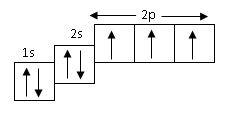
The above orbital diagram shown the electronic configuration of
- A.chlorine
- B.nitrogen
- C.calcium
- D.neon
The orbital diagram shows the arrangement of electrons in an atom. By counting the electrons (represented by arrows), we see 2 electrons in the 1s orbital, 2 electrons in the 2s orbital, and 3 electrons in the 2p orbitals. This gives a total of 2 + 2 + 3 = 7 electrons. For a neutral atom, the number of electrons is equal to the atomic number, and the element with atomic number 7 is Nitrogen.
Common mistake: Students might mistakenly choose Neon by assuming the 2p orbital is completely filled with 6 electrons, instead of correctly counting the 3 electrons shown in the diagram.
Which of the following metals burns with brick red
- A.Pb
- B.Ca
- C.Na
- D.Mg
The correct answer is Calcium (Ca). This question tests your knowledge of flame tests, which are used to identify certain metals. When heated in a flame, different metals produce distinct colours. Calcium metal and its compounds produce a characteristic brick-red colour when burned.
Common mistake: Students often confuse the flame colours of different metals, and might mistakenly choose Sodium (Na), which burns with a distinct golden-yellow flame, not brick-red.
In the production of soap, concentrated sodium chloride solution is added to
- A.increase the solubility of soap
- B.decrease the solubility of the soap
- C.saponify the soap
- D.emulsify the soap
The production of soap, known as saponification, results in a mixture of soap and glycerol. To separate the soap, concentrated sodium chloride solution is added in a process called 'salting out'. Soap is less soluble in salt water than in fresh water, so adding the brine causes the soap to precipitate as a solid, which can then be skimmed off from the liquid glycerol.
Common mistake: Students may mistakenly choose option C, confusing the role of sodium chloride with the alkali (like NaOH) which is the actual agent that causes the saponification reaction.
A liquid that will dissolve fat is
- A.hydrochloric acid
- B.calcium hydrochloride
- C.kerosene
- D.water
The chemical principle 'like dissolves like' means that non-polar substances will dissolve in non-polar solvents. Fats are non-polar organic compounds, and kerosene is a non-polar solvent because it is a mixture of hydrocarbons. Therefore, kerosene will dissolve fat, while polar substances like water and hydrochloric acid will not.
Common mistake: Many students choose water because it is known as a 'universal solvent', but they forget that this rule does not apply to non-polar substances like fats and oils.
Tartaric acid is used industrially to
- A.make baking powder
- B.make fruit juice
- C.remove rust
- D.dry substance
Tartaric acid is a weak acid used as a key ingredient in baking powder. Baking powder also contains a base, sodium hydrogen carbonate. When water is added to the mixture, the tartaric acid reacts with the base to produce carbon dioxide gas, which causes dough or batter to rise during baking.
Common mistake: Students may mistakenly choose 'make fruit juice' because tartaric acid is naturally found in many fruits like grapes, but its specific industrial use in this context is as the acidic component in baking powder.
P₁V₁ = P₂V₂ supports?
- A.Charles's law
- B.Boyle's law
- C.Graham's law
- D.Avogadro's law
Boyle's law describes the relationship between the pressure and volume of a gas at a constant temperature. It states that pressure is inversely proportional to volume, which means their product is always a constant (PV = k). Therefore, for a gas changing from an initial state (P₁, V₁) to a final state (P₂, V₂), the equation P₁V₁ = P₂V₂ holds true.
Common mistake: Students often confuse the different gas laws; they might incorrectly select Charles's law, which relates volume and temperature (V₁/T₁ = V₂/T₂), not pressure and volume.
A fixed mass of gas occupies 92 cm³ at 3°C. What will be its volume at 18°C if the pressure remains constant?
- A.15.3 cm³
- B.87.3 cm³
- C.2.0 cm³
- D.97.0 cm³
This question is an application of Charles's Law, which states that for a fixed mass of gas at constant pressure, volume is directly proportional to its absolute temperature. First, convert the temperatures from Celsius (°C) to Kelvin (K) by adding 273, so T₁ = 3 + 273 = 276 K and T₂ = 18 + 273 = 291 K. Using the formula V₁/T₁ = V₂/T₂, we can find the new volume (V₂) by rearranging it to V₂ = (V₁ × T₂) / T₁. Plugging in the values gives V₂ = (92 cm³ × 291 K) / 276 K, which calculates to 97.0 cm³.
Common mistake: The most common mistake is forgetting to convert the temperatures to the absolute Kelvin scale, or incorrectly applying an inverse relationship (like V₁T₁ = V₂T₂), which leads to the wrong answer B.
Which of the following ions requires the largest quantity of electricity for discharge at an electrode?
- A.2.0 mole of Q³⁺
- B.2.5 mole of R²⁺
- C.3.0 mole of T⁻
- D.4.0 mole of Y⁻
According to Faraday's laws of electrolysis, the quantity of electricity required to discharge an ion is the product of the number of moles and the magnitude of the ion's charge. For option A, the quantity is 2.0 moles × 3 = 6.0 Faradays. For B, it is 2.5 × 2 = 5.0 F; for C, it is 3.0 × 1 = 3.0 F; and for D, it is 4.0 × 1 = 4.0 F. Since 6.0 is the largest value, 2.0 moles of Q³⁺ requires the most electricity.
Common mistake: Students often mistakenly choose option D because it has the highest number of moles, forgetting to multiply the moles by the charge on the ion to find the total quantity of electricity.
Hydrogen can be displaced from a hot alkaline solution by
- A.Fe
- B.Cu
- C.Ca
- D.Sn
This question tests your knowledge of the electrochemical series, which arranges metals based on their reactivity. A metal can displace hydrogen from water if it is more reactive than hydrogen, meaning it is placed higher in the series. Among the given options, Calcium (Ca) is a very reactive metal and is high up in the electrochemical series, allowing it to react with even cold water to displace hydrogen gas. Therefore, it will definitely displace hydrogen from a hot alkaline solution.
Common mistake: Students might mistakenly choose Iron (Fe) because it is also above hydrogen in the activity series, but they forget that Calcium is much more reactive and displaces hydrogen from water more readily under less extreme conditions.
See all 50 JAMB Chemistry 2015 questions
Sign up free to unlock every question in this paper — with the verified answer and Beta's worked explanation on each one. No card needed to begin.
Start free