JAMB Economics 2024 Past Questions & Answers
80 JAMB Economics 2024 questions with verified answers and worked explanations. Here are the first 25 — sign up free to practise the full paper.
Which of the following is not emphasized in a product possibility curve?
- A.Scarcity of resources
- B.Unemployment of labour
- C.Inefficiency in the use of resources
- D.Economic development
The Production Possibility Curve (PPC) illustrates scarcity of resources, the choices an economy must make, and the opportunity cost of those choices. Points inside the curve represent unemployment of resources or inefficiency in their use. Economic development, which involves an outward shift of the entire PPC over time, is not directly emphasized by the curve itself at a given point in time, but rather by changes to it.
Common mistake: Students might confuse the PPC's ability to show the *potential for* economic growth (through shifts) with the curve itself emphasizing the *process* of economic development. The curve primarily shows current production limits and resource allocation issues.
Which of the following NOT among the objectives of OPEC?
- A.to stabilize the price of oil in the world market
- B.to established petroleum refineries in all member state
- C.to stabilize the revenue from oil to producing countries
- D.to make sure that oil flows to all the consuming countries
OPEC's main objectives include stabilizing oil prices, ensuring a steady income for producing countries, and guaranteeing a regular supply to consuming nations. Establishing petroleum refineries in all member states is an individual country's industrial development goal, not a collective objective of OPEC as an international organization. OPEC focuses on coordinating petroleum policies and market stability.
Common mistake: Students might mistakenly think that OPEC's role extends to direct industrial development like building refineries in every member state, confusing national development goals with the organization's collective mandate.
A market situation with few sellers and many buyers is called
- A.duopoly
- B.Omonopoly
- C.perfect competition
- D.oligopoly
An oligopoly is a market structure where a small number of large firms dominate the market, selling their products to many buyers. The question describes a situation with 'few sellers and many buyers', which is the exact definition of an oligopoly. For example, the telecommunications industry in Nigeria with a few major players like MTN, Glo, and Airtel is an oligopolistic market.
Common mistake: Students might mistakenly choose 'duopoly' because it also involves a small number of sellers, but duopoly specifically means only two sellers, while oligopoly is the correct general term for a few sellers.
MPC + MPS equals
- A.Zero
- B.Multiplier
- C.One
- D.APS
MPC (Marginal Propensity to Consume) represents the fraction of an additional income that is spent on consumption. MPS (Marginal Propensity to Save) represents the fraction of an additional income that is saved. Since any additional income can only be either consumed or saved, the sum of these two fractions must always equal 1 (or 100% of the additional income).
Common mistake: Students might incorrectly choose 'Multiplier' if they confuse the relationship between MPC/MPS with the formula for the multiplier effect, which is derived from these concepts but is not their sum.
Producers operating in a free market economy are more efficient as a result of
- A.the existence of competition
- B.government regulation of their activities
- C.the very few number of participants
- D.the commitment of the shareholders
In a free market economy, the existence of competition among producers is the primary driver of efficiency. To attract customers and survive, firms must constantly strive to produce goods and services at the lowest possible cost and highest quality. This competitive pressure forces them to innovate and operate efficiently, benefiting consumers.
Common mistake: Students might mistakenly choose government regulation (B) if they confuse free markets with mixed economies, or few participants (C) which actually describes a less competitive market structure leading to less efficiency.
In income determination theory, acceleration principles shows that
- A.investment is the causes, while income is the effects
- B.income and investment are both effects
- C.incomes is of on effect on investment
- D.income and investment are both causes
The acceleration principle explains that changes in national income cause changes in investment. However, it works together with the multiplier effect in the theory of income determination. The multiplier effect states that an initial change in spending, such as investment (the cause), leads to a larger overall change in national income (the effect). The question links the accelerator to income determination, and in this broader process, an initial investment is the trigger that causes income to change.
Common mistake: Students often confuse the accelerator principle with the multiplier effect; they might choose option C because it correctly states that income affects investment, which is the direct definition of the accelerator principle.
The largest component of national income in developing countries consist of
- A.wages and salaries
- B.rent
- C.profit
- D.profit and rent
National income is calculated by adding up all the incomes earned in a country, such as wages, rent, interest, and profit. In developing countries, a very large portion of the population is employed as workers who earn wages and salaries. Therefore, when all these individual earnings are added up, they form the largest single component of the country's total national income, more than rent or profits combined.
Common mistake: Students might mistakenly choose 'profit' because they think of the large profits made by big companies, but they forget that the total amount paid in wages and salaries to millions of workers is much larger overall.
Holding money to take care of contingencies is
- A.a precautionary motive
- B.a transactions motive
- C.an expansionary motive
- D.a speculative motive
In economics, people hold money for three main reasons. The precautionary motive is the desire to hold cash to cover unexpected expenses or emergencies, which are also known as contingencies. Since the question asks about holding money for contingencies (like a sudden illness or urgent repair), the precautionary motive is the correct answer.
Common mistake: Students might mistakenly choose the transactions motive because it also involves holding money for spending, but it's for planned, everyday expenses, not for unplanned emergencies.
In the long-run, a firm must shut down if its average revenue is
- A.greater than average cost
- B.equal to the average cost
- C.equal to the minimum average revenue is
- D.less than average variable cost
A firm must shut down if its average revenue (the price it gets per unit) is less than its average variable cost (the cost of materials and labour per unit). This is because for every item the firm produces and sells, it is losing money on the direct costs, even before considering its fixed costs like rent. In the long run, a firm must cover all its costs to survive, so if it cannot even cover its variable costs, it has no choice but to shut down.
Common mistake: Students may confuse the long-run exit condition (Price < Average Cost) with the more immediate shutdown condition (Price < Average Variable Cost), but failing to cover variable costs guarantees a shutdown in any time period.
The act of cultivating land and rearing of animal for man's use is
- A.forestry
- B.agriculture
- C.mono culture
- D.horticulture
The correct answer is 'agriculture' because it is the broad term that encompasses all activities related to farming. This includes both the cultivation of land to grow crops and the rearing of animals for food, wool, and other human needs. The question provides a direct and complete definition of agriculture.
Common mistake: Students may mistakenly choose 'horticulture', but this is a specific branch of agriculture focused only on plant cultivation, like fruits and vegetables, and does not include rearing animals.
In the event of bankruptcy, owners of joint-stock companies lose
- A.both company and private assets
- B.only the capital invested
- C.only their dividends
- D.their private properties
Joint-stock companies are characterized by limited liability, meaning the owners (shareholders) are only liable for the amount of capital they have invested in the company. In the event of bankruptcy, their personal assets are protected, and they only lose the money they used to purchase shares. This protects shareholders from losing everything they own if the business fails.
Common mistake: Students often mistakenly choose option A, thinking that owners of all business types lose both company and private assets, confusing joint-stock companies with sole proprietorships or partnerships.
The main disadvantages of deflationary policies is
- A.full employment in the country
- B.increasing cost of living
- C.unemployment in the country
- D.improved standard of living
Deflationary policies are measures implemented by the government or central bank to reduce aggregate demand in the economy, often to control inflation. These policies, such as increasing interest rates or reducing government spending, lead to a decrease in economic activity. A significant disadvantage of such policies is that reduced demand and production can cause businesses to cut back on staff, leading to increased unemployment in the country.
Common mistake: Students might mistakenly choose 'increasing cost of living' if they confuse deflationary policies with inflationary pressures, or 'full employment' if they misunderstand the immediate impact of demand-reducing policies.
If government in a fiscal year has its revenue receipts less than the expenditure, such country is having
- A.deficit budget
- B.favorable budget
- C.balanced budget
- D.surplus budget
A government's budget is its financial plan for a specific period, usually a year. When the government's total spending (expenditure) is greater than its total income (revenue receipts), it creates a shortfall. This financial situation is known as a deficit budget.
Common mistake: Students often confuse the terms and might select 'surplus budget', which is the opposite situation where government revenue is greater than its expenditure.
A firm's average cost decreases in the long-run because of
- A.increasing returns to scale
- B.diminishing average returns
- C.decreasing average fixed cost
- D.decreasing marginal returns
In the long run, all factors of production are variable, allowing a firm to change its scale of operation. When a firm experiences increasing returns to scale, a proportional increase in all inputs leads to a more than proportional increase in output, causing the average cost per unit to decrease. This efficiency gain as the firm grows is why long-run average costs can fall.
Common mistake: Students might mistakenly choose 'decreasing average fixed cost' (C), which is a short-run concept where fixed costs are spread over more output. However, in the long run, all costs are variable, so there are no fixed costs to average out.
What is the median term in the distribution below; 14, 13 29,15,13,17,12.
- A.14
- B.13
- C.15
- D.12
To find the median, first arrange the numbers in ascending order: 12, 13, 13, 14, 15, 17, 29. Since there are 7 numbers, the median is the middle term, which is the = 4th term. Counting from the beginning, the 4th term is 14.
Common mistake: A common mistake is to pick the mode (most frequent number, which is 13) or to pick a number from the original unordered list without arranging them first.
The following are type of business organization EXCEPT
- A.co-operative society
- B.partnership
- C.Entrepreneurship
- D.public corporation
The question asks to identify the option that is NOT a type of business organization. Co-operative society, partnership, and public corporation are all distinct forms of business organizations with specific legal structures. Entrepreneurship, on the other hand, refers to the process of starting and running a business, or the quality of being an entrepreneur, rather than a specific organizational structure itself.
Common mistake: Students might mistakenly choose one of the actual business types or confuse entrepreneurship as a business type because it is fundamental to starting businesses.
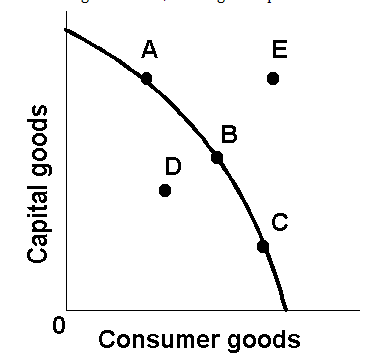
From the diagram below, moving from point A to B and from B to c is due to
- A.Economic depression
- B.Unemployment
- C.Economic growth
- D.Opportunity cost
The diagram likely represents a Production Possibility Frontier (PPF). Moving from one point to another along the PPF (like from A to B and then to C) illustrates that to produce more of one good, you must give up some production of another good. This sacrifice of the next best alternative is precisely what opportunity cost means.
Common mistake: Students might mistakenly choose 'Economic growth' if they confuse movement along the curve with a shift of the entire curve outwards, which represents growth.
The contribution of petroleum to the economy of Nigerian is most prominent in the area of
- A.revenue generation
- B.infrastructural development
- C.fuel provision
- D.employment generation
Petroleum, specifically crude oil, is Nigeria's primary export product. The sale of this natural resource to other countries generates the vast majority of the nation's foreign exchange earnings and government income. This revenue is far more significant than the sector's direct contribution to employment or infrastructure, making revenue generation its most prominent role in the economy.
Common mistake: Students may incorrectly choose 'employment generation' because the oil industry is large, but it is actually a capital-intensive sector that does not employ a large percentage of the Nigerian workforce.
Which of the following is NOT a feature of capitalism?
- A.Free enterprise
- B.private ownership of property
- C.competition
- D.detailed economics planning
The question asks to identify what is NOT a feature of capitalism. Capitalism is an economic system characterized by private ownership of resources, free enterprise, and competition, with decisions largely driven by market forces. Detailed economic planning, where the government makes most economic decisions, is a characteristic of command or socialist economies, not capitalism.
Common mistake: Students might mistakenly think that some level of government planning in a mixed economy is a feature of pure capitalism, leading them to choose another option.
When an economy is having a balance of payment surplus the best alternative opened to it is to
- A.devalue its currency
- B.borrow from abroad
- C.promote imports into the country
- D.increase its foreign reserve
A balance of payment surplus means a country is earning more foreign currency than it is spending. The most direct and beneficial outcome of this situation is an increase in the country's foreign exchange reserves. These reserves strengthen the economy, provide stability, and can be used for future international transactions.
Common mistake: Students might incorrectly choose 'devalue its currency' if they confuse a balance of payment surplus with a deficit, as devaluation is typically used to correct a deficit.
One of the function of united nation conference on trade and development (UNTAD) is to
- A.transfer technology from developed to less developed countries
- B.increase share of less developed countries in world trade
- C.increase impact of developed countries over less developed countries
- D.make goods available in developed countries
UNCTAD (United Nations Conference on Trade and Development) is an international economic organisation established to promote trade and development, especially for developing countries. A key function of UNCTAD is to facilitate the transfer of technology from developed nations to less developed ones. This helps developing countries improve their industrial capacity, productivity, and overall economic growth.
Common mistake: Students might be tempted by option B (increase share of less developed countries in world trade) because it is also a general objective of UNCTAD, but option A describes a more specific and direct function related to development assistance.
Wholesalers play an important in the distribution of goods and services because they
- A.are located very close to consumers
- B.pass information on from retailers to consumers
- C.sell in small units to consumers
- D.finance both producers and retailers
Wholesalers play a crucial role in the distribution chain by purchasing goods in large quantities from producers and selling them in smaller quantities to retailers. This bulk purchase provides producers with immediate capital, effectively financing their operations. Additionally, wholesalers often extend credit facilities to retailers, allowing them to stock goods without immediate full payment, thereby financing the retailers as well.
Common mistake: Students often confuse the roles of wholesalers and retailers, leading them to incorrectly choose options like 'are located very close to consumers' or 'sell in small units to consumers', which describe retailers.
Economics problems arise in all societies because
- A.the services of economists are not employed
- B.resource are not in adequate supply
- C.there is no proper planning
- D.resources are mismanaged by leaders
The fundamental problem in economics is scarcity, which is the idea that human wants are unlimited but the resources to satisfy them are limited. Option B correctly states that resources are not in adequate supply, which is the definition of scarcity. This scarcity forces societies to make choices about how to use their limited resources, leading to all economic problems.
Common mistake: Students often mistakenly choose option D, blaming mismanagement by leaders, because it is a visible problem in many countries, but the universal economic problem that exists in ALL societies, even well-managed ones, is the fundamental scarcity of resources.
A downward sloping demand curve means that
- A.price must be lowered to sell more
- B.total revenue declines as price is lowered
- C.demand falls as output increases
- D.demand falls as output falls
This question connects the demand curve to total revenue. When the price of a good is lowered, total revenue can either rise or fall depending on how much quantity demanded increases. This option is correct when demand is inelastic, meaning buyers are not very responsive to the price drop. In this case, the small increase in quantity sold is not enough to make up for the lower price, so total revenue (Price x Quantity) goes down.
Common mistake: Many students will pick option A, 'price must be lowered to sell more', because this is the basic law of demand, but the question is asking about the effect on total revenue, which is a topic in elasticity.
The bank established to finances project aimed at promoting economic and social development within the African continent is
- A.African bank for commerce and industry
- B.economic bank for African
- C.recovery fund bank for Africa
- D.African development bank
The African Development Bank (AfDB) is a multinational development finance institution established to promote sustainable economic growth and reduce poverty in Africa. Its main function is to provide financing for projects and programs that contribute to the economic and social progress of its member countries on the continent. The other options listed are not the correct names of established continental development banks.
Common mistake: Students may be confused by the other options which sound plausible and official, but are simply incorrect names for the actual institution.
See all 80 JAMB Economics 2024 questions
Sign up free to unlock every question in this paper — with the verified answer and Beta's worked explanation on each one. No card needed to begin.
Start free