JAMB Biology 2025 Past Questions & Answers
117 JAMB Biology 2025 questions with verified answers and worked explanations. Here are the first 25 — sign up free to practise the full paper.
The process that brings about the cooling effect on the body of mammals is
- A.sweat excretion
- B.digestion
- C.urine formation
- D.respiration
When a mammal's body gets hot, sweat glands release sweat, which is mostly water, onto the skin's surface. For this sweat to evaporate and turn into vapour, it needs to absorb heat energy. It takes this heat from the body, which causes a cooling effect and helps to lower the body temperature.
Common mistake: Students might confuse sweat excretion with urine formation since both are excretory processes, but only sweating on the skin surface leads to cooling through evaporation.
Which of the following controls protein and enzyme syntheses in the cytoplasm of the cell?
- A.DNA
- B.Nucleus
- C.Chromosome
- D.Mitochondria
The nucleus is often called the control center of the cell because it houses the genetic material (DNA) and directs all cellular activities, including the synthesis of proteins and enzymes. It initiates the process by transcribing DNA into mRNA, which then moves to the cytoplasm for protein synthesis. Therefore, the nucleus controls these vital processes.
Common mistake: Students might incorrectly choose DNA because it contains the genetic code for proteins. However, the nucleus is the organelle that houses the DNA and actively controls and regulates the entire process of protein and enzyme synthesis.
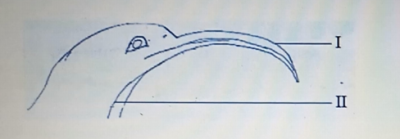
Use the diagram above to answer the question that follows. The structure labelled I is adapted for
- A.tearing
- B.sieving
- C.boring
- D.sucking
The question describes a structure adapted for a specific feeding method. The correct option, 'sucking', points to a specialized mouthpart like a proboscis, commonly found in insects such as butterflies or mosquitoes. This tube-like structure is specifically designed to draw up liquid food, like nectar or blood, which is a sucking mode of nutrition.
Common mistake: Students might mistakenly choose 'boring' if they think of how a mosquito pierces the skin, but 'boring' refers to drilling into hard surfaces like wood, whereas the primary function of the proboscis is suction.
A complex feeding relationship between organisms in a habitat that involves transfer of energy in form of food is
- A.food web
- B.pyramid of numbers
- C.pyramid of energy
- D.food chain
A food web represents the complex network of feeding relationships within an ecosystem, showing how multiple food chains are interconnected. It illustrates the transfer of energy from one organism to another as they consume each other. This complexity, involving various producers, consumers, and decomposers, is what distinguishes a food web from a simpler food chain.
Common mistake: Students might choose 'food chain' (D) because it also describes energy transfer, but the question specifically asks for a 'complex' feeding relationship, which is the definition of a food web.
One of the characteristics of insect pollinated flowers is
- A.large anthers
- B.absence of nectar
- C.scented flowers
- D.scentless flowers
Insect-pollinated flowers rely on insects to transfer pollen. To attract these insects, they often produce sweet scents, bright colours, and nectar. The scent acts as a strong attractant, guiding insects to the flower for pollination. Options like large anthers are more common in wind-pollinated flowers, and absence of nectar or scentless flowers would not attract insects.
Common mistake: Students might mistakenly choose large anthers, confusing the characteristics of insect-pollinated flowers with those of wind-pollinated flowers which need to release a lot of pollen into the air.
The process by which plants absorb water from the soil through their roots is
- A.diffusion
- B.photosynthesis
- C.osmosis
- D.transpiration
Osmosis is the specific process by which water molecules move from an area of higher water concentration (the soil) to an area of lower water concentration (inside the root cells) across a partially permeable membrane. Plant root hair cells have a lower water potential than the soil, creating a gradient that draws water into the roots. This mechanism is crucial for plants to absorb the water they need for survival.
Common mistake: Students often confuse osmosis with diffusion, which is a general movement of particles, or mistakenly choose transpiration, which is the loss of water from plants, not its absorption.
The bright colouration of the flower of a flowering plant is an adaptation for
- A.reproduction
- B.growth
- C.excretion
- D.respiration
The bright colouration of a flower is an adaptation specifically designed to attract pollinators like insects and birds. These pollinators are essential for transferring pollen between flowers, which is a vital step in the process of sexual reproduction in flowering plants. Without successful pollination, fertilization cannot occur, and the plant cannot produce seeds or fruits.
Common mistake: Some students might consider 'Ecology > Ecological factors and adaptation' because it is an adaptation, but 'Reproduction' is the specific biological function that the adaptation serves, making it the most accurate classification.
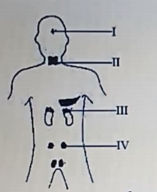
Use the diagram above to answer the questions that follow The endocrine gland that is located in the part labelled I is
- A.parathyroid
- B.thyroid
- C.pituitary
- D.adrenal
The question asks to identify the endocrine gland in the part labelled I, which points to the head region. The pituitary gland is a major endocrine gland located at the base of the brain, inside the skull. Therefore, it is the correct gland found in the head region.
Common mistake: Students may mistakenly choose the thyroid gland because it is also located in the upper part of the body, but it is found in the neck, not inside the head like the pituitary gland.
One of the components of peripheral nervous system is
- A.cerebellum
- B.brain
- C.spinal cord
- D.sensory neurones
The nervous system is broadly divided into the Central Nervous System (CNS) and the Peripheral Nervous System (PNS). The CNS comprises the brain and spinal cord. The PNS consists of all the nerves that extend from the CNS to the rest of the body, including sensory neurones which transmit information from sensory receptors to the CNS. Therefore, sensory neurones are a component of the peripheral nervous system.
Common mistake: Students often confuse components of the Central Nervous System (like the brain and spinal cord) with those of the Peripheral Nervous System.
When the cotyledons appear above the soil during germination is called
- A.epicotyl
- B.epigeal
- C.hypocotyl
- D.hypogeal
Epigeal germination is a type of seed germination where the hypocotyl (the part of the embryonic stem below the cotyledons) elongates, pushing the cotyledons and plumule above the soil surface. This allows the cotyledons to photosynthesize or provide stored food to the developing seedling. It is a key process in the early growth and development of many plants.
Common mistake: Students often confuse epigeal with hypogeal germination, which is when the cotyledons remain below the soil surface, or with epicotyl/hypocotyl which are parts of the seedling structure.
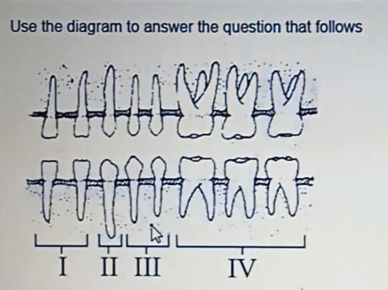
The type of teeth used for tearing in man is labelled
- A.IV
- B.III
- C.I
- D.II
In humans, there are four types of teeth, each with a specific function. The sharp, pointed teeth located next to the incisors are called canines. Their primary function is to grip and tear food, especially tough food like meat. The question asks for the teeth used for tearing, which are the canines, indicated by label II in the diagram.
Common mistake: Students may mistakenly choose the incisors because they are also at the front of the mouth, but incisors are used for cutting and biting, not tearing.
Which of these animals create their natural habitats in burrows?
- A.Bush rat
- B.Dove
- C.Chameleon
- D.Snails
The question asks about animals creating burrows, which are shelters dug into the ground. This behavior is a form of adaptation, allowing animals like the bush rat to cope with ecological factors such as predators and harsh weather. Burrows provide a safe habitat and are a key survival strategy for many burrowing animals.
Common mistake: Students might incorrectly choose snails, doves, or chameleons if they are not familiar with the specific habitat-building behaviors of these animals. Snails typically live under rocks or in damp places, doves build nests, and chameleons live in trees or shrubs, none of which involve digging burrows.
The green-brown colour of grasshopper's body in dry grass field is an adaptation for
- A.camouflage
- B.predation
- C.mating
- D.mimicry
The green-brown colour of the grasshopper is an adaptation that allows it to blend in with the dry grass in its environment. This blending in is known as camouflage. Camouflage helps the grasshopper avoid being seen by predators, thereby increasing its chances of survival in its habitat.
Common mistake: Students might confuse camouflage with mimicry, which involves one organism resembling another, not its environment.
Which of the following is an advantage of cross fertilization?
- A.Individuals produced are less adapted to local environment
- B.It leads to the production of healthier offspring.
- C.It leads to inbreeding depression.
- D.It leads to the production of weak offsprings.
Cross fertilization involves the fusion of gametes from two different parents, which introduces new and diverse gene combinations into the offspring. This genetic mixing often results in 'hybrid vigour', where the offspring are stronger, more resilient, and healthier than their parents. Therefore, the production of healthier offspring is a major advantage of cross fertilization.
Common mistake: Students may mistakenly choose option C by confusing the positive effects of cross fertilization with 'inbreeding depression', which is a negative outcome of repeated self-fertilization or breeding between closely related individuals.
In most vertebrates, the common basic plan with a skull, vertebral column and a pair of girdle is an evidence of evolution from
- A.molecular records
- B.fossil records
- C.comparative anatomy
- D.embryology
The question describes shared structural similarities (skull, vertebral column, girdles) among different vertebrates. This study of similarities and differences in the anatomy of different species to infer evolutionary relationships is known as comparative anatomy. It provides strong evidence for common ancestry and evolution.
Common mistake: Students might choose 'fossil records' because fossils are also evidence of evolution. However, the question specifically refers to the common basic plan in *existing* vertebrates, which is directly addressed by comparing their anatomical structures, not just their fossilized ancestors.
Example of animal exhibiting mating colouration is
- A.agama lizard
- B.variegated grasshopper
- C.chameleon
- D.leopard
Agama lizards are well-known for exhibiting distinct mating colouration, where the male's head and sometimes body turn bright red or blue during the breeding season. This vibrant display serves to attract females and establish dominance among males. It is a crucial part of their reproductive strategy.
Common mistake: Students might mistakenly choose chameleon because they are famous for changing colours, but chameleons primarily change colour for camouflage and communication, not specifically for a distinct mating display like the agama lizard.
Which of the following is the excretory organ in birds?
- A.Nephridia
- B.kidneys
- C.Malpighians tubules
- D.Green glands
Birds, being vertebrates, possess kidneys as their main excretory organs. The kidneys filter waste products from the blood, such as uric acid, and help regulate water and salt balance in the body. This process is crucial for removing harmful substances and maintaining homeostasis.
Common mistake: Students often confuse the excretory organs of different animal groups; for example, Malpighian tubules are found in insects, not birds.
Whose theory of evolution supports that characters acquired through use or disuse are transmitted to offspring?
- A.Darwin
- B.Mendel
- C.Morgan
- D.Larmark
The question describes the theory of inheritance of acquired characteristics, which states that traits developed during an organism's lifetime due to use or disuse can be passed on to its offspring. This theory was proposed by Jean-Baptiste Lamarck. While later disproven, it was an early significant theory of evolution.
Common mistake: Students might mistakenly choose Darwin because he is the most famous figure associated with evolution, but his theory focused on natural selection, not the inheritance of acquired traits.
The most suitable soil for crops cultivation in Nigeria is
- A.laterite
- B.loamy
- C.sandy
- D.clayey
Loamy soil is the most suitable for crop cultivation because it contains a balanced mixture of sand, silt, and clay particles. This ideal texture allows it to retain adequate water and nutrients for plants, while also providing good drainage and aeration for healthy root development. It is also typically rich in humus, which is decomposed organic matter that fertilizes the soil.
Common mistake: Students might mistakenly choose clayey soil because it holds water well, but they forget that it has poor drainage and aeration which can suffocate plant roots.
When calyx of a flower is joined together, it is called
- A.gamosepalous
- B.polypetalous
- C.gamopetalous
- D.polysepalous
The calyx is the outermost whorl of a flower, consisting of sepals. When these sepals are fused or joined together, the flower is described as having a gamosepalous calyx. This term specifically refers to the structure of the sepals in a flower.
Common mistake: Students often confuse the terms for sepals (calyx) and petals (corolla), leading them to mistakenly choose 'gamopetalous' if they think the question refers to joined petals, or 'polysepalous' if they misunderstand 'joined together' or confuse it with free sepals.
Which of the following statements about poliomyelitis is correct?
- A.It affects both young and old.
- B.It is a bacterial disease.
- C.There is no vaccination against the disease.
- D.It is capable for paralysing the limbs.
Poliomyelitis is a viral disease that attacks the nervous system, specifically the nerve cells in the spinal cord that control muscle movement. This damage can lead to muscle weakness and, in severe cases, irreversible paralysis of the limbs. Therefore, the statement that the disease is capable of paralysing the limbs is the correct description of its most serious effect.
Common mistake: Students might mistakenly choose option B, confusing poliomyelitis as a bacterial infection when it is actually caused by a virus (the poliovirus).
What is the phenotype of the offspring produced in F?
- A.Homozygous tall
- B.Homozygous short
- C.Heterozygous short
- D.Heterozygous tall
In a standard Mendelian cross, the F1 generation results from crossing two pure-breeding parents with contrasting traits, for example, a homozygous tall plant (TT) and a homozygous short plant (tt). Each offspring inherits one allele from each parent, making their genotype heterozygous (Tt). According to the law of dominance, the dominant allele (T for tall) determines the physical appearance (phenotype), so all the offspring will be tall.
Common mistake: Students may mistakenly choose 'Homozygous tall' because while they correctly identify the phenotype as tall, they forget that the F1 generation is by definition heterozygous.
The cortex of a herbaceous stem is made up of
- A.sclerenchyma and collenchyma
- B.collenchyma and xylem
- C.Sclerenchyma and parenchyma
- D.parenchyma and collenchyma
The cortex of a herbaceous (non-woody) stem is the region between the outer skin (epidermis) and the central transport tissues. This area is mainly composed of parenchyma cells, which store food and fill up space, and collenchyma cells, which have thickened walls to provide flexible support for the young stem. Sclerenchyma provides rigid support and is typically found in older, woody parts, while xylem is a transport tissue located in the vascular bundle, not the cortex.
Common mistake: Students may mistakenly choose an option with sclerenchyma, confusing its role of providing rigid support in woody plants with the flexible support provided by collenchyma in young, herbaceous stems.
The most advanced spermatophyte that forms the largest group of plant kingdom is the
- A.fern
- B.angiosperm
- C.cones
- D.gymnosperm
Angiosperms are flowering plants, which are the most diverse and largest group within the plant kingdom. They are considered the most advanced spermatophytes (seed plants) due to their complex reproductive structures like flowers and fruits, which aid in efficient pollination and seed dispersal. This advancement has allowed them to dominate most terrestrial ecosystems.
Common mistake: Students might incorrectly choose gymnosperms because they are also spermatophytes, but gymnosperms are less advanced than angiosperms as they do not produce flowers or fruits.
Which of the following is a medium of transportation in animal cells?
- A.Latex
- B.Cytoplasm
- C.Cell sap
- D.Blood
Blood is the main medium of transportation in most animals, including humans. It circulates throughout the body, carrying vital substances like oxygen, nutrients, hormones, and waste products to and from various cells and tissues. This ensures efficient delivery of resources and removal of waste, maintaining the body's functions.
Common mistake: Students might mistakenly choose Cytoplasm (B) because it facilitates intracellular transport, but the question refers to a broader medium of transportation within the entire animal body, which is blood.
See all 117 JAMB Biology 2025 questions
Sign up free to unlock every question in this paper — with the verified answer and Beta's worked explanation on each one. No card needed to begin.
Start free