JAMB Biology 2024 Past Questions & Answers
117 JAMB Biology 2024 questions with verified answers and worked explanations. Here are the first 10 — sign up free to practise the full paper.
The major building block of an organism is...
- A.Nitrogen
- B.Carbon
- C.Water
- D.Sulphur
Carbon is the correct answer because it is the main element that forms the backbone of all major organic molecules in living things, including carbohydrates, proteins, and fats. Its unique ability to form four strong bonds allows it to create the complex chains and rings that are essential for life's structures. All life as we know it is carbon-based, making it the fundamental building block.
Common mistake: Students often mistakenly choose Water because organisms are composed of a high percentage of it, but water is a solvent and medium, not the fundamental structural element that forms the backbone of organic molecules.
The process by which plants loss water to the atmosphere is
- A.transpiration
- B.guttation
- C.translocation
- D.evaporation
Transpiration is the specific biological process by which plants lose water in the form of vapour to the atmosphere, primarily through their leaves. This process is a key component of the plant's water transport system, as it creates a 'pull' that draws water from the roots up to the rest of the plant through the xylem vessels. It is essential for the movement of water and dissolved minerals throughout the plant.
Common mistake: Students often confuse transpiration with evaporation, which is a general physical process of water turning into vapour, or guttation, which is the loss of liquid water droplets from leaf margins.
Use the diagram above to answer the question that follows The organism belongs to kingdom
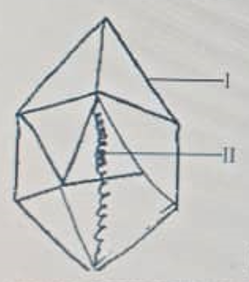
- A.monera
- B.protista
- C.fungi
- D.animalia
The question directly asks to identify the kingdom an organism belongs to, which falls under the classification of living things. Kingdom Monera includes all prokaryotic organisms like bacteria and cyanobacteria, characterized by the absence of a true nucleus and other membrane-bound organelles. Therefore, if the diagram depicted a prokaryote, Monera would be the correct kingdom.
Common mistake: Students often confuse Monera with Protista, as both are simple organisms, but Protista are eukaryotic while Monera are prokaryotic.
The formation of cilia and flagella in living cells is carried out with the help of
- A.ribosome
- B.lysosome
- C.centriole
- D.plastid
Centrioles are small, cylindrical organelles found in animal cells and some lower plant cells. They are essential for cell division and also serve as basal bodies, which are the structures from which cilia and flagella develop. Cilia and flagella are hair-like projections that aid in cell movement or moving substances across the cell surface.
Common mistake: Students might incorrectly choose ribosomes (A) because they are involved in protein synthesis, which is fundamental to all cell structures, but ribosomes do not directly form complex structures like cilia and flagella; that is a specialized function of centrioles.
The food nutrient with the highest energy value is
- A.protein
- B.carbohydrate
- C.lipid
- D.minerals
Lipids, which include fats and oils, are the food nutrient with the highest energy value. When broken down in the body, one gram of lipid releases about 9 kilocalories of energy. This is more than double the energy released by one gram of either carbohydrate or protein, which both provide about 4 kilocalories per gram.
Common mistake: Students often mistakenly choose carbohydrate because it is the body's primary and quickest source of energy, but they forget that lipids contain more energy per gram.
I 6 X + 6 HO → CHO + 6O III chlorophyll II IV Use the diagram above to answer question that follows The part labelled I is
- A.enzyme
- B.water
- C.sunlight
- D.chemical
The chemical equation provided represents photosynthesis, the process by which green plants produce their own food. For this reaction to occur, carbon dioxide (X) and water react in the presence of sunlight (I) and chlorophyll (II). Therefore, 'I' which provides the energy for the reaction, is sunlight.
Common mistake: Students might confuse 'I' with 'X' (carbon dioxide) or 'II' (chlorophyll) if they don't carefully interpret the diagram and the question's labels, or mistakenly think 'I' refers to an enzyme.
Bilateral symmetry,cylindrical bodies and double openings are characteristic features of
- A.nematodes
- B.hydra
- C.protozoa
- D.protists
Nematodes, commonly known as roundworms, are characterized by their cylindrical, unsegmented bodies and bilateral symmetry. A defining feature is their complete digestive system, which includes two separate openings: a mouth and an anus. These specific morphological traits are used to classify them within the animal kingdom.
Common mistake: Students might mistakenly choose Hydra, which has radial symmetry and only one body opening that serves as both mouth and anus, unlike the double openings of nematodes.
Mouth part adapted for piercing and sucking is found in
- A.housefly
- B.grasshopper
- C.mosquito
- D.cockroach
The correct answer is the mosquito. Mosquitoes possess a specialized mouthpart called a proboscis, which is sharp and needle-like, enabling it to pierce the skin of a host to suck blood. This feeding mechanism is a classic example of adaptation for a parasitic mode of nutrition.
Common mistake: Students often mistakenly choose the housefly because it also has a proboscis for liquid food, but the housefly's mouthpart is for sponging or lapping, not piercing.
The web-feet of frogs and toads is basically for
- A.leaping
- B.walking
- C.swimming
- D.mating
Frogs and toads are amphibians that spend a significant part of their lives in water. The skin between their toes, known as webbing, increases the surface area of their feet. This structural adaptation allows them to push against the water more effectively, making them powerful and efficient swimmers.
Common mistake: Students may choose 'leaping' because frogs are famous for jumping, but it is their long, muscular hind legs that provide the power for leaping, not the webbing on their feet.
The part of the inner ear that is responsible for hearing is
- A.sacculus
- B.cochlea
- C.utriculus
- D.ampullae
The cochlea is a spiral-shaped, fluid-filled structure located in the inner ear. It houses the organ of Corti, which contains specialized hair cells that detect sound vibrations. These vibrations are converted into electrical signals and sent to the brain, allowing us to perceive sound.
Common mistake: Students often confuse the cochlea with other parts of the inner ear like the sacculus, utriculus, and ampullae, which are primarily involved in maintaining balance rather than hearing.
See all 117 JAMB Biology 2024 questions
Sign up free to unlock every question in this paper — with the verified answer and Beta's worked explanation on each one. No card needed to begin.
Start free