JAMB Accounting 2004 Past Questions & Answers
80 JAMB Accounting 2004 questions with verified answers and worked explanations. Here are the first 10 — sign up free to practise the full paper.
The accounting principle that is applied to check arbitrary actions on the part of accountants is?
- A.consistency
- B.materiality
- C.objectivity
- D.realization
The objectivity principle requires that accounting information and financial reporting should be independent, verifiable, and free from the personal bias or subjective judgement of the accountant. This principle serves as a check against 'arbitrary actions' by ensuring that all transactions are supported by factual evidence, like invoices or receipts. Therefore, financial statements are presented based on facts, not feelings or opinions.
Common mistake: Students may mistakenly choose 'consistency' because it also prevents arbitrary changes, but consistency is about using the same accounting methods over time, not about ensuring the information is free from personal bias in the first place.
The loss of equipment in a fire disaster, results in?
- A.a decrease in current assets
- B.an increase in liabiities and assets
- C.a decrease in assets and capital
- D.an increase in liabilities and a decrease in assets
The fundamental accounting equation is Assets = Capital + Liabilities. When equipment, which is a non-current asset, is lost in a fire, the total value of the business's assets decreases. This loss is an expense that reduces the business's profit and, in turn, decreases the owner's capital. Therefore, the loss results in a decrease in both assets and capital, keeping the equation in balance.
Common mistake: Students may mistakenly choose option A, correctly identifying a decrease in assets but wrongly classifying equipment as a current asset instead of a non-current asset.
A source document is used for verifying the?
- A.amount due to creditors
- B.actual cost of an asset
- C.selling price of goods
- D.amount due from debtors
Source documents, like receipts and invoices, are the original records that provide evidence that a transaction occurred. When a business buys an asset, the invoice or receipt from the seller is the source document. This document proves the exact amount paid for the asset, which is its actual cost, and serves as the basis for recording it in the books of account.
Common mistake: Students might mistakenly choose option D because a sales invoice, which is a source document, shows the amount a debtor owes, but the primary role of a source document is to provide objective proof of the cost of a transaction.
The rule of accounting equation requires that account payable should be placed under?
- A.liabilities
- B.equities
- C.assets
- D.capital
The accounting equation states that a company's Assets are equal to the sum of its Liabilities and Capital (Assets = Liabilities + Capital). Accounts payable represents money that the business owes to its suppliers for goods purchased on credit. Because this is a debt or an obligation to an outside party, it is correctly classified as a liability.
Common mistake: Students might mistakenly choose 'assets' because they associate accounts payable with the goods received, which are assets, but the question asks about the 'payable' itself, which is the obligation to pay.
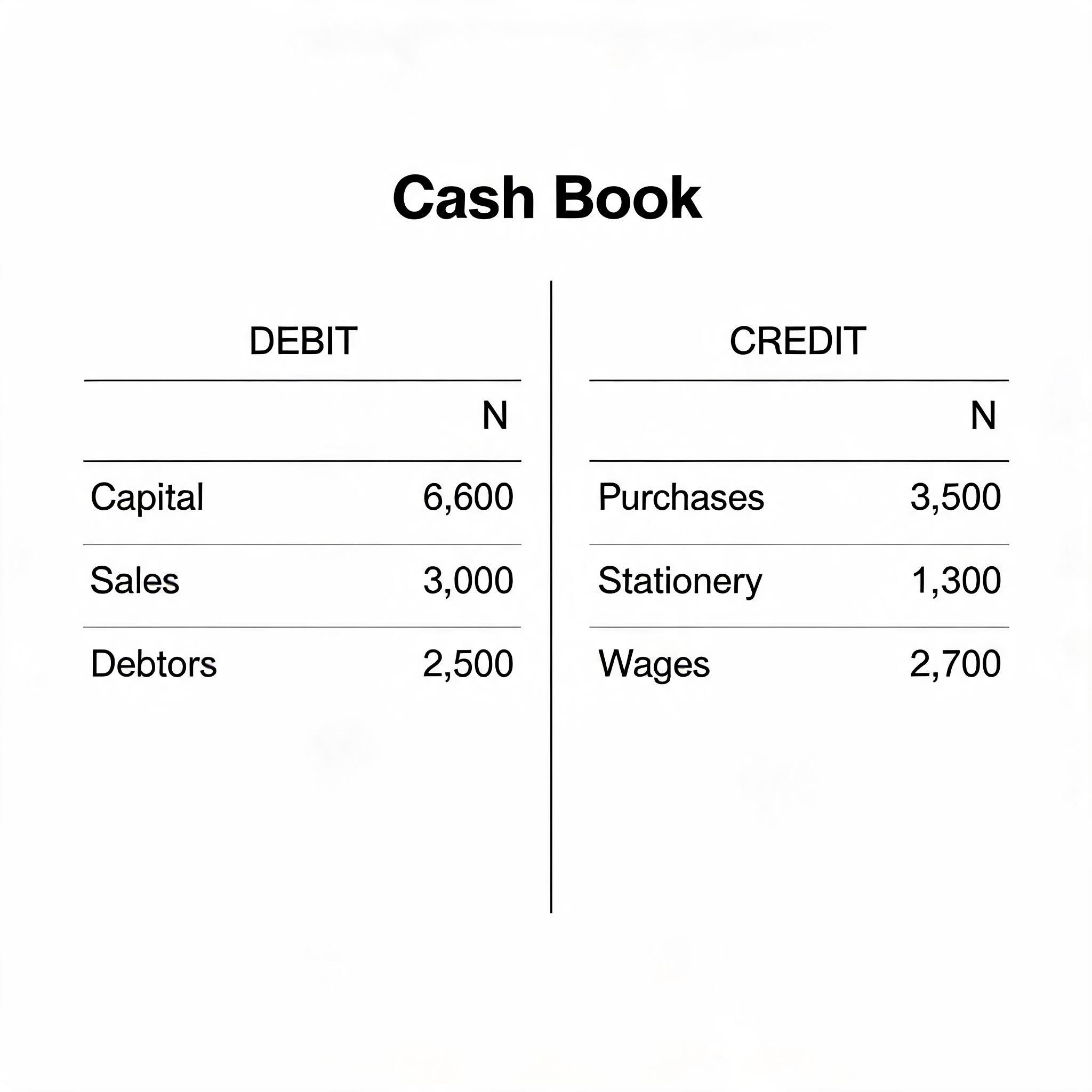
Use the information below to answer questions 5 and 6 The owner wishes to maintain an amount equal to of capital as drawings The amount withdrawn is?
- A.₦2,100
- B.₦2,200
- C.₦4,400
- D.₦6,400
The question states that the owner's drawings are equal to of the capital. From the provided Cash Book image, the capital contributed is shown on the debit (receipts) side as ₦6,600. To find the amount withdrawn, you simply calculate one-third of this capital amount. Therefore, the calculation is x ₦6,600, which equals ₦2,200.
Common mistake: Students might mistakenly calculate two-thirds of the capital , which represents the remaining capital after drawings, instead of the one-third that was actually withdrawn.
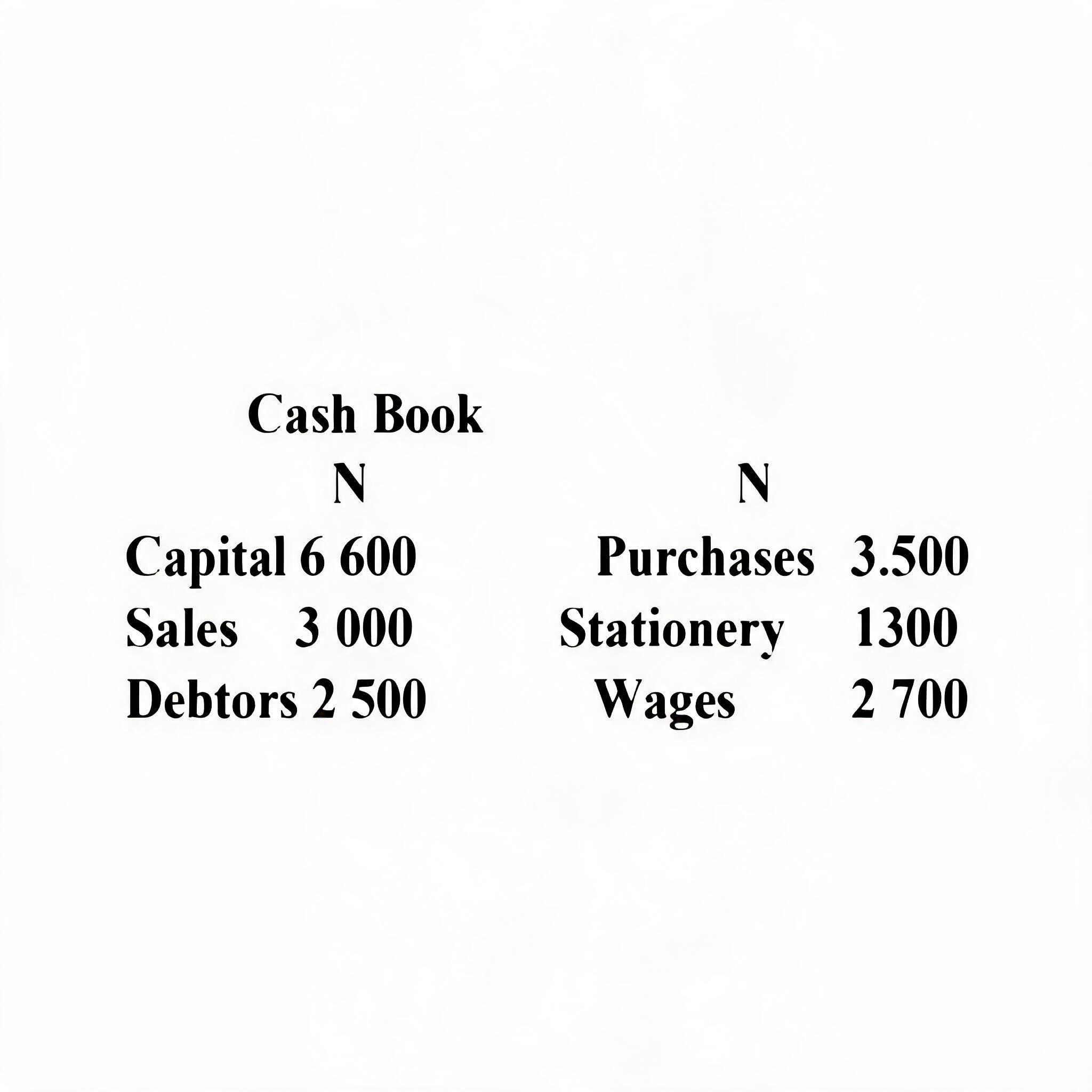
Use the information below to answer questions 5 and 6 The owner wishes to maintain an amount equal to of capital as drawings The cash book closing balance will be?
- A.₦900
- B.₦2,400
- C.₦4,200
- D.₦4,600
To find the closing balance of the cash book, you subtract total payments from total receipts. First, calculate total receipts from the debit side shown in the image: Capital (₦6,600) + Sales (₦3,000) + Debtors (₦2,500) = ₦12,100. Next, calculate total payments, which includes the items on the credit side plus the drawings mentioned in the question ; so, Purchases (₦3,500) + Stationery (₦1,300) + Wages (₦2,700) + Drawings (₦2,200) = ₦9,700. The closing balance is the difference: ₦12,100 - ₦9,700 = ₦2,400.
Common mistake: Students often forget to calculate the drawings and include it as a payment, leading them to incorrectly choose ₦4,600.
A debit in the suspense accounting will appear in the balance sheet as?
- A.a current asset
- B.a current lability
- C.capital
- D.drawings
A suspense account is a temporary account used to make the trial balance agree when there is an error. A debit balance in an account represents either an asset or an expense. Since the suspense account is a temporary placeholder and not a business expense, it is shown as a current asset in the balance sheet until the underlying error is corrected.
Common mistake: Students often mistakenly choose 'a current liability' because they confuse the treatment of a debit balance with that of a credit balance in the suspense account.
The receipt whose name appears on a cheque is called a?
- A.payer
- B.drawer
- C.drawee
- D.payee
A cheque involves three main parties. The 'drawer' is the person who writes the cheque, the 'drawee' is the bank ordered to pay, and the 'payee' is the person or organisation whose name is on the cheque and who will receive the money. Therefore, the recipient whose name appears on the cheque is the payee.
Common mistake: Students often confuse the 'payee' with the 'drawer', but the drawer is the person who writes and signs the cheque to make the payment, not the one who receives it.
The imprest account is subsidiary to the?
- A.ledger account
- B.bank account
- C.cash book
- D.bank column
The imprest system is a method for controlling small cash payments, which are recorded in a petty cash book. The main cashier provides a fixed amount of cash (the float) to the petty cashier, and this transaction is recorded in the main cash book. When the petty cashier needs more money, they are reimbursed for the exact amount spent, and this reimbursement is also recorded in the main cash book, making the imprest account subsidiary to it.
Common mistake: Students might mistakenly choose 'ledger account' because petty cash is an asset account, but the imprest system's funding and control originate from the main cash book, not the general ledger directly.
Zakari started a business in January 2000. He bought a shop costing ₦54,000 and stock worth ₦7,600. Profit for the year amounted to 22,100. His closing capital was ₦73,800. Zakari's personal drawings amounted to?
- A.₦2,300
- B.₦9,900
- C.₦17,100
- D.₦19,500
To find the drawings, we use the accounting equation for capital: Closing Capital = Opening Capital + Profit - Drawings. First, calculate the opening capital by adding the initial assets: ₦54,000 (shop) + ₦7,600 (stock) = ₦61,600. Now, rearrange the formula to find drawings: Drawings = Opening Capital + Profit - Closing Capital. Substituting the figures gives: Drawings = ₦61,600 + ₦22,100 - ₦73,800, which equals ₦9,900.
Common mistake: A common mistake is to calculate the opening capital using only the shop's value (₦54,000) and forgetting to add the initial stock (₦7,600), which leads to an incorrect answer.
See all 80 JAMB Accounting 2004 questions
Sign up free to unlock every question in this paper — with the verified answer and Beta's worked explanation on each one. No card needed to begin.
Start free