JAMB Accounting 2010 Past Questions & Answers
33 JAMB Accounting 2010 questions with verified answers and worked explanations. Here are the first 25 — sign up free to practise the full paper.
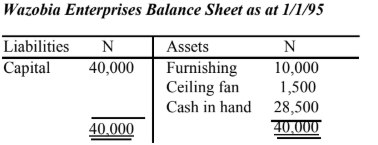
Use the information below to answer questions 17 and 18 If at the following information was ascertained (i)Rent shop ₦12,000 paid for the year (ii) Total purchases ₦15,000 (iii) Total sales ₦8,200 (iv) Stock of goods left ₦10,000 (v) Paid sales boy ₦500. What is the new balance sheet total as ?
- A.₦30 700.
- B.₦41,500
- C.₦41,700
- D.₦48,500.
To find the new balance sheet total, we first need to calculate the closing capital. Start with the opening capital of ₦40,000 from the balance sheet in the image. Next, calculate the net loss for the period: Gross Profit (Sales ₦8,200 - Cost of Sales (₦15,000 - ₦10,000) = ₦3,200) minus total expenses paid (Rent ₦12,000 + Salary ₦500 = ₦12,500), which gives a net loss of ₦9,300. The closing capital is the opening capital minus the net loss (₦40,000 - ₦9,300 = ₦30,700), which represents the new balance sheet total.
Common mistake: Students often incorrectly apply the accrual concept by only expensing one month's rent (₦1,000), which would lead to a net profit and an incorrect balance sheet total of ₦41,700.
Use the information below to answer questions 17 and 18 If at the following information was ascertained (i)Rent shop ₦12,000 paid for the year (ii) Total purchases ₦15,000 (iii) Total sales ₦8,200 (iv) Stock of goods left ₦10,000 (v) Paid sales boy ₦500. What is the balance on its cash account as at ?
- A.₦22,800
- B.₦21,200
- C.₦9,200
- D.₦800
To find the closing cash balance, we must prepare a summary of cash movements. We start with the opening cash balance shown in the Balance Sheet image, which is ₦28,500. We add all cash received (₦8,200 from sales) and subtract all cash paid out (₦12,000 for rent, ₦15,000 for purchases, and ₦500 for the sales boy). The final calculation is: ₦28,500 + ₦8,200 - ₦12,000 - ₦15,000 - ₦500 = ₦9,200.
Common mistake: A common mistake is to incorrectly omit one of the cash payments, such as the rent, which would lead to an incorrect answer like ₦21,200 (Option B).
On Ist January, 1993, lobo Company purchased equipment for ₦18,000. it uses straight-line depreciation with an estimates eight-year useful life and a ₦2,000 salvage value. On 31st December, 1996, it sells the equipment for ₦8000. In recording this sales, it should reflect?
- A.₦10,000 loss
- B.₦2,000 loss
- C.₦4,000 loss
- D.₦8,000 gain
First, calculate the annual depreciation using the straight-line method: (Cost ₦18,000 - Salvage Value ₦2,000) ÷ 8 years = ₦2,000 per year. Next, find the total depreciation from 1993 to 1996 (4 years), which is 4 × ₦2,000 = ₦8,000. The book value of the equipment at the time of sale is the cost minus total depreciation (₦18,000 - ₦8,000 = ₦10,000). Since the equipment was sold for ₦8,000, which is less than its book value, the company made a loss of ₦10,000 - ₦8,000 = ₦2,000.
Common mistake: A common mistake is choosing option A, where students correctly calculate the net book value (₦10,000) but mistakenly report it as the loss instead of subtracting the sale price from it.
The balance on a purchase ledger control account represents the?
- A.present amount that a business owes its suppliers at date
- B.total credit avaiable to the end of the year to be utilized in future
- C.total credit the business enjoyed for the particular year from its suppliers
- D.total credit owd the business by its customers
A purchase ledger control account, also known as a total creditors' account, is a summary account that shows the total amount a business owes to all its suppliers for goods bought on credit. The balance on this account represents the total of all the individual balances in the purchase ledger. Therefore, the closing balance shows the present amount that the business owes its suppliers at that particular date.
Common mistake: Students often confuse the purchase ledger control account (for suppliers/creditors) with the sales ledger control account (for customers/debtors), leading them to incorrectly choose option D.
A powerful instrument of control over both the sales ledger and the clek whose duty is to post the ledger is the?
- A.total debtors account
- B.purchase day book
- C.sales day book
- D.cash book
The total debtors account, also known as the Sales Ledger Control Account, is a summary account that shows the total amount owed by all credit customers. Its balance is used to check the accuracy of the individual accounts in the sales ledger, which are posted by a clerk. If the total of the individual customer balances does not match the control account balance, it signals an error or potential fraud, making it a key control instrument.
Common mistake: Students often mistakenly choose the 'sales day book' because it's the source of information for the sales ledger, but it is the control account that serves as the check and balance, not the book of original entry.
Mini Enterprises Sales Ledger as at read: ₦ Balance b/f 12750 Total credit sales 28185 Payments by debtors 12112 Discount allowed 638 Sales returns 1500 Prepare the sales ledger control account and determine the balance due from debtors.
- A.₦40,935
- B.₦27,961
- C.₦26,685
- D.₦1,185
To find the balance due from debtors, you prepare a Sales Ledger Control Account. You start with the opening balance (₦12,750) and add the credit sales (₦28,185) on the debit side, which totals ₦40,935. On the credit side, you add all items that reduce the debt: payments (₦12,112), discount allowed (₦638), and sales returns (₦1,500), which total ₦14,250. The closing balance is the difference between the total debits and total credits, which is ₦40,935 - ₦14,250 = ₦26,685.
Common mistake: Students often mistakenly choose option A by only adding the opening balance and credit sales, forgetting to subtract the payments, discounts, and returns that reduce the debtors' balance.
Determine the year''s purchase from the following information relating to a firm. Total creditor''s b/f ₦ 7,200 Total cash payment to suppliers ₦ 98,800 Total creditors c/f ₦ 8,400
- A.₦7,200
- B.₦98,800
- C.₦100,000
- D.₦105,800
To find the year's purchases, you use the Creditors' Control Account formula. The formula is: Purchases = (Cash Paid + Closing Creditors) - Opening Creditors. By substituting the given figures, we get (₦98,800 + ₦8,400) - ₦7,200, which equals ₦107,200 - ₦7,200, giving total purchases of ₦100,000.
Common mistake: Students often mistakenly choose the cash paid to suppliers (₦98,800) as the total purchase, forgetting to adjust for the change in the amount owed to creditors from the beginning to the end of the year.
Derive the total sales figure from the following information extracted from a firm's cash book and other relevant records. Total debtors b/f ₦ 5,600 Total cash receipts from debtors and cash sales ₦ 153,000 Total debtors c/f ₦ 6,800
- A.₦6,800
- B.₦153,000
- C.₦154,200
- D.₦159,800
To find the sales figure, you must prepare a Debtors Control Account to determine the credit sales. The formula is: Credit Sales = Closing Debtors + Cash Received from Debtors - Opening Debtors. Using the figures provided, the calculation is (₦6,800 + ₦153,000) - ₦5,600 = ₦154,200. Since the question does not provide a separate figure for cash sales, this calculated credit sales amount is taken as the total sales.
Common mistake: Students often mistakenly add the cash received to the closing debtors balance (₦153,000 + ₦6,800 = ₦159,800) but forget to subtract the opening debtors balance to find the correct sales figure.
The statement of affairs prepared from incomplete records can be described as?
- A.the summary of all the business transactions of the trader ascertained by the accountant
- B.a balance sheet at a particular date showing the assets and liabilities of the business
- C.a schedule of all the business ventures entered into for the period to which the records relates
- D.the statement that shows the profit or loss made during the period
A statement of affairs is prepared for businesses with incomplete records to determine their financial position on a certain date. It lists all the assets and liabilities, which is the exact function of a balance sheet. The difference between the total assets and total liabilities is used to calculate the owner's capital, so it is essentially a balance sheet created from limited information.
Common mistake: Students might mistakenly choose option D, confusing the statement of affairs (which shows financial position) with the statement of profit or loss (which calculates profit for a period).
The contribution marginal on a job is the?
- A.gross profit
- B.net profit
- C.excess of sales revnue over variable costs
- D.difference between fixed and variable costs
Contribution margin is a key concept in cost accounting that shows how much money is available to 'contribute' towards covering a company's fixed costs. It is calculated by subtracting all variable costs (costs that change with production levels) from the sales revenue. Once fixed costs are covered, the remaining contribution margin becomes the company's profit.
Common mistake: Students often confuse contribution margin with gross profit, but gross profit is calculated as sales minus the cost of goods sold, which can include both fixed and variable manufacturing costs.
The objective of allocating all costs to producer is to?
- A.produce a scientifically accurate cost
- B.avoid unallocated overhead and compute total accounts
- C.co-odinate the cost and financial accounts
- D.compute the contribution of the product to the final profit
The main reason for allocating all costs to a product is to determine its total production cost. This process, known as absorption costing, ensures that both direct costs and indirect costs (overheads) are included. By allocating all overheads, we avoid leaving any costs out and can accurately calculate the total cost of the goods produced, which is the primary purpose of a manufacturing account.
Common mistake: Students may mistakenly choose option D, but computing 'contribution' is the objective of marginal costing, which only considers variable costs, not all costs as stated in the question.
Use the information below to answer question 28 and 29. Raw materials inventory at the beginning of a period was ₦ 46,800 and at the close of the period there was a balance of ₦38,600. From the purchases made during the period, defective materials costing ₦9,200 were returned. Cost of materials consumed during the period was ₦448,500. What was the total purchases made during the period?
- A.₦497,100
- B.₦457,700
- C.₦449,500
- D.₦440,300
To find the total purchases, you must work backwards using the formula for the cost of raw materials consumed. The formula is: Opening Stock + Purchases - Returns Outwards - Closing Stock = Cost of Materials Consumed. To find Purchases, rearrange the formula: Purchases = Cost of Materials Consumed + Closing Stock + Returns Outwards - Opening Stock. Therefore, Purchases = ₦448,500 + ₦38,600 + ₦9,200 - ₦46,800, which equals ₦449,500.
Common mistake: Students often calculate the net purchases (₦440,300) and forget to add back the returns outwards (₦9,200) to arrive at the total purchases, leading them to incorrectly choose option D.
Use the information below to answer question 28 and 29. Raw materials inventory at the beginning of a period was ₦ 46,800 and at the close of the period there was a balance of ₦38,600. From the purchases made during the period, defective materials costing ₦9,200 were returned. Cost of materials consumed during the period was ₦448,500. What was the cost of materials available for use during the period?
- A.₦487,100
- B.₦449,500
- C.₦448,500
- D.₦440,300
The cost of materials available for use is the total value of materials that could have been used during the period. This is found by adding the materials that were actually used (cost of materials consumed) and the materials that were left over at the end (closing stock). Therefore, you simply add the cost of materials consumed (₦448,500) to the closing stock of raw materials (₦38,600) to get ₦487,100.
Common mistake: Students often get confused and try to use all the figures provided, sometimes calculating the net purchases (₦440,300) instead of the cost of materials available for use.
The limitations of the receipts and payments account arise mainly because of the reliance on?
- A.cash movement as evidence of transaction
- B.the acconuting officer to report
- C.the capital account of the organization
- D.the transaction papers as evidence of transaction
A Receipts and Payments Account is a summary of all cash and bank transactions for a not-for-profit organisation over a period. Its major limitation is that it only records the physical movement of cash, ignoring important accounting concepts like accruals, prepayments, and non-cash expenses like depreciation. Because it relies only on cash flow, it does not show the true financial performance (surplus or deficit) of the organisation for that period.
Common mistake: Students might mistakenly choose option D, but relying on transaction papers (source documents) is a fundamental strength and requirement of all proper accounting, not a limitation of this specific account.
The trading account is to a sole trader what income and expenditure account is to a?
- A.partnership
- B.public limited organization
- C.manufacturing organization
- D.non-profit making organization
A sole trader is a profit-making business that uses a Trading Account to find its gross profit. A non-profit making organization, like a club or charity, does not aim to make profit. Instead, it prepares an Income and Expenditure Account to determine if it has a surplus (income greater than expenses) or a deficit (expenses greater than income) for the year.
Common mistake: Students might mistakenly choose other business types like 'partnership' because they are also business entities, but they fail to recall that the Income and Expenditure account is the specific final account used by non-profit organisations.
A non-profit-making organization differs from a profit-making one in that?
- A.it does not earn income
- B.proceeds from sale of shares form part of its income
- C.all its income is committed
- D.annual subscriptions and levies form part of its income
A key difference between non-profit and profit-making organizations is their main source of income. Non-profit organizations, such as clubs and societies, primarily raise funds from their members through annual subscriptions and levies. This income is then used to run the organization's activities, not to make a profit for owners.
Common mistake: Students may wrongly choose option A, thinking that 'non-profit' means the organization earns no income at all, but these organizations do earn income to cover their expenses.
Which of the following indicate that a partnership business is in place? (i) There is a business (ii)It is run commonly by partners (iii)It has profit-making in view (iv) Partners' liability is limited
- A.i and ii only
- B.i, ii and iii only
- C.i, iii and iv only
- D.ii, iii and iv only
A partnership is an agreement between two or more people to run a business together with the aim of making a profit. Therefore, the key features are that there is a business (i), it is run by partners (ii), and its goal is to make a profit (iii). The statement that partners' liability is limited (iv) is incorrect because partners in a general partnership have unlimited liability, meaning their personal assets can be used to pay business debts.
Common mistake: Students often mistakenly choose options including statement (iv) because they confuse the unlimited liability of a partnership with the limited liability of a company.
When forming a partnership, new partners should record non-monetary assets on the new partnership's books at?
- A.their current fair market values
- B.their historical costs when first use
- C.their historical costs when first purchase by each new partner
- D.the highest values practical so that future income tax deductions are maximized
When a partner contributes a non-cash asset like a vehicle or building to a new partnership, it must be recorded at its current fair market value. This is the price the asset would sell for in the open market at that time. Using the current value ensures that the partner's capital contribution is recorded fairly and accurately reflects the true worth of what they are bringing into the business.
Common mistake: Students often mistakenly choose historical cost because it is a fundamental accounting principle, but they forget that for partnership formation, the fair market value is used to ensure fairness among all partners.
Which of the following is an intangible asset and a measure of a firm's superior earning power?
- A.Patent
- B.Goodwill
- C.Trademark
- D.Right issue
Goodwill is an intangible asset that represents the value of a company's good reputation, customer base, and brand recognition. This strong reputation allows the business to earn profits above the average for its industry, which is known as 'superior earning power'. Therefore, goodwill is the specific accounting term used to measure this advantage, especially when one business buys another.
Common mistake: Students often mistakenly choose Patent or Trademark because they are also valuable intangible assets, but Goodwill is the specific term that measures the overall superior earning power of the entire firm.
The price paid by an acquiring company is the?
- A.premium
- B.purchase consideration
- C.sales consideration
- D.conversion fee
Purchase consideration is the correct accounting term for the total price an acquiring company pays to take over another business. This payment can be made using cash, issuing new shares, or a combination of both. It represents the total value exchanged for the ownership of the acquired company.
Common mistake: Students might mistakenly choose 'premium' because they confuse the total price with the extra amount paid above the fair value of the company's net assets, which is actually called goodwill.
Use the information below to answer questions 38 and 39 Dan & Baker are in partnership with capitals of ₦50,000 and ₦30,000 each. The partnership agreement provides that: (i) profits be shared in the ratio of capital (ii) Baker be paid a salary of ₦8,000 (iii) both partners pay interest on drawings at 6% p.a. At the end of the year, Dan drew₦15,000 while Baker drew ₦14,000 in four equal installment on , , and . The net profit for the year was ₦48,000. ₦5,000 is to be written off the Goodwill account. What is the interest on the drawings by Baker?.
- A.₦210
- B.₦315
- C.₦450
- D.₦840
Interest on drawings is calculated based on the amount drawn and the time period it was owed. Baker drew ₦14,000 in four equal installments of ₦3,500 each on , , , and . The interest for each drawing is calculated as: (1) ₦3,500 x 6% x = ₦157.50; (2) ₦3,500 x 6% x = ₦105; (3) ₦3,500 x 6% x = ₦52.50; (4) The last drawing on has no interest for that year. Summing up the interest for each period gives ₦157.50 + ₦105 + ₦52.50 = ₦315.
Common mistake: Students often make the mistake of calculating the interest on the total annual drawing for the entire year (₦14,000 x 6% = ₦840), forgetting that interest is only charged from the date the money was taken.
Use the information below to answer questions 38 and 39 Dan & Baker are in partnership with capitals of ₦50,000 and ₦30,000 each. The partnership agreement provides that: (i) profits be shared in the ratio of capital (ii) Baker be paid a salary of ₦8,000 (iii) both partners pay interest on drawings at 6% p.a. At the end of the year, Dan drew₦15,000 while Baker drew ₦14,000 in four equal installment on , , and . The net profit for the year was ₦48,000. ₦5,000 is to be written off the Goodwill account. Determine the total interest on capital due to the partners.?
- A.₦1200
- B.₦1800
- C.₦3000
- D.₦4800
The question asks for the total interest on capital. Although the agreement text mistakenly mentions a 6% rate for 'interest on drawings', this rate is meant to be applied to capital to find the answer. To calculate, find the interest for each partner: Dan's is 6% of his ₦50,000 capital (0.06 x 50,000 = ₦3,000) and Baker's is 6% of his ₦30,000 capital (0.06 x 30,000 = ₦1,800). The total interest on capital is the sum of both, which is ₦3,000 + ₦1,800 = ₦4,800.
Common mistake: Students might mistakenly choose option C (₦3,000) by calculating the interest on capital for only one partner (Dan) instead of adding both partners' interest together.
The ordinary shareholders enjoy the following rights except the right to?
- A.vote at annual general meetings
- B.elect the board of directors
- C.participate in additional issues of shares
- D.receive dividends at a preddetermined rate
Ordinary shareholders are the true owners of a company and have rights like voting at meetings and electing directors. However, the dividend they receive is not fixed; it changes based on the company's profit and the directors' decision. It is preference shareholders who get dividends at a fixed, predetermined rate, making this the right that ordinary shareholders do not have.
Common mistake: Students often confuse the rights of ordinary shareholders with those of preference shareholders, especially regarding the nature of dividend payments.
Granada Corporation has net assets of ₦600,000 and contributed capital of ₦180,000. The corporation has 30,000 shares of common stock outstanding with no preferred stock. This suggest that the corporation has?
- A.a book value of ₦14 per share
- B.a book value of ₦20 per share
- C.a deficit of ₦420,000
- D.retained earnings of ₦600,000
Book value per share is calculated by dividing the company's total net assets (which is the same as total shareholders' equity) by the number of outstanding shares. In this question, the net assets are ₦600,000 and the number of shares is 30,000. Therefore, dividing ₦600,000 by 30,000 gives a book value of ₦20 per share.
Common mistake: Students often mistakenly calculate the retained earnings (₦420,000) and then divide that figure by the number of shares to get ₦14, forgetting that book value is based on total net assets.
Under which of these conditions can a company issue shares at discount? (i)A resolution must be passed at a general meeting (ii) The amount of discount must be stated in the resolution (iii) The share must have existed for at least six years (iv) On the order of a court.
- A.i, ii and iii only
- B.i, ii and iv only
- C.i, iii, and iv only
- D.ii, iii and iv only
This question is about the rules for issuing company shares. According to the Companies and Allied Matters Act (CAMA) in Nigeria, a company can only issue shares at a discount under very strict conditions. These conditions include passing a resolution in a general meeting, stating the exact discount amount in that resolution, and getting an order from the court to approve it. The statement that the share must have existed for six years is not a requirement, which is why option B is the correct answer.
Common mistake: Students often get confused by the many regulations surrounding share issues and might incorrectly believe there is a time-based rule, leading them to choose option A which wrongly includes statement (iii).
See all 33 JAMB Accounting 2010 questions
Sign up free to unlock every question in this paper — with the verified answer and Beta's worked explanation on each one. No card needed to begin.
Start free