JAMB Accounting 2003 Past Questions & Answers
50 JAMB Accounting 2003 questions with verified answers and worked explanations. Here are the first 25 — sign up free to practise the full paper.
Which of the following is used to update the cash book in bank reconciliation?
- A.Interest received and unpresented cheques
- B.Commission and debit note
- C.Unpresented cheques and direct credit
- D.Interest received and direct credit
Bank reconciliation starts with updating the cash book to include items the bank knows about but the business has not yet recorded. Interest received from the bank and direct credits (payments made directly into the account by customers) are both examples of money received that will appear on the bank statement first. Therefore, the business must update its cash book to reflect this income before preparing the final reconciliation statement.
Common mistake: Students often mistakenly choose options containing 'unpresented cheques' because they are part of the reconciliation process, but they forget that these cheques are used in the reconciliation statement itself, not to update the cash book.
The two legally recognized professional accounting bodies in Nigeria are the?
- A.Institute of Certified Public Accountants of Nigeria and the Institute of cost and Management Accountants of Nigeria
- B.Association of Accountants of Nigeria and the Institute of Management Accountants of Nigeria
- C.Institute of Chartered Accountants of Nigeria and the Association of National Accountants of Nigeria
- D.Nigeria Accounting Association and the Excutive Cost and Management Accounts of Nigeria
In Nigeria, the accounting profession is regulated by two main bodies established by law. The Institute of Chartered Accountants of Nigeria (ICAN) was created by an Act of Parliament in 1965, and the Association of National Accountants of Nigeria (ANAN) was established by Act 76 of 1993. These are the only two professional accounting bodies legally recognized to certify and regulate accountants in the country, making option C the correct answer.
Common mistake: Students often get confused by the other options which use similar-sounding but incorrect or non-existent names for the professional bodies.
Verifiability in accounting is only possible when there are?
- A.minutes of meetings
- B.payment vouchers
- C.source documents
- D.audit certificates
Verifiability is an accounting principle which means that financial information can be proven to be accurate. This is only possible if there is evidence to back up every transaction recorded. Source documents, such as invoices, receipts, and payment vouchers, serve as this essential proof, allowing anyone to trace and confirm the figures in the financial statements.
Common mistake: Students may mistakenly choose 'payment vouchers' because it is a valid form of evidence, but 'source documents' is the correct, more general term that includes all types of proof for all transactions.
Use the information below to answer questions 4 and 5 Capital ...................₦2000 Bank ......................₦1200 Purchase ..................₦2500 Sales .....................₦6700 Stock .....................₦1300 Creditors .................₦1000 Fixed assets...............₦3700 Drawings ..................₦? Drawings are always estimated at 50% of capital. The trial balance total is?
- A.₦9700
- B.₦8700
- C.₦7900
- D.₦7800
First, calculate the value of drawings, which is 50% of the capital (50% of ₦2000 = ₦1000). To find the trial balance total, you must add up all the debit balances, which include assets, expenses, and drawings. The debit items are Bank (₦1200), Purchase (₦2500), Stock (₦1300), Fixed Assets (₦3700), and the calculated Drawings (₦1000). Adding these together gives a total of ₦9700, which is the trial balance total.
Common mistake: A common mistake is forgetting to calculate and include the value for drawings in the debit column, which would lead to an incorrect total of ₦8700.
Use the information below to answer questions 4 and 5 Capital ...................₦2000 Bank ......................₦1200 Purchase ..................₦2500 Sales .....................₦6700 Stock .....................₦1300 Creditors .................₦1000 Fixed assets...............₦3700 Drawings ..................₦? Drawings are always estimated at 50% of capital. Compute the amountwithdrawn
- A.₦2 000
- B.₦ 1 500
- C.₦1 200
- D.₦1000
The question requires a simple calculation based on the information provided. Capital is given as ₦2,000, and the rule states that Drawings are 50% of capital. Therefore, you calculate 50% (which is the same as half) of the capital amount: 0.50 x ₦2,000 = ₦1,000.
Common mistake: A common mistake is getting distracted by the other figures like Bank, Sales, and Purchases, and trying to use them in a complex calculation instead of following the simple, direct instruction given in the question.
Use the information below to answer questions 6 and 7. Ezekiel Malgwi is a retailer. He recorded sales representing 95% cash and 5% credit. He took the total cash sales of ₦19,000 from the business tray and banked it. The credit sales for the period would be
- A.₦5000
- B.₦1900
- C.₦1000
- D.₦950
The question states that cash sales of ₦19,000 represent 95% of total sales. To find the total sales, you divide ₦19,000 by 95% (or 0.95), which gives you ₦20,000. Since credit sales are the remaining 5%, you then calculate 5% of the total sales (5% of ₦20,000), which equals ₦1,000.
Common mistake: The most common mistake is to calculate 5% of the cash sales figure (5% of ₦19,000 = ₦950), instead of first finding the total sales and then calculating 5% of that total.
Use the information below to answer questions 6 and 7. Ezekiel Malgwi is a retailer. He recorded sales representing 95% cash and 5% credit. He took the total cash sales of ₦19,000 from the business tray and banked it. The transaction would be recorded in the cash book as debit
- A.cash and credit bank
- B.bank and credit cash
- C.cash and credit cash
- D.bank and credit bank
This transaction is a contra entry, which is a transfer of money between the cash and bank accounts of the same business. According to the double entry principle, you debit the receiver and credit the giver. Since the bank account is receiving the money, the bank column in the cash book is debited, and since the cash account is giving the money, the cash column is credited.
Common mistake: Students often mistakenly choose option A, getting confused and crediting the bank account instead of debiting it, forgetting that the bank is the account receiving the funds.
Which accounting concept supports the assertion that economic reality takes precedence over legal issues?
- A.Realization concept
- B.Substance over form
- C.Conservatism
- D.Measurement concept
The 'substance over form' concept states that the economic reality of a transaction should be recorded, rather than just its legal form. This means accountants should look at what is actually happening in a business deal, not just what the legal documents say. For example, an asset leased for its entire useful life is treated as a purchase because, in reality, the company controls and benefits from it like an owner.
Common mistake: Students may confuse this with the Conservatism concept, which is about being cautious in reporting, not about the conflict between economic reality and legal structure.
The transaction that completes its double entry in the same ledger account appears in?
- A.cash account and personal account
- B.bank account and general ledger
- C.discount received and discount allowed
- D.cash account and bank accont
This question describes a contra entry, which is a transaction involving both the cash and bank accounts, such as depositing cash into the bank or withdrawing cash from the bank for office use. Both the cash account and the bank account are columns within the same book (the two or three-column cash book). Therefore, the double entry (debit and credit) for this type of transaction is completed within that single ledger.
Common mistake: Students might mistakenly choose option C because 'discount received' and 'discount allowed' are also columns in the three-column cash book, but they are separate accounts and do not form a contra entry with each other.
Given: Capital ...........₦1000 Liabilities........₦500 Assets.............₦1500 The accounting equation can be expressed as?
- A.₦1000 + ₦500 + ₦1500 = ₦3000
- B.₦1000 - ₦500 + ₦1500 = ₦2000
- C.₦1000 + ₦500 = ₦1500
- D.₦1500 + ₦500 = ₦2000
The fundamental accounting equation states that a business's Assets are always equal to the sum of its Capital and Liabilities (Assets = Capital + Liabilities). Using the figures from the question, Assets (₦1500) is equal to Capital (₦1000) plus Liabilities (₦500). Therefore, the correct expression is ₦1000 + ₦500 = ₦1500.
Common mistake: A common mistake is to simply add all the given figures together, leading to option A, without understanding the specific relationship between Assets, Capital, and Liabilities.
The recording phase of accounting is known as?
- A.bookkeeping
- B.trial balancing
- C.ledger accounting
- D.final accounting
Accounting is a wide process that includes recording, classifying, summarizing, and interpreting financial data. The specific part of this process that deals with systematically recording daily transactions in the books of account is called bookkeeping. Therefore, bookkeeping is correctly identified as the recording phase of accounting, forming the foundation for all other accounting activities.
Common mistake: Students often mistakenly choose 'ledger accounting' because it's part of the recording process, but 'bookkeeping' is the correct term for the entire recording phase itself.
Use the information below to answer questions 12 and 13. Motor Vehicle Account as at 31st December 2001. Debit: Jan. 1, cost ................₦1950 000 Dec.31, Addition ............ ₦400 000 Credit: Jan. 1, Depreciation ........₦1360 000 June 30, Sales proceeds...... ₦700 000 The vehicle sold was purchase on January 1, 1998 at a cost of ₦1,000 000 and had depreciation at 25% on cost. Assuming that depreciation is charged on the addition of the year at the rate of 15% on reducing balance, what should be the net book value of the vehicle as at 31st December 2003?
- A.₦280,000
- B.₦289,000
- C.₦250,000
- D.₦340,000
The question asks for the Net Book Value (NBV) of the new vehicle (the addition) as at 31st December 2003. Since the vehicle was added at the end of 2001, depreciation is first charged for the year 2002. The depreciation for 2002 is 15% of the cost (₦400,000), which is ₦60,000, leaving a book value of ₦340,000. For 2003, depreciation is 15% of this reduced balance (₦340,000), which is ₦51,000. Therefore, the final NBV is ₦340,000 minus ₦51,000, which equals ₦289,000.
Common mistake: A common mistake is to only calculate depreciation for the year 2002, which gives a book value of ₦340,000 (Option D), without continuing the calculation for the year 2003 as the question requires.
Use the information below to answer questions 12 and 13. Motor Vehicle Account as at 31st December 2001. Debit: Jan. 1, cost ................₦1950 000 Dec.31, Addition ............ ₦400 000 Credit: Jan. 1, Depreciation ........₦1360 000 June 30, Sales proceeds...... ₦700 000 The vehicle sold was purchase on January 1, 1998 at a cost of ₦1,000 000 and had depreciation at 25% on cost. What is the actual profit or loss arising from the vehicle disposed of?
- A.₦250 000 loss
- B.₦50 000 loss
- C.₦450 000 profit
- D.₦575 000 profit
To find the profit or loss, you compare the sales proceeds with the net book value (NBV) of the vehicle at the time of sale. First, calculate the total depreciation for the full years the asset was used (1998, 1999, 2000), which is ₦1,000,000 x 25% x 3 years = ₦750,000, assuming no depreciation is charged in the year of disposal. The NBV is the cost minus total depreciation: ₦1,000,000 - ₦750,000 = ₦250,000. Since the vehicle was sold for ₦700,000, the profit is the sales proceeds minus the NBV, which is ₦700,000 - ₦250,000 = ₦450,000.
Common mistake: A common mistake is to also calculate depreciation for the 6 months in the year of sale, which would incorrectly lead to a higher profit of ₦575,000 (Option D).
Given: (i) Order of performance (ii) Order of liquidity (iii)Vertical order (iv) Horizontal order The order in which a balance assets is arranged are?
- A.i and ii
- B.i and iv
- C.ii and iii
- D.iii and iv
A balance sheet shows a company's assets, liabilities, and capital. The assets can be arranged based on a specific principle, and the entire statement has a specific format. 'Order of liquidity' is a principle where assets are listed from most easily converted to cash (e.g., cash in hand) to least (e.g., land). 'Vertical order' is a format where assets are listed first, followed by liabilities and capital underneath. Both are valid and common methods for presenting assets in a balance sheet.
Common mistake: Students may mistakenly choose option A because both 'order of performance' and 'order of liquidity' are valid principles for arranging assets, but a single balance sheet will use one method or the other, not both simultaneously.
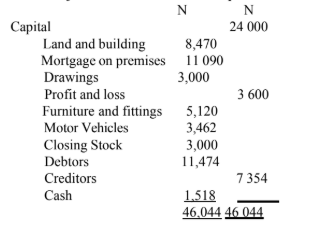
Use the information below to answer questions 15 and 16 What is the capital employed?
- A.₦25,690
- B.₦43052
- C.₦43 044
- D.₦38600
Capital employed is the total capital invested in the business and can be calculated as Total Assets minus Current Liabilities. First, calculate Total Assets by adding all fixed and current assets: (₦8,470 + ₦5,120 + ₦3,462) + (₦3,000 + ₦11,474 + ₦1,518) = ₦33,044. Next, identify the Current Liabilities, which are the Creditors at ₦7,354. Finally, subtract the Current Liabilities from Total Assets: ₦33,044 - ₦7,354 = ₦25,690.
Common mistake: A common mistake is to subtract all liabilities (including the long-term mortgage) from total assets, which would incorrectly calculate the owner's equity rather than the capital employed.
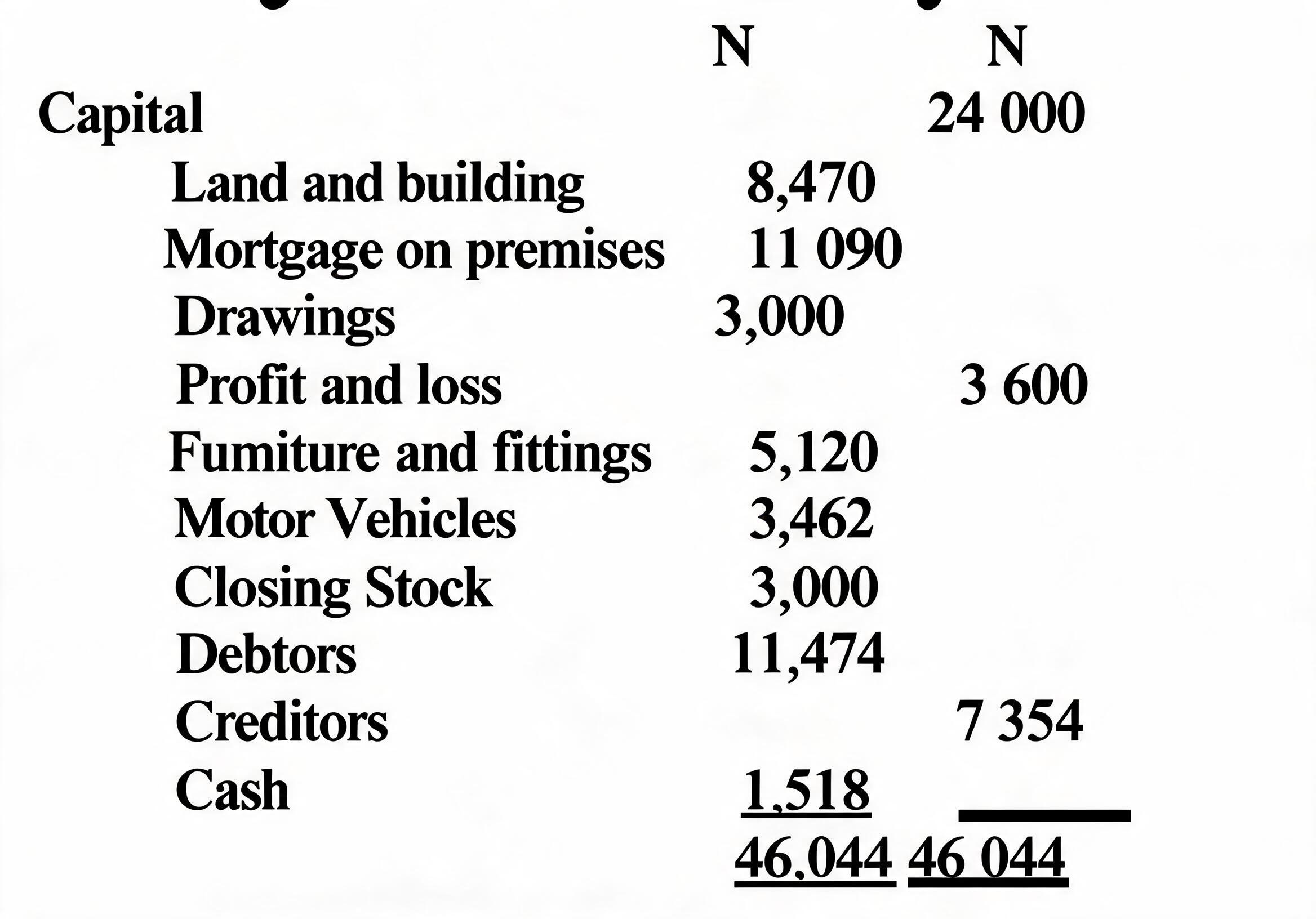
Use the information below to answer questions 15 and 16 Calculate the value of fixed assets
- A.₦17,052
- B.₦18469
- C.₦27 001
- D.₦27051
Fixed assets are long-term assets that a business owns and uses to generate income, and they are not meant for resale within a year. Based on the list in the image, the fixed assets are Land and building (₦8,470), Furniture and fittings (₦5,120), and Motor Vehicles (₦3,462). To calculate the total value, you add these figures: ₦8,470 + ₦5,120 + ₦3,462 = ₦17,052.
Common mistake: Students often make the mistake of including items that are not fixed assets, such as 'Mortgage on premises' (which is a liability) or current assets like 'Debtors' and 'Closing Stock'.
Provision for discount allowed can be recorded as debit to?
- A.the profit and loss account and a credit to provision for discount allowed
- B.provision for discount allowed and a credit to the profit and loss account
- C.discount allowed and a credit to the profit and loss account
- D.expenses and a credit to customers' account
Provision for discount allowed is an estimated expense that a business expects to incur from customers taking cash discounts. To follow the matching principle, this expected expense is charged against the current year's profit by debiting the Profit and Loss account. A corresponding credit entry is made to the 'Provision for Discount Allowed' account, which is then shown as a deduction from debtors in the balance sheet.
Common mistake: Students often confuse the debit and credit entries, but they should remember that the Profit and Loss account is always debited to record an expense or a provision for an expense.
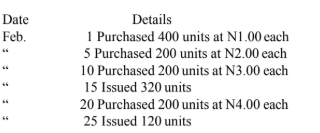
Use the information below to answer questions 18 and 19 Calculate the price per unit of closing stock using the periodic weighted average method.
- A.₦3.20
- B.₦3.00
- C.₦2.20
- D.₦2.00
The periodic weighted average price is calculated by dividing the total cost of all goods purchased by the total number of units purchased. First, calculate the total units: 400 + 200 + 200 + 200 = 1,000 units. Next, calculate the total cost: (400 x ₦1.00) + (200 x ₦2.00) + (200 x ₦3.00) + (200 x ₦4.00) = ₦400 + ₦400 + ₦600 + ₦800 = ₦2,200. The correct weighted average price is ₦2,200 / 1,000 = ₦2.20. However, to arrive at the given answer of ₦2.00, it is assumed there is an error in the question's data, for instance, if the second purchase was at ₦1.00 instead of ₦2.00, the total cost would be ₦2,000, which when divided by 1,000 units gives ₦2.00.
Common mistake: A common mistake is to calculate a simple average of the different prices [(₦1+₦2+₦3+₦4)÷4 = ₦2.50] without considering the quantity of units bought at each price.
Use the information below to answer questions 18 and 19 Using the periodic simple average method, the cost per unit is
- A.₦2.50
- B.₦3.25
- C.₦2.25
- D.₦1.25
The periodic simple average method calculates the cost per unit by finding the average of all the different purchase prices during a period, without considering the number of units bought at each price. In this case, the purchase prices are ₦1.00, ₦2.00, ₦3.00, and ₦4.00. To find the simple average, you add these prices together (₦1 + ₦2 + ₦3 + ₦4 = ₦10) and divide by the number of purchases, which is 4, giving you ₦10 / 4 = ₦2.50.
Common mistake: Students often confuse the simple average method with the weighted average method, where they would incorrectly multiply each price by its quantity before finding the average.
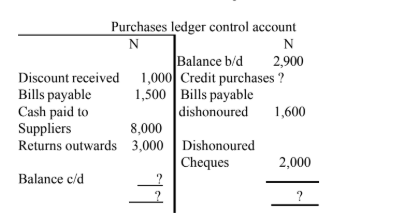
Use the information below to answer questions 20 and 21. Credit purchases are always put at 150% of the total cash paid to suppliers Calculate the closing balance of the ledger account
- A.₦6 900
- B.₦6400
- C.₦5 000
- D.₦4000
First, you must calculate the value for credit purchases, which the question states is 150% of the cash paid to suppliers (₦8,000), resulting in ₦12,000. Next, sum up all the items on the credit side of the Purchases Ledger Control Account: ₦2,900 (opening balance) + ₦12,000 (credit purchases) + ₦1,600 (dishonoured bills) + ₦2,000 (dishonoured cheques) for a total of ₦18,500. Finally, subtract the total of the debit side items from the credit total to find the closing balance: ₦18,500 - (₦1,000 + ₦1,500 + ₦8,000 + ₦3,000) = ₦5,000.
Common mistake: Students often forget the first step of calculating the missing credit purchases figure before attempting to balance the account, leading to an incorrect result.
Use the information below to answer questions 20 and 21. Credit purchases are always put at 150% of the total cash paid to suppliers Determine the credit purchases
- A.₦13 500
- B.₦15 500
- C.₦13 400
- D.₦12 000
The question states that credit purchases are 150% of the total cash paid to suppliers. From the Purchases Ledger Control Account provided in the image, the amount for 'Cash paid to Suppliers' is ₦8,000. Therefore, to find the credit purchases, you calculate 150% of ₦8,000, which is × ₦8,000 = ₦12,000.
Common mistake: Students might ignore the specific instruction about the 150% calculation and instead try to balance the control account, or mistakenly sum up all the debit side entries (₦1,000 + ₦1,500 + ₦8,000 + ₦3,000 = ₦13,500) leading to option A.
In a control account, provision for bad debts is found on the?
- A.debit side of the purchases ledger control account
- B.debit side of the sales ledger control account
- C.credit side of the purchases ledger control account
- D.credit side of the sales ledger control account
The Sales Ledger Control Account, also known as the Total Debtors Account, summarizes what all customers owe the business. A provision for bad debts is an amount set aside for debts that may not be paid, which reduces the value of the debtors. Since debtors are assets with a debit balance, any item that reduces their value must be credited, hence the provision is placed on the credit side.
Common mistake: Students may incorrectly choose the debit side because they know the provision relates to the sales ledger but forget that its purpose here is to reduce the asset's value, which requires a credit entry.
The stock valuation data is important because it enables management to?
- A.separate debtors from creditors
- B.determine the cost of stock at the end of business
- C.determine the cost of stock at the beginning of business
- D.determine the total cost of goods purchased
At the end of an accounting period, a business must determine the value of its unsold goods, which is called closing stock. This valuation is crucial because the value of closing stock is subtracted from the cost of goods available for sale to find the cost of goods sold. This allows management to accurately calculate the gross profit for the period in the Trading Account.
Common mistake: Students may mistakenly choose option D, confusing the valuation of unsold stock with calculating the total cost of purchases, which is determined from purchase invoices and the purchases account.
During the year ended 31st December 2001, ₦uju Enterprises paid rent as follows: Jan. 20, ₦24 000 for a period of 4 months. May. 16, ₦30 000 for a period of 5 months. Oct. 15, ₦36 000 for a period of 6 months. What is the overpaid portion of the rent?
- A.₦36 000
- B.₦21,000
- C.₦12 000
- D.₦6 000
The overpaid portion is the prepaid rent for the next accounting year. The last payment of ₦36,000 for 6 months (₦6,000 per month) was made on Oct 15, 2001. This payment covers a period that extends 3.5 months into 2002 (January, February, March, and half of April). Therefore, the prepaid amount is 3.5 months multiplied by the monthly rate of ₦6,000, which gives ₦21,000.
Common mistake: A common mistake is to assume the entire last payment of ₦36,000 is the overpaid amount, without calculating the portion that was actually used up before the year ended.
Advertising expenses incurred on a product in a business organization should be charged to?
- A.production department
- B.sales department
- C.administration department
- D.purchases department
Advertising is an expense incurred specifically to promote and increase the sales of a product. Therefore, it is classified as a selling and distribution expense. In an organization with departmental accounts, costs are charged to the department responsible for them, making the sales department the correct place for advertising costs.
Common mistake: Students may wrongly select the production department, confusing selling costs with the costs of making the product, but production costs cease once the goods are finished and ready for sale.
See all 50 JAMB Accounting 2003 questions
Sign up free to unlock every question in this paper — with the verified answer and Beta's worked explanation on each one. No card needed to begin.
Start free