JAMB Accounting 2002 Past Questions & Answers
50 JAMB Accounting 2002 questions with verified answers and worked explanations. Here are the first 10 — sign up free to practise the full paper.
In preparing the final accounts, the bad debt account is closed by a transfer to the?
- A.balance sheet
- B.provision for bad debt account
- C.profit and loss account
- D.trading account
Bad debt is an expense a business incurs when a customer cannot pay what they owe. At the end of the accounting year, all nominal accounts, which include expenses and incomes, must be closed off. These accounts are closed by transferring their balances to the Profit and Loss account to calculate the net profit or loss for the period.
Common mistake: Students often mistakenly choose 'provision for bad debt account' because they confuse the actual bad debts written off during the year with the provision, which is an estimate for future doubtful debts.
Given: Stock ₦800 Purchases of flour ₦2450 Sales ₦4745 Wages of bakery staff ₦675 Carriage outwards ₦50 Salary of administrative staff ₦225 Stock ₦940 Capital ₦1540 Determine the cost of goods sold?
- A.₦2575
- B.₦2985
- C.₦3250
- D.₦3925
To determine the cost of goods sold, you add the opening stock, purchases, and any direct costs, then subtract the closing stock. In this case, the wages of bakery staff are a direct cost of production. The calculation is: Opening Stock (₦800) + Purchases (₦2450) + Wages (₦675) - Closing Stock (₦940), which equals ₦2985. Carriage outwards and administrative salaries are indirect expenses and are not included in this calculation.
Common mistake: Students often mistakenly choose option D by calculating the cost of goods available for sale (Opening Stock + Purchases + Direct Expenses) but forget to subtract the closing stock.
In a petty cash book the imprest is ₦1380. Expenses: Stationery ₦350 Cleaning material ₦335 General expenses ₦265 How much was received to maintain the imprest at the ends of the month?
- A.₦950
- B.₦970
- C.₦430
- D.₦380
The imprest system requires that the amount spent from the petty cash float is reimbursed to restore the original imprest amount. First, calculate the total expenses: Stationery (₦350) + Cleaning material (₦335) + General expenses (₦265) = ₦950. This total expense of ₦950 is the exact amount that must be received to bring the petty cash balance back to the original imprest of ₦1380.
Common mistake: A common mistake is to calculate the closing balance (₦1380 - ₦950 = ₦430) instead of the reimbursement amount, which is always equal to the total expenses for the period.
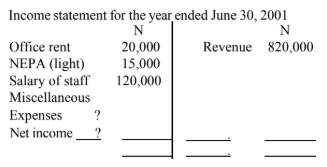
Miscellaneous expenses is 10% of revenue. Calculate the net income
- A.₦583,000
- B.₦563,000
- C.₦483,000
- D.₦683,000
To find the net income, you must subtract the total expenses from the revenue. First, calculate the missing miscellaneous expenses, which is 10% of the revenue shown in the image (10% of ₦820,000 = ₦82,000). Next, add all the expenses together: ₦20,000 + ₦15,000 + ₦120,000 + ₦82,000 gives a total of ₦237,000. Finally, subtract the total expenses from the revenue to get the net income: ₦820,000 - ₦237,000 = ₦583,000.
Common mistake: A common mistake is to forget to calculate the miscellaneous expense based on the revenue, and instead only sum the expenses already listed in the income statement.
An entry in a subsidiary book which does not form part of the double entry system is a?
- A.contra entry
- B.journal entry
- C.single entry
- D.memorandum entry
A memorandum entry is an informal note made in a book of original entry for record-keeping or informational purposes only. Unlike other entries, it does not have a corresponding debit and credit, meaning it does not form part of the double-entry system. It's simply a reminder and does not affect the balances in the ledger accounts.
Common mistake: Students may confuse this with 'single entry', but single entry refers to a complete, alternative bookkeeping method, not a specific type of note within the double-entry framework.
In an incomplete record, the preparation of the bank reconciliation ensures that?
- A.all cash taking are banked
- B.the cash book is correct
- C.there are no overdrafts
- D.there are no hidden loans
A bank reconciliation statement is prepared to compare the bank entries in the cash book with the entries in the bank statement. This process helps to identify items like bank charges or uncredited cheques that have not been recorded in the cash book. By making the necessary adjustments, the bank reconciliation ensures that the cash book is updated and correct.
Common mistake: Students often mistakenly choose option A, thinking that a bank reconciliation can detect all missing cash, but it can only verify cash that has been recorded in the cash book first.
(i) Fixtures account (ii) Machinery account (iii) Wages accounts (iv) Rent account. Which of the above are nominal account?
- A.iii and iv
- B.i and ii
- C.i and iii
- D.ii and iii
Nominal accounts are used to record expenses, losses, incomes, and gains. Wages is an expense for paying workers and rent is an expense for using a building, making them both nominal accounts. On the other hand, Fixtures and Machinery are physical assets the business owns, so they are classified as real accounts, not nominal accounts.
Common mistake: Students often mistakenly choose option B, confusing nominal accounts (which are for expenses and incomes) with real accounts (which are for assets like fixtures and machinery).
₦AFARA A₦D SO₦S Balance Sheet items as at 31st December, 1987. Capital ₦74480 Creditors ₦15875 Prepaid expenses ₦580 Motor vehicles ₦34750 Furniture ₦35850 Accrued expenses ₦645 Stock ₦8100 Cash balances ₦9911 Debtors ₦1809 Compute the value of current assets?
- A.₦20400
- B.₦20465
- C.₦35695
- D.₦19820
Current assets are resources that a business expects to convert to cash or use up within one year. From the list provided, the current assets are Stock (₦8,100), Debtors (₦1,809), Cash balances (₦9,911), and Prepaid expenses (₦580). To find the total value, you simply add these amounts together: ₦8,100 + ₦1,809 + ₦9,911 + ₦580 = ₦20,400.
Common mistake: Students often mistakenly choose option D by forgetting to include Prepaid expenses (₦580) in their calculation of current assets.
Use the information below to answer questions 9 and 10 The Assets and liabilities of Udo Co.ltd. as at 31st December, 2000. Creditors ₦50,000 Debtors ₦46,000 Loan ₦100,000 Stock ₦20,000 Motor vehicle ₦120,000 Building ₦70,000 Accrued wages 30,000 Bank ₦25 ,000 The value of capital invested by the owners is?
- A.₦110,000
- B.₦105,000
- C.₦101,000
- D.₦100,000
The accounting equation states that Assets = Capital + Liabilities, so to find capital, we use the formula Capital = Assets - Liabilities. First, sum all assets: Debtors (₦46,000) + Stock (₦20,000) + Motor vehicle (₦120,000) + Building (₦70,000) + Bank (₦25,000) = ₦281,000. Next, sum all liabilities: Creditors (₦50,000) + Loan (₦100,000) + Accrued wages (₦30,000) = ₦180,000. Finally, subtract total liabilities from total assets to get the capital: ₦281,000 - ₦180,000 = ₦101,000.
Common mistake: A common mistake is incorrectly classifying an item, for example, adding a liability like 'Loan' to the assets total or subtracting an asset like 'Debtors' from the liabilities.
Use the information below to answer questions 9 and 10 The Assets and liabilities of Udo Co.ltd. as at 31st December, 2000. Creditors ₦50,000 Debtors ₦46,000 Loan ₦100,000 Stock ₦20,000 Motor vehicle ₦120,000 Building ₦70,000 Accrued wages 30,000 Bank ₦25 ,000 The liabilities of Udo Co. Ltd is?
- A.₦180,000
- B.₦181,000
- C.₦177,000
- D.₦110,000
To find the total liabilities, you need to identify and sum up all the amounts the company owes to others. From the list, the liabilities are Creditors (₦50,000), Loan (₦100,000), and Accrued wages (₦30,000). Adding these amounts together gives ₦50,000 + ₦100,000 + ₦30,000, which equals ₦180,000.
Common mistake: A common mistake is to confuse assets with liabilities, for example, by incorrectly adding Debtors (an asset) to the total liabilities.
See all 50 JAMB Accounting 2002 questions
Sign up free to unlock every question in this paper — with the verified answer and Beta's worked explanation on each one. No card needed to begin.
Start free