JAMB Accounting 2001 Past Questions & Answers
50 JAMB Accounting 2001 questions with verified answers and worked explanations. Here are the first 25 — sign up free to practise the full paper.
The current growth in the volume of trading and financial dealings in Nigeria is helped by?
- A.increased financial activities
- B.government intervention
- C.credit as a factor in business
- D.payment for goods in cash
The correct answer is C because the use of credit is a major driver of modern business. Credit allows companies and customers to buy and sell goods and services without needing to pay cash immediately, which massively increases the number and size of transactions possible. This expansion of buying and selling on credit directly leads to the growth in the volume of trading and financial dealings.
Common mistake: Students might mistakenly choose option A, 'increased financial activities', because it seems related, but this is just another way of describing the growth mentioned in the question, not explaining what caused it.
Cost accounting entails the provision of information?
- A.for investment purposes
- B.for descision making
- C.to shareholders
- D.to stockholders
Cost accounting is a branch of accounting that focuses on providing detailed cost information to a company's internal management. The main purpose of this information is to help managers in planning, controlling costs, and making strategic business decisions, like setting prices for products. The other options relate to financial accounting, which provides information to external parties like investors and shareholders.
Common mistake: Students often confuse the purpose of cost accounting with financial accounting, so they might incorrectly choose option A ('for investment purposes'), which is a primary use of financial reports by external investors.
The main objective of accounting report is to provide information about?
- A.a company's shareholding
- B.an entity's management
- C.the efficacy of assets
- D.a company's economic resources
The primary objective of accounting is to provide useful financial information to various users (like investors, creditors, and management) for decision-making. This information is mainly about a company's economic resources (assets), the claims to those resources (liabilities and equity), and how they have changed over time. Therefore, reporting on a company's economic resources is a fundamental purpose of accounting reports.
Common mistake: Students might mistakenly choose option B, thinking that reports are for management, but the reports are about the company's performance and resources, not about the managers themselves.
If liabilities amounted to ₦12,045, other assets ₦36,800and equity ₦26,896, the cash at hand would be?
- A.₦2,241
- B.₦2,214
- C.₦2,141
- D.₦2,114
This question tests your knowledge of the basic accounting equation, which states that Assets = Liabilities + Equity. First, calculate the total of liabilities and equity: ₦12,045 + ₦26,896 = ₦38,941. This total must equal the total assets, so to find the missing cash at hand, subtract the 'other assets' from this total: ₦38,941 - ₦36,800 = ₦2,141.
Common mistake: The most common mistake is incorrectly arranging the accounting equation, for example, by adding assets to liabilities instead of setting total assets equal to the sum of liabilities and equity.
Use the information below to answer questions 5 and 6. Given: Fixed assets ₦85,600 Sales ₦197,000 Stock ₦34,300 Salaries ₦37,000 Purchases ₦127,700 Share capital ₦120,000 Creditors ₦16, 050 Motor expenses ₦10,500 Debtors ₦25,000 What is the cash balance?
- A.₦12,095
- B.₦12,590
- C.₦12,905
- D.₦12,950
This question requires you to find a missing figure using the principle of a trial balance, where total debits must equal total credits. First, sum all the credit balances: Sales (₦197,000) + Share capital (₦120,000) + Creditors (₦16,050) = ₦333,050. Next, sum all the given debit balances (assets and expenses): Fixed assets (₦85,600) + Stock (₦34,300) + Salaries (₦37,000) + Purchases (₦127,700) + Motor expenses (₦10,500) + Debtors (₦25,000) = ₦320,100. The cash balance (an asset, so a debit) is the difference needed to make the totals equal: ₦333,050 - ₦320,100 = ₦12,950.
Common mistake: Students often make mistakes by incorrectly placing an item on the wrong side of the trial balance, for example, treating sales as a debit instead of a credit, which leads to an incorrect final calculation.
Use the information below to answer questions 5 and 6. Given: Fixed assets ₦85,600 Sales ₦197,000 Stock ₦34,300 Salaries ₦37,000 Purchases ₦127,700 Share capital ₦120,000 Creditors ₦16, 050 Motor expenses ₦10,500 Debtors ₦25,000 Determine the total of the trial balance?
- A.₦335,050
- B.₦333,050
- C.₦323,050
- D.₦230,550
To find the total of the trial balance, you must first separate the accounts into their debit and credit columns. Assets (Fixed Assets, Stock, Debtors) and Expenses (Salaries, Purchases, Motor Expenses) have debit balances. Liabilities (Creditors), Capital (Share Capital), and Income (Sales) have credit balances. Summing the credit balances gives: Sales (₦197,000) + Share Capital (₦120,000) + Creditors (₦16,050) = ₦333,050, which is the correct total for a balanced trial balance.
Common mistake: A common mistake is to incorrectly classify an item, for example, placing a credit balance like Sales on the debit side, which results in an incorrect total.
The accuracy of journalist is checked by?
- A.ensuring that debit totals equal credit totals
- B.posting all journal entries to ledger accounts
- C.adding all figures in the debit column
- D.comparing accounts in the ledger against the journals
This question, which has a typo and should say 'journal' instead of 'journalist', is about the fundamental principle of double-entry bookkeeping. The journal is a book of original entry where every transaction is first recorded. For the journal to be arithmetically accurate, the total value of debit entries must be equal to the total value of credit entries, which is the core of the double-entry system.
Common mistake: Students might mistakenly choose option B, 'posting all journal entries to ledger accounts', because it is the next step in the accounting cycle, but this action itself does not check the journal's accuracy; it simply transfers the data.
Hauwa Ltd bought 10bags of rice for N500 each. The company was given 5% AND 12% trade and cash discounts respectively. What will be recorded as discount received in the company's book?
- A.₦250
- B.₦570
- C.₦600
- D.₦850
First, calculate the total cost of the rice, which is 10 bags multiplied by N500, giving N5,000. Next, deduct the trade discount of 5% (N250) from the total cost to get the invoice price of N4,750; trade discounts are not recorded in the books. The discount received is the cash discount, which is calculated on this invoice price, so 12% of N4,750 equals N570. This is the amount that will be recorded in the discount received column of the cash book.
Common mistake: Students often make the mistake of calculating the cash discount on the original price (N5,000) instead of first deducting the trade discount to get the invoice price (N4,750).
A cash book had opening balance of ₦15,200 closing balance ₦18,400 and total cash received during the period ₦36,000. What was the amount of cash paid out during the same period?
- A.₦17,800
- B.₦19,600
- C.₦29,200
- D.₦32,800
To find the total cash paid out, you use the cash book formula: Opening Balance + Total Receipts - Total Payments = Closing Balance. In this case, the opening balance is ₦15,200 and total cash received is ₦36,000, giving a total of ₦51,200 available. Since the closing balance is ₦18,400, the amount paid out is the difference, which is ₦51,200 - ₦18,400 = ₦32,800.
Common mistake: A common mistake is to incorrectly subtract the opening balance from the receipts instead of adding it to find the total cash available before payments.
In a petty cash book, the closing balance was ₦235, imprest ₦1,250, while the stationery expenses were ₦655. How much was paid for other general expenses?
- A.₦360
- B.₦355
- C.₦350
- D.₦305
Under the imprest system, the total amount spent is the difference between the imprest (the starting float) and the closing balance. First, calculate the total expenses: ₦1,250 (imprest) - ₦235 (closing balance) = ₦1,015. This total expense of ₦1,015 is made up of stationery and other general expenses, so to find the other expenses, subtract the known stationery cost: ₦1,015 - ₦655 = ₦360.
Common mistake: A common mistake is to make a simple arithmetic error when finding the total expenses, for example, calculating ₦1,250 - ₦235 as ₦1,005, which leads to an incorrect answer of ₦350 (Option C).
When a bill is negotiated to a bank, it is said be?
- A.surrendered
- B.cashed
- C.discounted
- D.accepted
When a business holds a bill of exchange (a promise of future payment), it can take it to a bank before the due date to get cash immediately. This process is called 'discounting' the bill. The bank gives the holder the face value of the bill minus a small charge (the discount) for providing the cash early.
Common mistake: Students often choose 'cashed' because the transaction results in receiving cash, but 'discounted' is the specific technical term for obtaining money from a bank on a bill of exchange before its maturity date.
Given that the balance as per cash book after necessary adjustment was ₦4,315, unpresented cheques were ₦1,688 and the bank statement balance was ₦4,791, what was the balance of uncredited cheques?
- A.₦1,223
- B.₦1,212
- C.₦1,202
- D.₦1,115
To solve this, you prepare a bank reconciliation statement. Start with the balance as per the bank statement (₦4,791) and subtract the unpresented cheques (₦1,688), which gives you ₦3,103. The difference between this figure and the adjusted cash book balance (₦4,315) represents the uncredited cheques. Therefore, the uncredited cheques are ₦4,315 - ₦3,103 = ₦1,212.
Common mistake: Students often make mistakes by incorrectly adding unpresented cheques to the bank statement balance instead of subtracting them, which disrupts the entire reconciliation calculation.
If a property developing company sells a completed building to an interested third party, this sale can be treated in the books of the company as?
- A.capital receipt
- B.revenue receipt
- C.windfall receipt
- D.miscellaneous receipt
A revenue receipt is money earned from the normal day-to-day activities of a business. Since the company's main business is developing and selling property, the money from selling a completed building is considered revenue. This is different from a capital receipt, which comes from selling a fixed asset that is not part of the business's regular trading stock.
Common mistake: Students often mistakenly choose 'capital receipt' because they see the word 'building' and think of it as a fixed asset, without considering that for a property developer, buildings are their main trading goods.
Use the information below to answer questions 14 and 15 Palaju Enterprises had fixed assets of ₦3,100,000 at the end of the year. Fixed assets costing ₦900,000 with provision for depreciation of ₦150,000 were disposed of during the period. Fixed assets of ₦100,000 were added during the year. Provision for depreciation was ₦350,000 at the beginning of the year and ₦300,000 at the end of the year. What was the value of fixed assets at the beginning of the year?
- A.₦2,900,000
- B.₦3,800,000
- C.₦3,900,000
- D.₦4,000,000
To find the value of fixed assets at the beginning of the year, you must work backwards from the closing balance. The formula is: Opening Balance = Closing Balance + Cost of Disposals - Cost of Additions. Using the figures provided, this is ₦3,100,000 + ₦900,000 - ₦100,000. This calculation gives you the opening value of ₦3,900,000.
Common mistake: Students might mistakenly calculate the closing balance plus disposals (₦3,100,000 + ₦900,000 = ₦4,000,000) but forget to subtract the cost of additions made during the year.
Use the information below to answer questions 14 and 15 Palaju Enterprises had fixed assets costing ₦900,000 with provision for depreciation of ₦150,000 were disposed of during the period. Fixed assets of ₦100,000 were added during the year. Provision for depreciation was ₦350,000 at the beginning of the year and ₦300,000 at the end of the year. The depreciation expenses charged for the year is?
- A.₦450,000
- B.₦250,000
- C.₦150,000
- D.. ₦100,000
To find the depreciation expense for the year, you need to prepare the Provision for Depreciation account. The opening balance is ₦350,000 (credit), and the closing balance is ₦300,000 (debit). When an asset is disposed of, the accumulated depreciation on it (₦150,000) is debited to this account. The balancing figure, which is the depreciation charge for the year, is calculated as (Closing Balance + Depreciation on Disposal) - Opening Balance, which is (₦300,000 + ₦150,000) - ₦350,000 = ₦100,000.
Common mistake: Students often mistakenly select the depreciation on the disposed asset (₦150,000) as the depreciation charge for the year, confusing a one-time removal from the account with the annual expense.
A reduction in the catalogue price of an article given by a wholesaler to a retailer is called a?
- A.bad debt
- B.trade discount
- C.premium
- D.cash discount
A trade discount is a reduction from the list or catalogue price of goods, given by a seller to a buyer, often to encourage bulk purchases. This discount is deducted on the invoice (a source document) before the transaction is recorded in the books of original entry. The sale or purchase is recorded at the net amount, which is the list price minus the trade discount.
Common mistake: Students often confuse trade discount with cash discount, but a cash discount is offered to encourage quick payment of a debt, not as a reduction from the catalogue price at the time of sale.
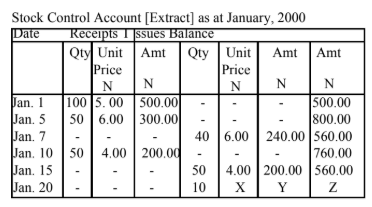
Use the information below to answer questions 17 and 18. What is the stock valuation method used?
- A.Last In First Out
- B.First In First Out.
- C.Average cost
- D.Weighted average.
The Last-In, First-Out (LIFO) method assumes that the last items of inventory purchased are the first ones to be sold or issued. In the provided stock control account, we see that on January 7, 40 units were issued at a price of N6.00 each, which was the price of the last stock received on January 5. Similarly, the issue on January 15 was valued at N4.00, the price of the stock received on January 10, confirming the use of the LIFO method.
Common mistake: Students often confuse LIFO with FIFO and might incorrectly assume the first stock that came in (on Jan 1) should be the first one issued, leading them to choose First-In, First-Out.
Use the information below to answer questions 17 and 18. The value of x is
- A.₦560.00
- B.₦5.00
- C.₦5.50
- D.₦6.00
The image shows a stores ledger card, which is used to track the movement and value of raw materials. The valuation method demonstrated is Last-In, First-Out (LIFO), which is a key concept in costing materials for a manufacturing account. Although the question asks for 'x' (unit price), the correct option, ₦560.00, is the stock balance amount after the transaction on Jan 15. This value is calculated by subtracting the cost of the Jan 15 issue (₦200) from the previous balance (₦760), indicating a likely error in the question's wording.
Common mistake: Students may correctly identify the LIFO method and calculate the unit price 'x' as ₦6.00 (Option D), not realizing the question is flawed and the intended answer corresponds to the balance from the previous transaction.
Use the information below to answer questions 19 and 20 Purchases ledger opening balance ₦4,000 Sales ledger opening balance ₦6,000 Credit purchases during the year ₦25,000 Discounts allowed ₦1,000 Returns inwards ₦2,000 Credit sales during the year ₦10,000 Returns outwards ₦6,000 Calculate the sales ledger balance?
- A.₦3,000
- B.₦6,000
- C.₦10,000
- D.₦13,000
To find the sales ledger balance, you need to prepare a Sales Ledger Control Account, which tracks the total amount owed by customers (debtors). You start with the opening balance (₦6,000), add credit sales (₦10,000), and then subtract items that reduce the debt, like returns inwards (₦2,000) and discounts allowed (₦1,000). The final calculation is ₦6,000 + ₦10,000 - ₦2,000 - ₦1,000 = ₦13,000.
Common mistake: The most common mistake is getting confused by the extra information and incorrectly including items related to the purchases ledger, such as 'returns outwards', in the sales ledger calculation.
Use the information below to answer questions 19 and 20 Purchases ledger opening balance ₦4,000 Sales ledger opening balance ₦6,000 Credit purchases during the year ₦25,000 Discounts allowed ₦1,000 Returns inwards ₦2,000 Credit sales during the year ₦10,000 Returns outwards ₦6,000 What is the purchases ledger balance?
- A.₦4,000
- B.₦23,000
- C.₦24,000
- D.₦29,000
To find the purchases ledger balance, you prepare a purchases ledger control account, which tracks money owed to suppliers. Start with the opening balance of ₦4,000 and add the credit purchases of ₦25,000, giving a total of ₦29,000. From this, you must subtract the returns outwards of ₦6,000, as this reduces the amount owed, resulting in a final balance of ₦23,000.
Common mistake: Students often mistakenly choose ₦29,000 by adding the opening balance and credit purchases but forgetting to subtract the returns outwards.
For an incomplete record to provide necessary information, it must be converted to?
- A.complete records
- B.double entry records
- C.statement of affairs
- D.single entry
When a business keeps incomplete records, it is impossible to prepare a normal trial balance and final accounts. The first step to determine the profit or loss is to find the capital at the beginning and end of the period. A Statement of Affairs is prepared for this purpose by listing all known assets and liabilities; the balancing figure represents the capital, which is the necessary information needed for further calculations.
Common mistake: Students often mistakenly choose 'double entry records' because converting to a double-entry system is the overall objective, but the Statement of Affairs is the specific initial document prepared to find the missing capital figure from the incomplete data.
Use the information below to answer questions 22 and 23 Using the given balance sheet information for and , determine the total fixed assets from the opening balance sheet . Given data: : Plant & Machinery ₦1,500, Fixtures ₦700, Stock ₦500, Debtors ₦900, Cash ₦200, Creditors ₦500, Loan ₦600 : Plant & Machinery ₦1,200, Fixtures ₦520, Stock ₦600, Debtors ₦400, Cash ₦300, Creditors ₦600, Loan ₦400
- A.₦2,200
- B.₦2,020
- C.₦1,720
- D.₦2,070
To find the total fixed assets for , you must identify the long-term assets from the list provided for that specific date. Fixed assets are assets bought for long-term use in the business, not for resale. From the data, the fixed assets are Plant & Machinery (₦1,500) and Fixtures (₦700). Adding these two values gives the total: ₦1,500 + ₦700 = ₦2,200.
Common mistake: Students may mistakenly calculate the fixed assets for the wrong year , which would result in ₦1,200 + ₦520 = ₦1,720 (Option C).
Use the information below to answer questions 22 and 23 Using the given balance sheet information for and , What is the capital from the opening balance sheet?. Given data: : Plant & Machinery ₦1,500, Fixtures ₦700, Stock ₦500, Debtors ₦900, Cash ₦200, Creditors ₦500, Loan ₦600 : Plant & Machinery ₦1,200, Fixtures ₦520, Stock ₦600, Debtors ₦400, Cash ₦300, Creditors ₦600, Loan ₦401
- A.₦3,600
- B.₦2,700
- C.₦2,070
- D.₦1520
To find the opening capital, you must use the accounting equation, which is Capital = Assets - Liabilities. First, add all the assets on the opening date of (Plant & Machinery ₦1,500 + Fixtures ₦700 + Stock ₦500 + Debtors ₦900 + Cash ₦200) to get a total of ₦3,800. Next, add the liabilities on that same date (Creditors ₦500 + Loan ₦600) to get ₦1,100. Finally, subtract the total liabilities from the total assets to find the capital: ₦3,800 - ₦1,100 = ₦2,700.
Common mistake: Students might mistakenly use the figures for the closing date instead of the opening date which the question specifically asks for.
Given: Direct material ₦2,500 Direct labour ₦5,000 Direct expenses ₦1,000 Overhead expenses ₦1,500 From the data above, compute the prime cost?
- A.₦8,500
- B.₦7,500
- C.₦6,500
- D.₦6,000.
Prime cost represents the total of all direct costs involved in manufacturing a product. To find the prime cost, you must add the direct material, direct labour, and direct expenses together. Based on the figures given, the calculation is ₦2,500 + ₦5,000 + ₦1,000, which gives a total of ₦8,500. Overhead expenses are indirect costs and are not part of the prime cost calculation.
Common mistake: Students often make the mistake of choosing option B by incorrectly adding only direct materials and direct labour, forgetting to include direct expenses in the prime cost calculation.
Use the information below to answer question 25 and 26. Bar opening stock ₦10,000 Amount owed to bar suppliers at the end the beginning of the year ₦10,000 Bar sales ₦50,000 Bar credit purchases ₦40,000 Payment to suppliers ₦30,000 Bar expenses ₦1,000 Bar closing stock ₦15,000 What is the bar profits?
- A.₦20,000
- B.₦15,000
- C.₦14,000
- D.₦10,000
To find the bar profit, you need to prepare a simple trading, profit and loss account. First, calculate the cost of goods sold, which is Opening Stock (₦10,000) + Purchases (₦40,000) - Closing Stock (₦15,000) = ₦35,000. Then, find the gross profit by subtracting the cost of goods sold from sales: ₦50,000 - ₦35,000 = ₦15,000. Finally, subtract the bar expenses from the gross profit to get the net profit: ₦15,000 - ₦1,000 = ₦14,000.
Common mistake: A common mistake is to calculate the gross profit (₦15,000) and select it as the answer, forgetting to subtract the bar expenses (₦1,000) to find the final net profit.
See all 50 JAMB Accounting 2001 questions
Sign up free to unlock every question in this paper — with the verified answer and Beta's worked explanation on each one. No card needed to begin.
Start free