JAMB Accounting 1997 Past Questions & Answers
50 JAMB Accounting 1997 questions with verified answers and worked explanations. Here are the first 10 — sign up free to practise the full paper.
The most important reason for studying accounting is that
- A.the information provided by accounting is useful in making decision
- B.Accounting plays an important role in the society
- C.the study of Accounting leads to challeging career
- D.Accounting provides gross profit information
The main purpose of accounting is to provide reliable financial information to different people, known as users of accounting information. These users, like managers, investors, and banks, rely on this information to make smart economic decisions about a business. While accounting does offer a good career and is important to society, its most fundamental role is to be a tool for decision-making.
Common mistake: Students might choose option B because it is a true statement, but it is too general; option A is more specific and explains *how* accounting plays an important role in society.
In preparing accounting records, the owner of a business and the business are treated as
- A.the same person
- B.having business relationship
- C.separate legal entities
- D.partners
This question tests the 'business entity concept', which is a fundamental accounting principle. This concept requires that the business and its owner are treated as two separate and distinct entities for the purpose of preparing financial records. This means the owner's personal transactions must be kept completely separate from the business's transactions.
Common mistake: Students often mistakenly choose 'the same person' because in a small business like a sole proprietorship, the owner and the business are legally the same, but they forget that for accounting purposes, the business entity concept requires them to be treated as distinct.
Creditors use Accounting information for the purpose of
- A.planning sales to a company
- B.controlling a company's affairs
- C.investing in a company
- D.assessing a company's liquidity
Creditors are people or businesses that the company owes money to, for example, suppliers or banks. Their main interest is to be sure that the company can pay back the money it owes. Assessing a company's liquidity means checking if it has enough cash or assets to pay its short-term debts, which is exactly what a creditor needs to know before lending more money or extending credit.
Common mistake: Students often confuse the role of creditors with investors (Option C), but investors are concerned with ownership and long-term profit, while creditors are focused on the company's ability to repay its debts.
The instrument that are generated when firms enter into business transactions with others are called
- A.purchase document
- B.journals
- C.source documents
- D.invoices
Source documents are the original papers or records that provide evidence that a business transaction has taken place. They are the 'source' of the information that is recorded in the books of original entry, like the journals. Examples of source documents include receipts, invoices, debit notes, and credit notes.
Common mistake: Students often confuse source documents with journals, but journals are the books where transactions are first recorded using information taken from the source documents.
The document that is used to acknowledge the acceptance of the return of goods by the seller from the buyer is known as
- A.credit note
- B.debit note
- C.invoice
- D.voucher
A credit note is a document sent by a seller to a buyer to confirm the return of goods and to show that the buyer's account has been credited. This means the amount the buyer owes the seller is now reduced. This document is the official source for the seller to record the transaction in their Returns Inwards Journal.
Common mistake: Students often mistakenly choose 'debit note' because they confuse which party issues which document; the buyer sends a debit note to request the return, but the seller issues the credit note to confirm it.
The effect of the payment of liability is that it
- A.increase both assets and liabilities
- B.increase assets and decrease liabilities
- C.decrease assets and increase liabilities
- D.decrease both assets and liabilities
The accounting equation is Assets = Liabilities + Equity. When a business pays a liability (e.g., pays a creditor), it uses cash or money from its bank account, which are assets. Therefore, assets decrease. At the same time, the amount the business owes (the liability) is also reduced. This means both assets and liabilities decrease, keeping the equation in balance.
Common mistake: Students sometimes confuse paying a liability with taking on a new liability (like getting a loan), which is a transaction that would increase both assets and liabilities, leading them to incorrectly choose option A.
Books of original entry are used for
- A.recording business transactions
- B.the adjustment of accounts
- C.reminding the book keeping to post transactions in the ledger
- D.informing the bookkeeper about the state of affairs
Books of original entry, also known as daybooks or journals, are the first books where financial transactions are recorded in chronological order. They get their information from source documents like invoices and receipts. Their main job is to capture every transaction as it happens before it is posted to the main ledger, which is why their primary use is for recording business transactions.
Common mistake: Students might mistakenly choose option C because transactions are posted from books of original entry to the ledger, but the primary function is the initial recording itself, not just serving as a reminder for the next step.
The term 'posting' in Accounting refers to
- A.recording entries in the journal
- B.transferring the balance in the ledger to the trial balance
- C.tracing amounts from the journal to the ledger to find errors
- D.transferring entries to the ledger from the journal
In accounting, after you first record a transaction in a book of original entry (like a journal), the next step is to 'post' it. Posting is the process of transferring the debit and credit entries from the journal to their respective accounts in the ledger. This action helps to group all transactions affecting a single account, like cash or sales, in one place.
Common mistake: Students often mistakenly choose option A, confusing 'posting' with 'journalising', which is the initial act of recording a transaction in the journal before it is transferred to the ledger.
Erroneous rearrangement of financial figures such as writing ₦624 as ₦264 is called
- A.transposition
- B.principle
- C.commission
- D.omission
The correct answer is transposition. A transposition error is a specific type of clerical error that happens when the digits of a number are accidentally reversed or swapped during recording. In the example given, writing ₦264 instead of ₦624 is a clear case of transposing the '6' and the '2'.
Common mistake: Students often mistakenly choose 'commission' because it is also a type of error, but an error of commission involves posting to the correct class of account but the wrong specific account (e.g., debiting customer Ade instead of customer Bola).
What is the balance of the bank account shown above?
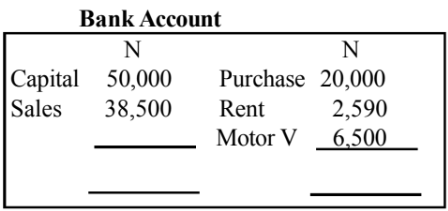
- A.₦ 88,500 debit
- B.₦88,500 credit
- C.₦59,410 credit
- D.₦59,410 debit.
To find the balance of the bank account, first, add up all the money that came in (debit side) and all the money that went out (credit side). The total debits are ₦50,000 (Capital) + ₦38,500 (Sales) = ₦88,500. The total credits are ₦20,000 (Purchase) + ₦2,590 (Rent) + ₦6,500 (Motor V) = ₦29,090. The balance is the difference between the two sides (₦88,500 - ₦29,090 = ₦59,410), and this balancing figure is placed on the smaller side (the credit side) to make both sides equal.
Common mistake: Students often correctly calculate the amount as ₦59,410 but incorrectly choose the debit option, confusing the balancing figure (balance c/d) with the final balance brought down (balance b/d), which would be a debit.
See all 50 JAMB Accounting 1997 questions
Sign up free to unlock every question in this paper — with the verified answer and Beta's worked explanation on each one. No card needed to begin.
Start free